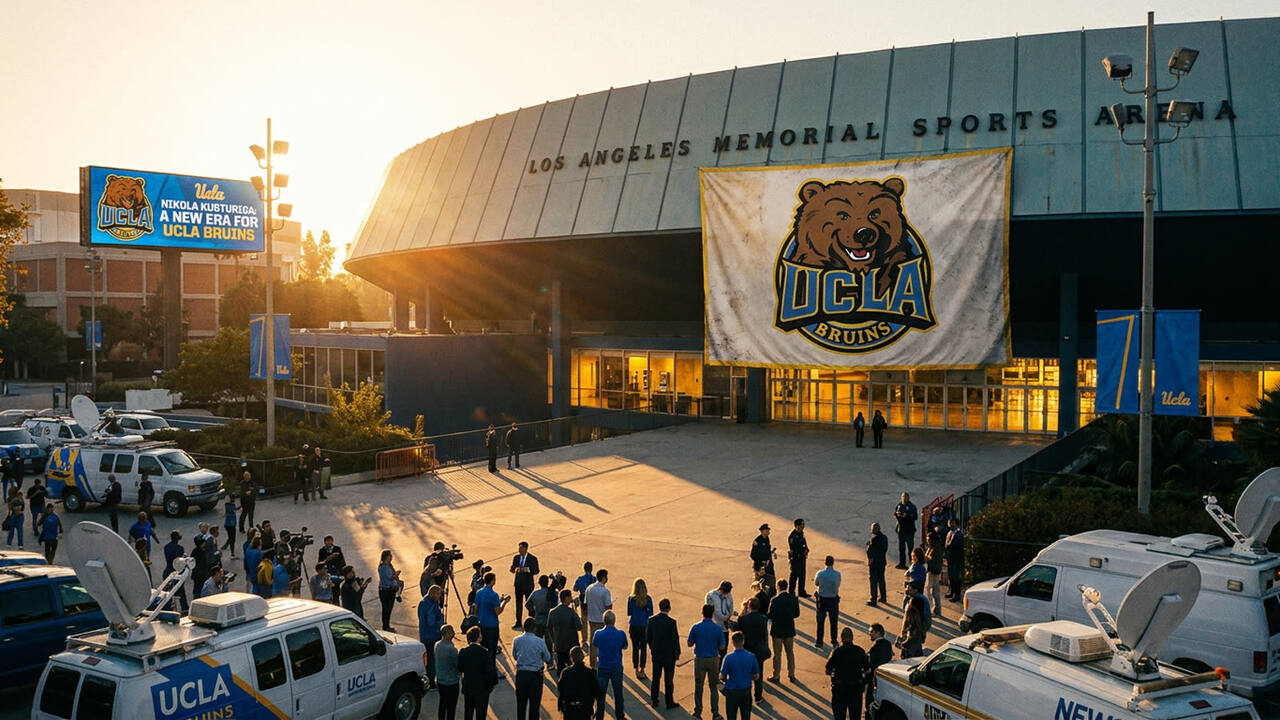
College basketball recruiting rarely moves markets, but Nikola Kusturica is not a normal recruit. The 18-year-old Serbian forward—fluid, skilled, and built like a small-ball five who can orchestrate from the elbow—has committed to UCLA, and the reverberations will be felt from Westwood to the NBA lottery.
Kusturica has been the consensus top prospect in the 2027 draft class since his breakout performances in European youth competitions two years ago. His decision to play college basketball rather than remain overseas or enter the G League Ignite pipeline represents a significant vote of confidence in the NCAA's ability to showcase elite talent—and a coup for Bruins head coach Mick Cronin, who has quietly rebuilt UCLA into a program capable of landing generational players.
Why Kusturica matters
The comparisons are inevitable and, for once, not hyperbolic. Kusturica possesses the passing vision of a point guard in a body that can protect the rim. His shooting touch extends to the three-point line, and his basketball IQ—honed in the Serbian development system—is advanced beyond his years. Scouts have whispered about Dirk Nowitzki's skill set combined with Nikola Jokić's court vision, though such comparisons carry the usual caveats about young players who have yet to face elite American competition.
What makes the UCLA commitment particularly notable is the opportunity cost. Kusturica had standing offers from multiple European clubs willing to pay him handsomely, and the G League Ignite—though diminished in recent years—remained an option. He chose the college route, suggesting either genuine desire for the campus experience or a calculated bet that UCLA's platform and March Madness exposure will maximize his draft positioning.
The UCLA renaissance
For UCLA, this is validation. The Bruins have been knocking on the door of the sport's elite programs for several seasons, reaching Final Fours and competing for conference titles without quite landing the singular talent who transforms a very good team into a national championship favorite. Kusturica changes that equation.
The Pac-12's realignment chaos threatened to diminish UCLA's recruiting appeal, but the move to the Big Ten has, if anything, enhanced it—offering more national television exposure and a conference schedule that will prepare prospects for the physicality of the NBA. Kusturica will face legitimate competition every week, not the occasional cupcake that plagued the old Pac-12's non-conference scheduling.
Our take
This is the kind of signing that reminds you why college basketball still matters in an era of NIL chaos and transfer portal madness. Kusturica chose UCLA over professional money, betting that one year in Westwood—under the lights of Pauley Pavilion, in the crucible of March—will serve him better than a season in Belgrade or Frisco. He is probably right. The NBA's scouting apparatus will descend on UCLA like never before, and Kusturica will have every opportunity to prove the hype is real. For UCLA, it is a program-defining moment. For the rest of college basketball, it is a reminder that the one-and-done model, for all its flaws, can still produce the sport's most compelling storylines.