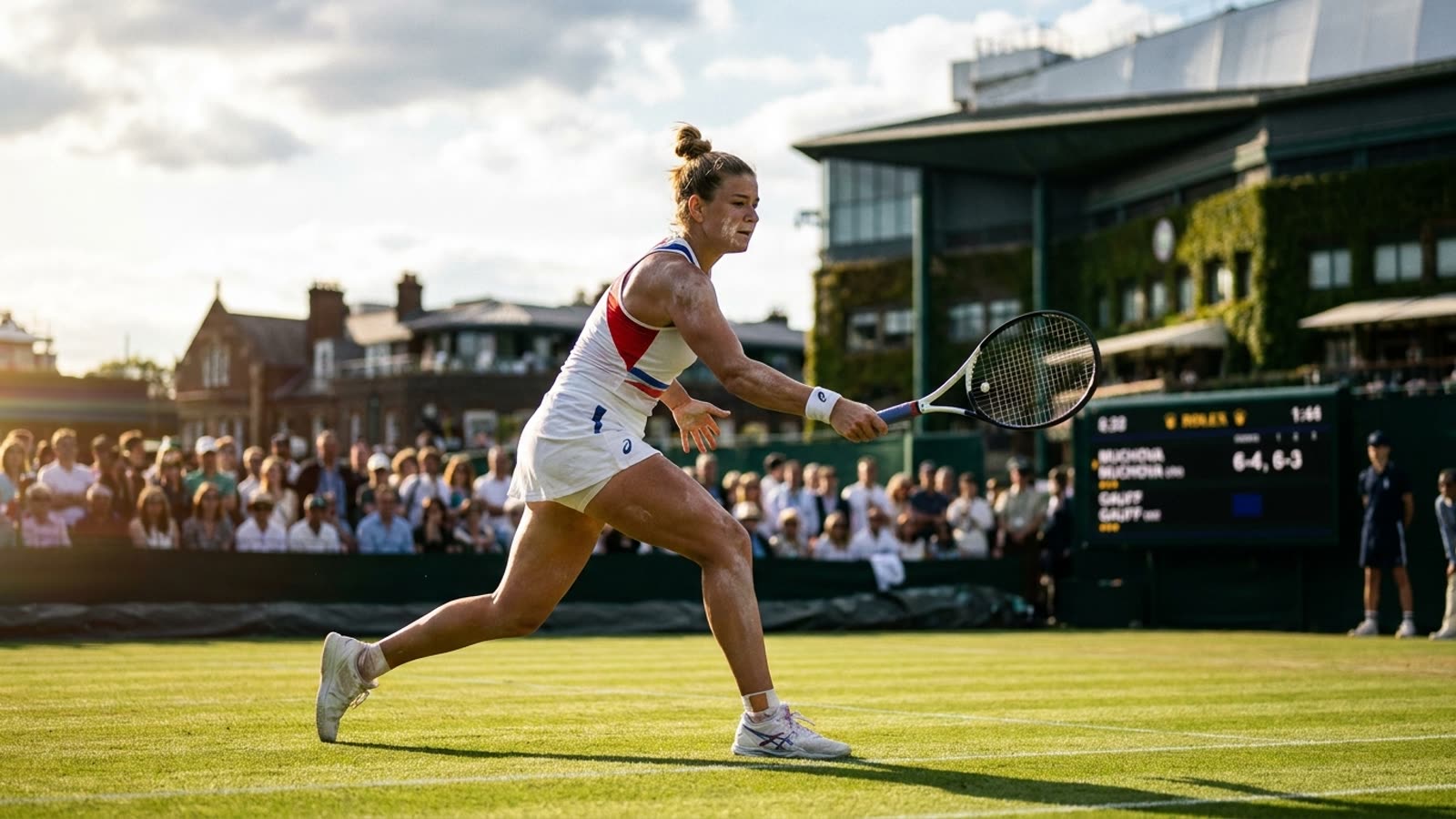
Coco Gauff arrived at Wimbledon as the tournament's most bankable American hope, a 22-year-old with a US Open title and the burden of a nation's grass-court expectations. She left Centre Court having been outplayed by Karolina Muchova, the 29-year-old Czech whose injury-plagued career has somehow produced the most complete grass-court game in the women's draw.
The semifinal was not close in the ways that matter. Muchova's variety—the sliced backhand that skids and dies, the dropshots that materialize from nowhere, the serve-and-volley sequences that feel anachronistic until they work—systematically dismantled Gauff's baseline power. This was a clinic in surface-specific tennis, and Gauff was the student.
The Czech renaissance
Muchova's path to this final represents one of tennis's more improbable redemption arcs. A wrist injury cost her most of 2024, and her ranking cratered outside the top 50. Yet on grass, where touch and timing matter more than raw athleticism, she has found something approaching her best form. Her semifinal victory was her 12th consecutive win on the surface dating back to last summer, a streak that includes a title in Birmingham and now a second Wimbledon final berth.
What makes Muchova dangerous is her refusal to play modern baseline tennis. She constructs points like a chess player, moving opponents around the court before striking. Against Gauff's power, she simply declined to engage in rallies she could not win, instead creating angles and net approaches that neutralized the American's biggest weapons.
American grass-court malaise
Gauff's exit extends a drought that has become statistically remarkable. No American woman has won Wimbledon since Serena Williams in 2016—a decade without a title from a country that produces more professional tennis players than any other. The reasons are structural: American development emphasizes hard-court power, the surface that dominates the domestic calendar. Grass requires a different education, one that rewards subtlety over strength.
Gauff herself acknowledged the gap after the match, noting that her game "doesn't translate as naturally" to grass as it does to hard courts. She is 22 and improving, but the technical adjustments required for Wimbledon success cannot be acquired in a fortnight. They require years of repetition on a surface that barely exists in American tennis infrastructure.
Our take
Muchova versus whoever emerges from the other semifinal will be compelling television, but the larger story is what Gauff's loss reveals about tennis development. The sport's economics push young players toward hard courts, where the majority of prize money and ranking points reside. Wimbledon remains the sport's most prestigious event, yet it rewards a skill set that the modern game actively discourages. Gauff has time to learn grass, but the American system that produced her offers few incentives to bother.