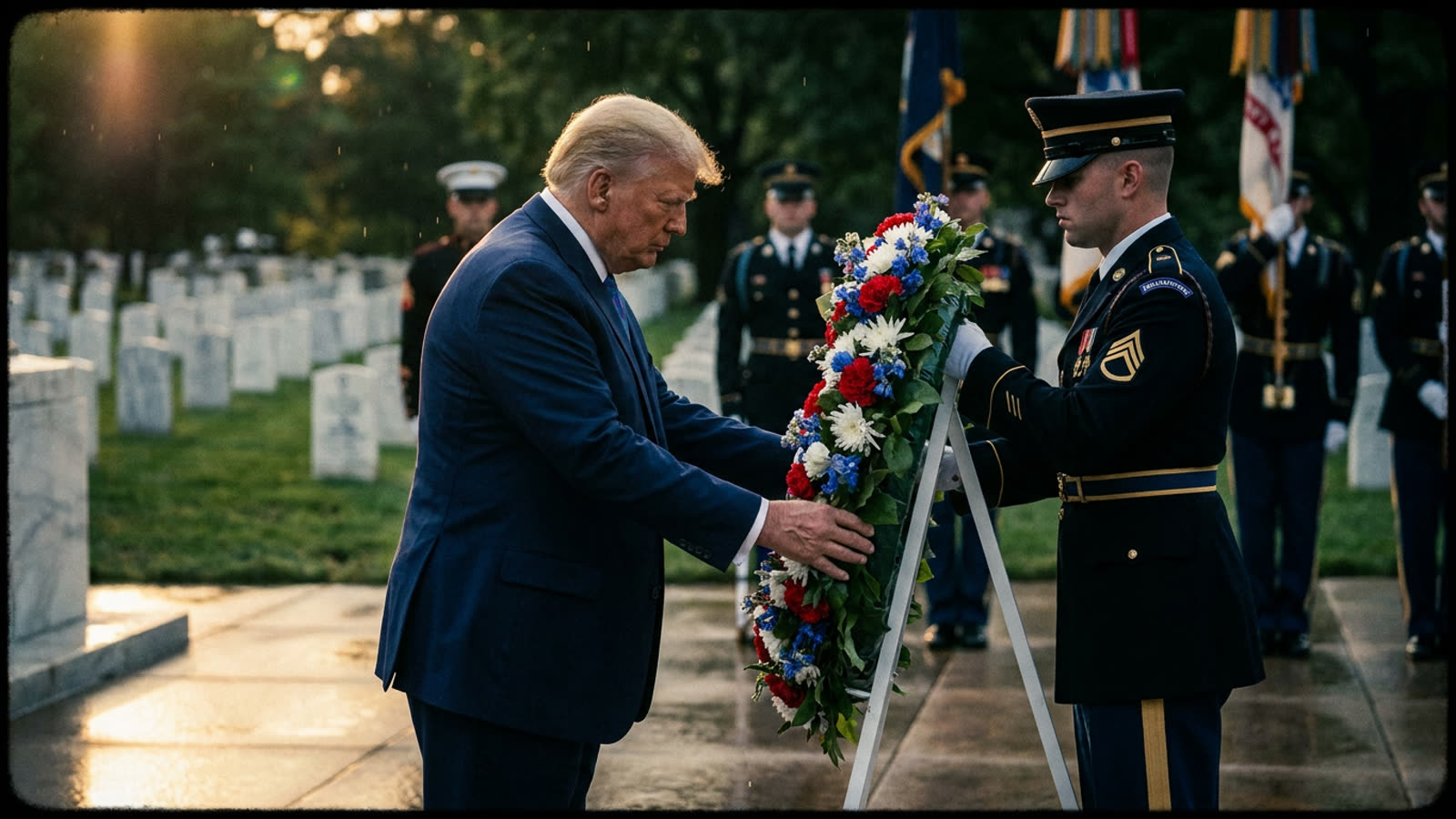
The split-screen was jarring even by the standards of this presidency. On Sunday morning, Donald Trump took to social media with a Memorial Day message that read less like a tribute to fallen service members and more like a campaign rally transcript—attacking political opponents, defending his Iran war strategy, and settling scores with critics who questioned whether the conflict was worth American lives. By afternoon, he stood solemnly at Arlington National Cemetery, laying a wreath at the Tomb of the Unknown Soldier.
The juxtaposition captures something essential about Trump's relationship with military sacrifice: he understands the imagery but struggles with the restraint the occasion demands.
The morning rant
Trump's social media posts on Memorial Day morning wandered through familiar territory. He praised his own leadership during the Iran conflict, dismissed critics as "weak" and "disloyal," and suggested that questioning the war's conduct dishonored the troops who died fighting it. The posts came as American families gathered to mourn service members killed in a war that has now claimed hundreds of U.S. lives—many of them in the past six months of active combat before the ceasefire negotiations began.
The timing was particularly discordant given that Memorial Day exists precisely to set aside partisan grievance in favor of collective mourning. Previous presidents of both parties have treated the holiday as a moment for restraint, understanding that the families of the fallen are not interested in hearing their loved ones' deaths weaponized for political advantage.
Arlington's choreography
The afternoon ceremony at Arlington proceeded with the usual military precision. Trump placed the wreath, observed the moment of silence, and delivered brief remarks honoring those buried in the cemetery's rolling hills. The White House released photographs designed to convey presidential gravity.
But the images could not unsay the morning's words. Trump's critics—including several Gold Star families who have clashed with him before—noted that the solemnity felt performative, a photo opportunity scheduled to provide visual counterweight to the rhetorical excess that preceded it. The president's defenders argued that his morning posts reflected genuine frustration with opponents who, in their view, have undermined the war effort and by extension disrespected the troops.
A pattern, not an aberration
This is not Trump's first Arlington controversy. His 2024 campaign faced criticism for filming political content at the cemetery, and his relationships with military families have been rocky throughout his political career. The pattern suggests less a failure of staff preparation than a fundamental tension in how Trump processes the concept of sacrifice. He gravitates toward the aesthetics of military honor while resisting the self-effacement that traditionally accompanies it.
Our take
Memorial Day asks one simple thing of a commander-in-chief: make it not about you. Trump has sent Americans to die in a war he initiated and is now negotiating to end. The least he owed their memory was twenty-four hours without grievance. He could not manage it. The wreath at Arlington was real; so was the rant that preceded it. Both are the presidency now.