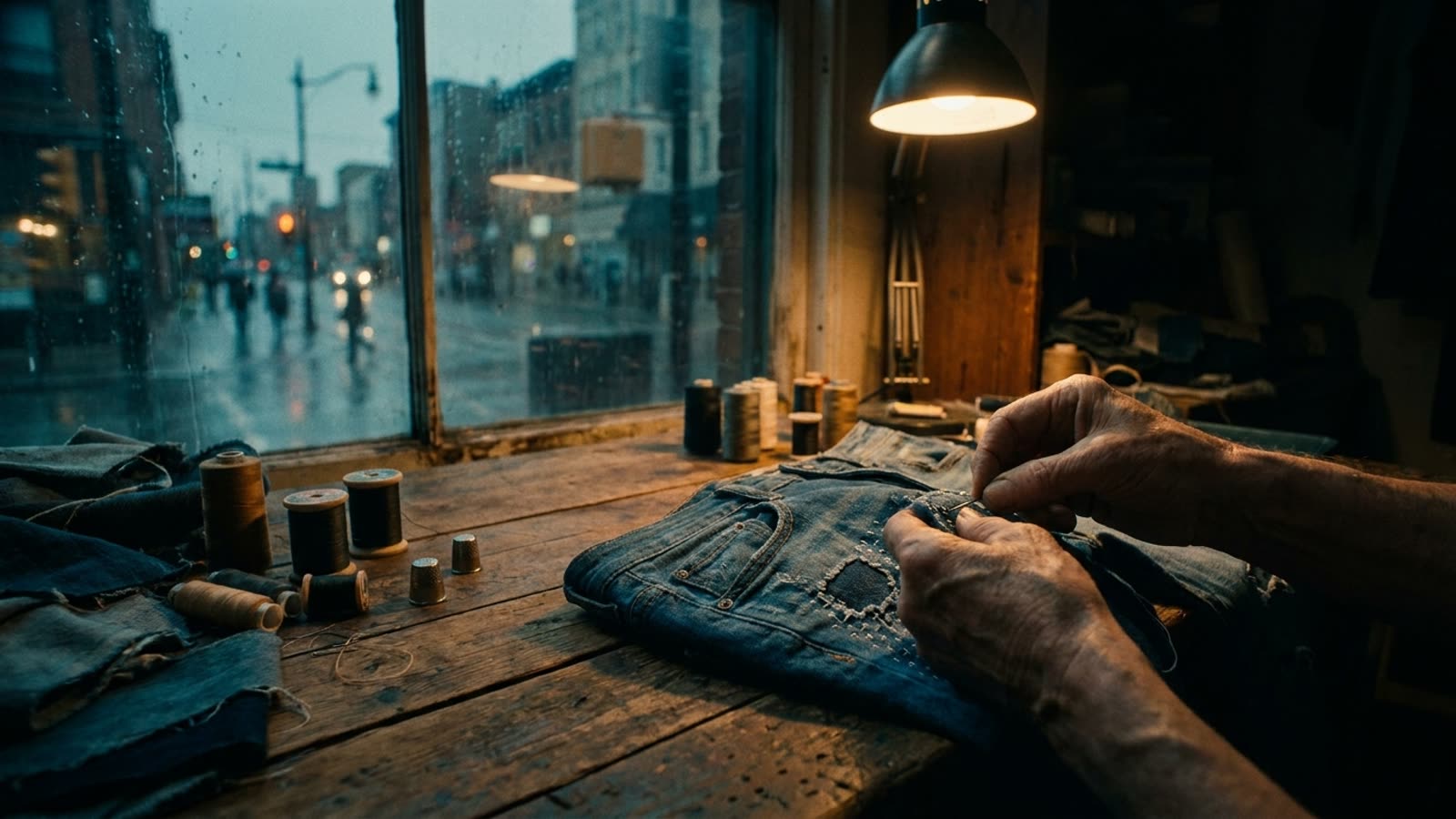
The most expensive-looking garment in any room increasingly bears the marks of its own repair. A cashmere sweater with a constellation of darned patches, jeans with hand-stitched reinforcements at the knee, a linen blazer whose elbow has been reborn in contrasting thread — these are no longer signs of poverty or neglect but of a particular kind of cultivation that money alone cannot purchase.
This represents a genuine inversion of fashion logic. For most of the twentieth century, the goal was seamlessness: invisible mending was a specialized trade, and the highest compliment a tailor could receive was that their repair work was undetectable. Now the stitch itself has become the statement.
The Japanese precedent
Western fashion's embrace of visible repair owes an enormous debt to the Japanese concept of boro, the practice of patching and reinforcing indigo-dyed cotton textiles that emerged from rural necessity in the Edo period. What poor farming families did to survive winters became, centuries later, the subject of museum exhibitions and the inspiration for luxury collections. The philosophical framework proved equally exportable: wabi-sabi, the aesthetic appreciation of imperfection and transience, offered a ready-made intellectual justification for what might otherwise look like laziness.
But the current mending movement has developed its own distinct vocabulary. Where boro was characterized by layered patches of similar fabrics, contemporary visible mending often emphasizes contrast — a deliberate clash between the original garment and its repair that announces itself as intervention rather than camouflage.
The economics of attention
Learning to darn a sock properly takes perhaps an hour. Learning to do it beautifully takes considerably longer. This is precisely the point. In an economy where time has become the ultimate luxury good, the hand-mended garment signals that its owner possesses enough of it to spend on maintenance rather than replacement. It is conspicuous non-consumption, which turns out to be its own form of display.
The practical barriers to entry are remarkably low. A basic darning mushroom costs less than a coffee, and instructional content proliferates across every platform. Yet the cultural barriers remain significant. Mending requires accepting that a garment will look different afterward — not worse, necessarily, but changed. This demands a relationship with clothing that fast fashion has spent decades systematically destroying.
The sustainability question
Environmental arguments for repair are straightforward and largely uncontested. Extending a garment's life by even nine months reduces its carbon, water, and waste footprint by meaningful percentages. The fashion industry's contribution to global emissions remains substantial, and individual mending represents one of the few interventions available to consumers that requires no systemic change, no policy shift, no corporate cooperation.
Yet framing visible mending purely as environmental activism undersells its appeal. The practice has attracted adherents who care little about carbon footprints but care deeply about aesthetics, about craft, about the particular satisfaction of solving a material problem with needle and thread. The sustainability case provides convenient justification, but the real draw is often simpler: it feels good to fix things.
Our take
Visible mending succeeds because it resolves a genuine tension in contemporary taste. We want to signal environmental consciousness without appearing pious, to demonstrate craft knowledge without seeming precious, to reject consumerism while still caring about how we look. The darned sweater accomplishes all of this simultaneously. It is fashion's equivalent of the annotated paperback — proof not just of ownership but of engagement, of a relationship with objects that extends beyond the transaction. Whether this remains a durable shift or merely a prolonged trend depends largely on whether the next generation learns to thread a needle.