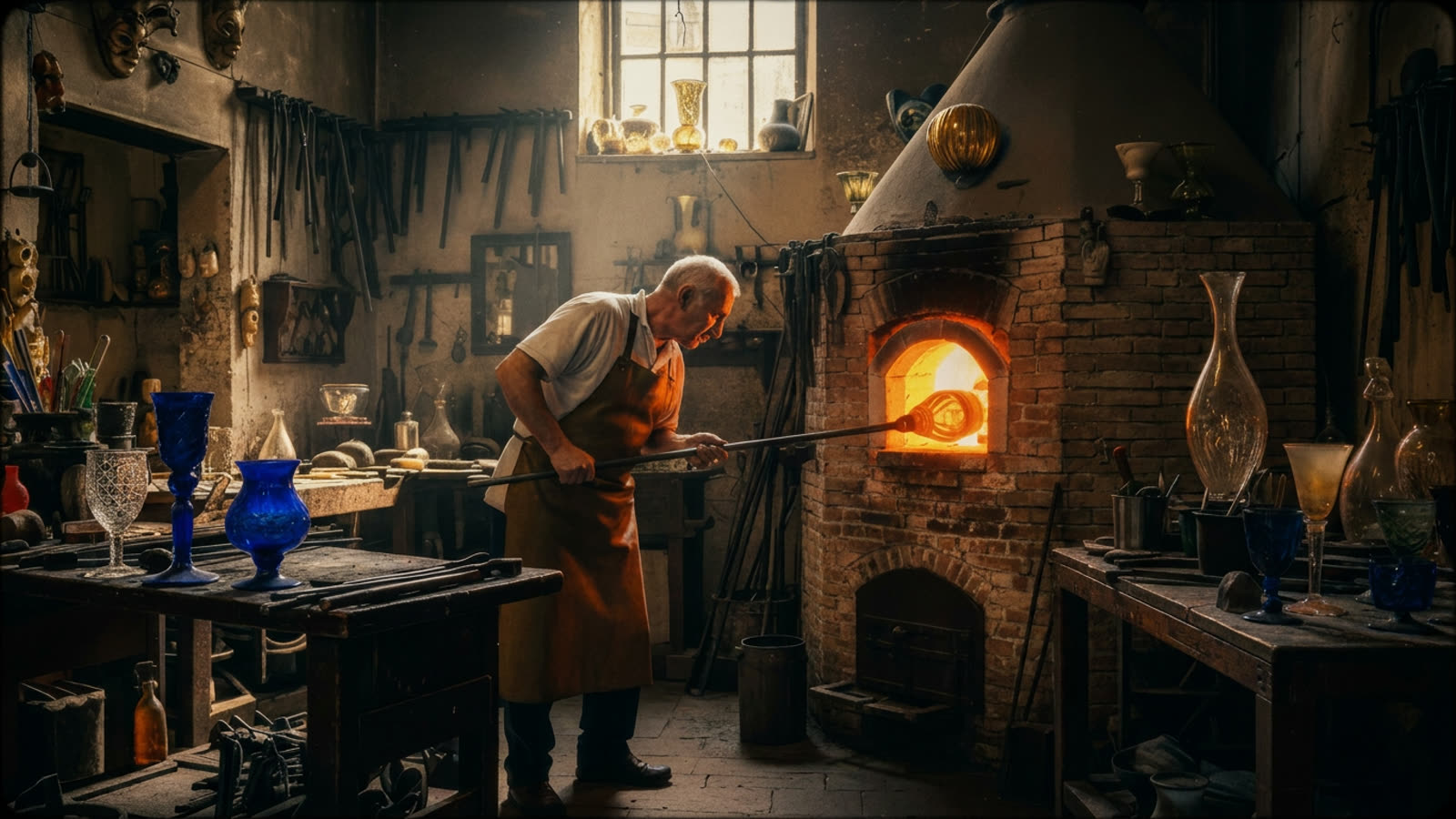
The glass masters of Murano do not discuss their trade in terms of luxury or heritage, though both words appear relentlessly in the marketing materials that follow their work around the world. They speak instead of heat — the specific, unforgiving temperature at which silica becomes malleable, the narrow window in which a gather of molten material will accept the breath and tools of a craftsman before it stiffens into something merely decorative. This is the central fact of Venetian glassmaking: it cannot be paused, cannot be corrected, cannot be delegated to a machine that might handle the repetitive middle steps while a human performs the flourishes. The entire process, from furnace to finished chandelier, demands continuous human attention, and that demand has shaped an industry, an island, and a particular philosophy of work.
The lagoon island sits a short vaporetto ride from Venice proper, a geographic separation that began as a fire-safety measure in the late thirteenth century and evolved into something more deliberate — a quarantine of knowledge. For generations, Murano's glassmakers were forbidden to leave the Venetian Republic, their skills deemed too valuable to risk losing to foreign competitors. The penalty for defection was, at various points, death. This sounds medieval because it was, but the underlying logic — that certain knowledge is so difficult to transmit that it must be physically contained — has proven remarkably durable.
The economics of patience
A master glassblower on Murano typically begins training in adolescence and does not achieve full independence until their late twenties or early thirties. The progression is not merely technical but social, moving through a hierarchy of roles at the furnace that determines who may touch which tools and when. This structure persists not because Murano's workshops are hostile to efficiency but because the alternative — faster training, more workers, higher output — has been tried and found to produce inferior results. The island's reputation depends on a quality that cannot be rushed, and the economics follow accordingly.
Prices for serious Murano work reflect this reality. A significant chandelier from one of the established houses can cost as much as a luxury automobile. Collectors and interior designers pay these sums not because glass is intrinsically expensive — the raw materials are almost comically cheap — but because they are purchasing time that has already been spent: the decade of an apprentice's formation, the centuries of accumulated technique, the hours of a master's attention on a single piece.
What machines cannot learn
Industrial glass production has existed for more than a century, and it has grown extraordinarily sophisticated. Factories can now produce glass objects of remarkable precision and consistency, at scales and speeds that would have seemed magical to a Renaissance craftsman. Yet none of this has rendered Murano obsolete. The island's output has fluctuated with fashion and economic cycles, but the core proposition — that certain effects can only be achieved by human hands working at the edge of their capability — has not been disproven.
The specific techniques that distinguish Murano glass, many of which carry names that have not changed since the fifteenth century, involve manipulations of molten material that require real-time judgment about color, viscosity, and temperature. A master working on a piece of vetro a reticello, the intricate lattice pattern that has been a Murano specialty for five hundred years, is making dozens of micro-decisions per minute, each one informed by tactile feedback that no sensor has yet replicated. This is not nostalgia speaking; it is a straightforward description of the production process.
Our take
Murano matters in the current moment not because handmade glass is morally superior to the machine-produced alternative, but because the island offers a working example of an economic arrangement that most industries have abandoned. The glassmakers have preserved a model in which expertise takes years to develop, cannot be easily transferred, and commands prices that reflect its scarcity. Whether this model can survive another generation — the workshops report difficulty attracting young apprentices willing to commit to the timeline — remains genuinely uncertain. But the furnaces are still lit, the masters are still working, and the objects they produce remain, by any honest assessment, impossible to fake. In an economy increasingly organized around the replication of skill, that impossibility is worth more than the glass itself.