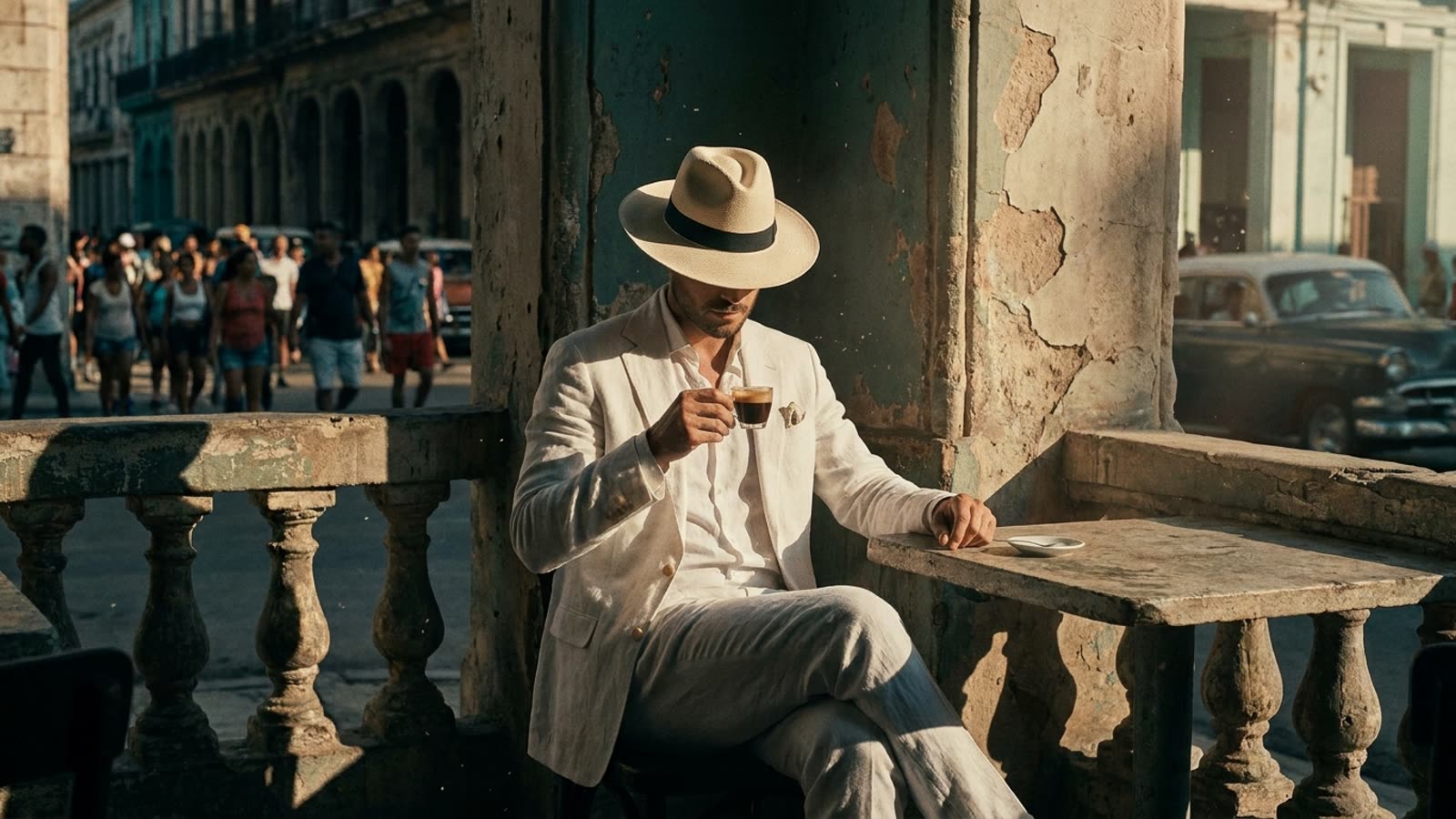
The white linen suit is an act of defiance against the modern world. It wrinkles in transit, yellows with age, and broadcasts every splash of marinara within a five-meter radius. To wear one is to announce that you have the leisure to sit carefully, the staff to maintain it, or the insouciance to simply buy another. In an era when athleisure has conquered the boardroom and tech billionaires dress like summer-camp counselors, the white linen suit persists as fashion's most eloquent argument for difficulty.
The garment's origins lie in colonial pragmatism. British administrators in India and planters in the Caribbean discovered that loosely woven flax fiber breathed in tropical heat far better than wool. White reflected sunlight. But what began as sensible adaptation quickly became something else: a visual marker separating those who labored from those who supervised. The suit's impracticality was a feature, not a bug. A man in spotless white linen clearly did not dig ditches.
From Havana to Hollywood
By the early twentieth century, the white linen suit had migrated from the verandas of empire to the cultural imagination. Writers embraced it as shorthand for louche sophistication—think of Tom Wolfe prowling Manhattan in his signature three-piece, or the dissolute planters populating Graham Greene novels. Hollywood costumed its morally ambiguous charmers in the fabric: Humphrey Bogart sweating through "Casablanca," countless antiheroes slouching through noir. The suit came to signify a man who had seen too much to care about convention, yet cared deeply about appearance. Contradiction, tailored.
The garment's association with the American South proved equally durable. From Atticus Finch to Colonel Sanders, white linen became visual code for a particular strain of gentility—courtly manners concealing harder edges. The suit said: I belong to a place where summer is a season of endurance, where air conditioning is a recent mercy, where sweat is managed rather than eliminated.
The economics of elegant inconvenience
Today's white linen suit occupies a curious market position. At the accessible end, fast-fashion retailers offer versions for modest sums, though the fabric quality rarely survives more than a season. At the bespoke pinnacle, Neapolitan tailors cut suits from Irish linen that costs more per meter than many people's monthly rent. The price differential can span two orders of magnitude, yet the essential proposition remains identical: you are purchasing the right to be inconvenienced beautifully.
This is what distinguishes the white linen suit from other luxury signifiers. A expensive watch hides under a cuff. A designer handbag might be mistaken for a knockoff. But a white linen suit cannot be faked or concealed. It demands to be seen, and it reveals instantly whether its wearer has the life circumstances to keep it pristine. In an age of stealth wealth and quiet luxury, it is almost embarrassingly loud.
Our take
The white linen suit endures because it solves a problem that never goes away: how to communicate refinement without speaking. Logos shout. Minimalism whispers so quietly it risks being ignored. But white linen occupies the perfect middle register—visible enough to register, tasteful enough to flatter. It is a costume for people who understand that elegance has always been a performance, and that the best performances require a little suffering. The wrinkles are not a flaw. They are proof you showed up.