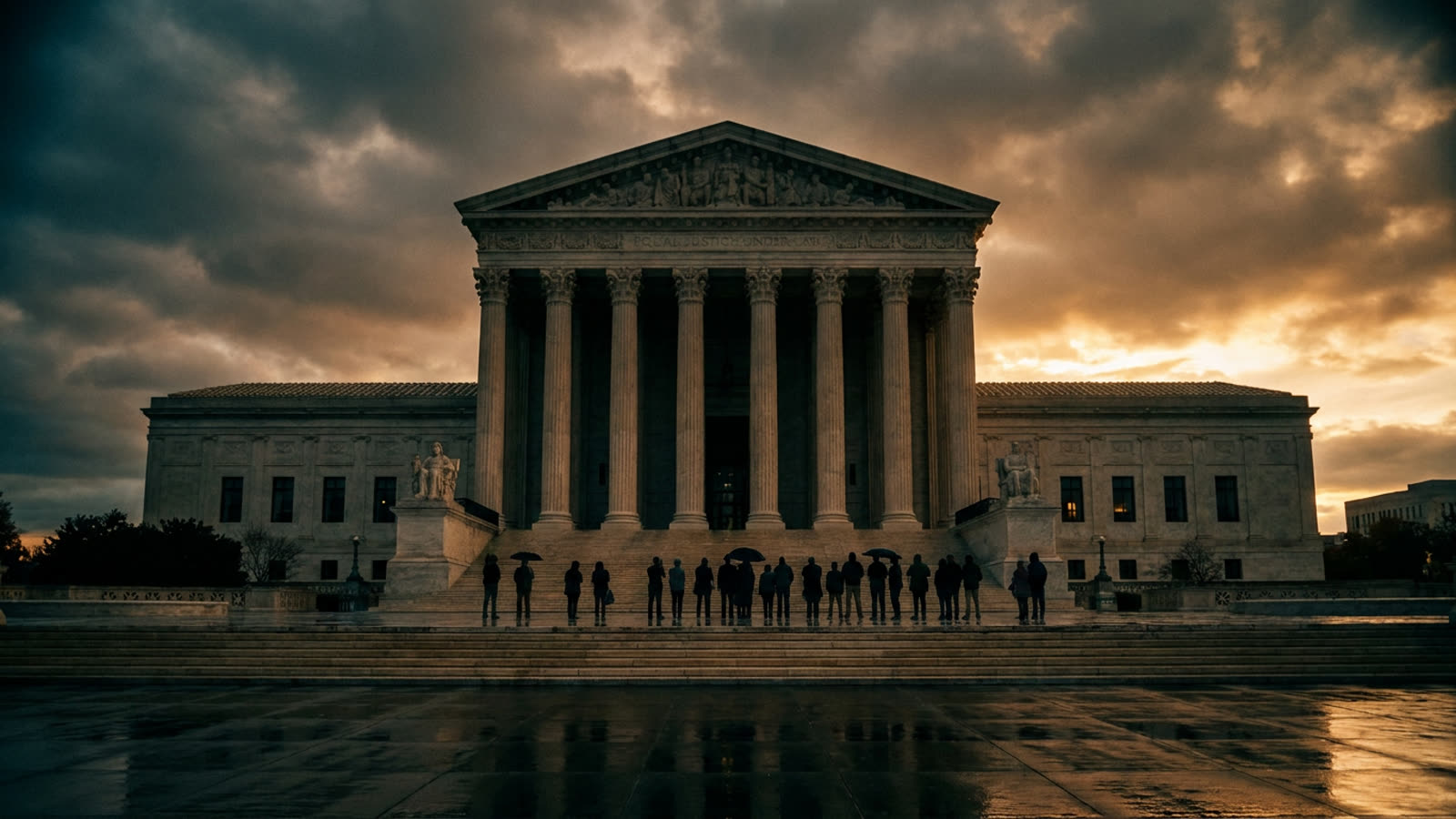
The Supreme Court's Wednesday double-header was not a surprise so much as a confirmation: the judiciary has decided it no longer wishes to second-guess the executive branch on immigration. In paired rulings, the Court upheld the administration's authority to turn away asylum seekers at the border and to terminate Temporary Protected Status for hundreds of thousands of Haitians and Syrians. The combined effect is a constitutional reset that grants the presidency more unilateral power over immigration than at any point since the Chinese Exclusion Act era.
The legal architecture here matters. For decades, lower courts treated immigration enforcement as subject to the same procedural due-process constraints that govern other administrative actions. Asylum seekers could challenge expedited removal; TPS holders could argue that termination decisions were arbitrary. Wednesday's rulings collapse that framework. The majority opinions, written by Justice Alito, emphasize that immigration is a domain of "plenary" executive power where judicial review is, at best, a formality.
The asylum ruling
The first decision allows border officials to summarily turn away migrants claiming asylum without the individualized credible-fear interviews that have been standard practice since 1996. The administration argued that the sheer volume of claims—over two million last fiscal year—made case-by-case screening operationally impossible. The Court agreed, holding that Congress's grant of enforcement discretion to the executive includes the power to adopt categorical exclusions. Justice Sotomayor's dissent called this "the end of asylum as a legal right," a characterization the majority did not dispute so much as shrug at.
The TPS termination
The second ruling is, if anything, more consequential for people already living in the United States. Temporary Protected Status was designed as a humanitarian pause button—a way to shield nationals of countries experiencing war, natural disaster, or other crises from deportation. Roughly 300,000 Haitians and 8,000 Syrians currently hold TPS. The administration moved to end their protections last year, arguing that conditions in both countries had sufficiently improved. Lower courts blocked the termination, citing procedural defects and evidence that the decision was pretextual. The Supreme Court reversed, holding that TPS determinations are committed to executive discretion and are essentially unreviewable.
The practical upshot: families who have lived in the United States for a decade or more, who have citizen children and mortgages and small businesses, now face deportation orders that can be executed at the administration's convenience. There is no appeal, no stay, no meaningful judicial recourse.
Our take
The Court has not hidden the ball. It has decided that immigration is, functionally, whatever the president says it is. This is a defensible reading of constitutional text and historical practice—Congress has always granted the executive enormous latitude at the border—but it is also a choice. The justices could have preserved some procedural floor, some minimal guarantee that people fleeing persecution get a hearing. They chose not to. The result is a system in which the rights of non-citizens depend entirely on who occupies the Oval Office. That is not a legal regime; it is a coin flip with human lives.