FIFA's decision to pay a referee who never blew a whistle at the 2026 World Cup might seem like bureaucratic charity. It is actually something more significant: an acknowledgment that officiating has become too important to the sport's legitimacy to be treated as an afterthought.
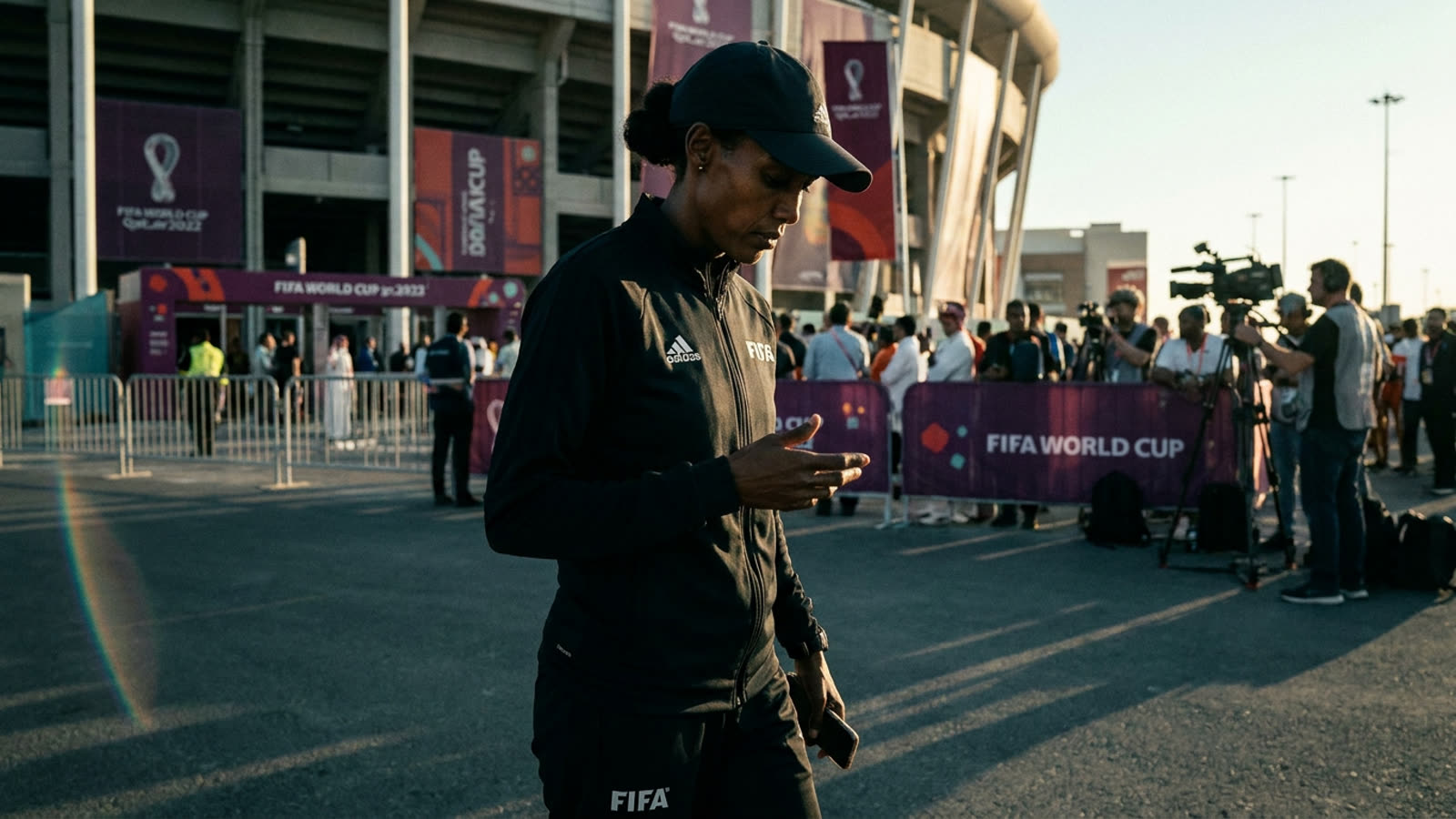
Hassan Khalif Adan, the Somali referee caught in visa complications that prevented him from reaching the United States in time for his scheduled assignments, will receive his full tournament compensation according to sources familiar with the matter. The sum itself is modest by football's inflated standards — World Cup referees typically earn between $50,000 and $70,000 for the tournament — but the principle is not.
The officiating crisis FIFA cannot ignore
Professional football has spent the past decade lurching from one refereeing controversy to the next. VAR was supposed to solve everything; instead it created new arguments about consistency, delay, and the subjective nature of "clear and obvious error." Meanwhile, the sport's expansion into new markets has stretched the pool of qualified officials thinner than ever.
Adan's case touches on something FIFA rarely discusses publicly: the precarious position of referees from developing football nations. He is one of only a handful of officials from the African continent's smaller federations to reach World Cup level, a journey that required years of development in conditions far removed from the pampered circuits of European leagues. That his participation was derailed by administrative failure rather than performance made the situation uniquely embarrassing for an organization that has loudly championed global football development.
What the payment actually signals
The compensation decision, while framed internally as a matter of contractual fairness, serves several purposes. It protects FIFA from accusations that it abandons officials when logistics fail. It maintains goodwill with the Confederation of African Football, whose support FIFA president Gianni Infantino has cultivated assiduously. And it establishes a precedent that referees are employees deserving of protection, not contractors who absorb all risk.
This matters because FIFA has long treated referees as semi-amateur figures who should be grateful for the honor of participation. Elite officials in domestic leagues now earn substantial salaries — Premier League referees make upward of £200,000 annually — but the international game has been slower to professionalize. The Adan decision suggests that gap may finally be closing.
Our take
Football's referee problem will not be solved by one compensated Somali official. But institutions reveal themselves in edge cases, and FIFA's handling of this one suggests someone in Zurich understands that the sport's credibility rests partly on how it treats the people tasked with enforcing its rules. Paying Hassan Khalif Adan costs FIFA almost nothing. Not paying him would have cost considerably more.