The pattern is familiar by now: a foundational AI architecture matures in one domain, then someone realizes it transfers to another. Large language models begat image generators begat video synthesis. Now a cohort of well-funded startups is betting that the same attention mechanisms and massive pretraining regimes that made ChatGPT possible are about to do the same for robotics — machines that manipulate atoms, not just bits.
The thesis is seductive and, if correct, transformative. Language models succeeded because the internet provided essentially unlimited training data in the form of text. Robotics has historically lacked an equivalent corpus; you cannot download a trillion hours of robot arm movements from Reddit. But several converging trends are changing that calculus.
The data problem is solving itself
Simulation environments have grown photorealistic enough that policies trained in virtual warehouses transfer to physical ones with minimal fine-tuning. Meanwhile, the proliferation of cheap sensors — cameras, LiDAR, force-torque arrays — means that every operational robot now generates dense telemetry. Companies like Tesla, with millions of vehicles collecting real-world driving data, have demonstrated that fleet learning can close the sim-to-real gap faster than academics predicted. The same logic applies to manipulation: a sufficiently large installed base of robots, even clumsy ones, produces the training signal for the next, less clumsy generation.
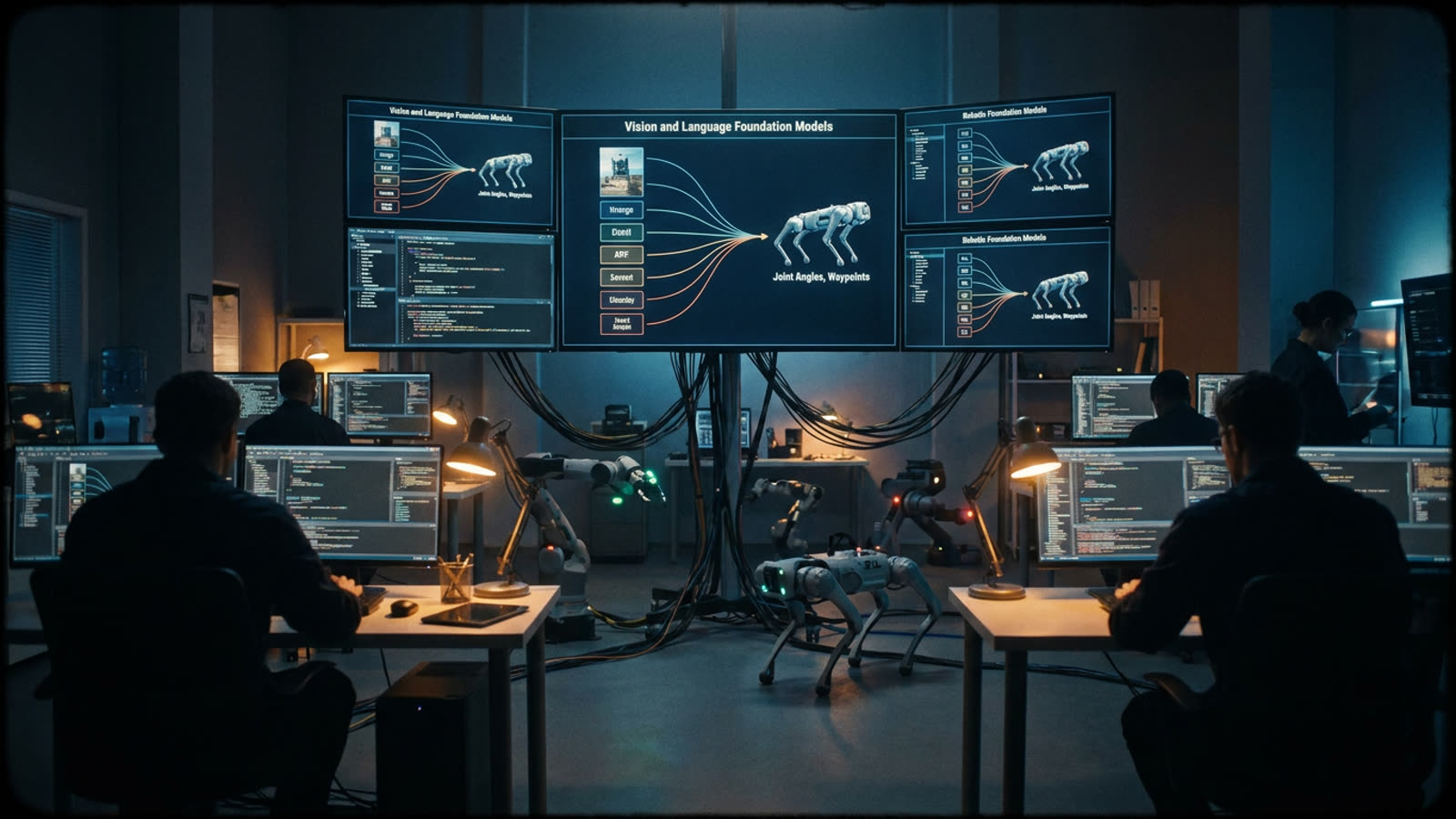
Foundation models for robotics — sometimes called "world models" — are the technical bet. Rather than programming explicit rules for grasping a coffee mug, you train a model on millions of grasping attempts until it internalizes the physics. The approach has already produced impressive lab demos: robots that fold laundry, assemble IKEA furniture, and recover gracefully from perturbations they were never explicitly taught to handle.
Why this matters more than chatbots
Language models disrupted knowledge work, a sector that employs perhaps a quarter of the global workforce in developed economies. Robotics, if it achieves a similar capability jump, disrupts physical labor — manufacturing, logistics, agriculture, construction — which employs a far larger share of humanity, particularly in the Global South. The economic and political ramifications are correspondingly larger.
The optimistic case is that general-purpose robots will do for physical drudgery what tractors did for farming: free human labor for higher-value tasks while dramatically increasing output. The pessimistic case is that the transition will be faster and more dislocating than the agricultural revolution, with fewer obvious destinations for displaced workers. Both cases assume the technology actually works, which remains unproven outside controlled settings.
The investment thesis
Venture capital has noticed. Robotics startups are raising at valuations that would have seemed absurd five years ago, justified by the argument that whoever builds the "GPT-4 of robotics" will capture an enormous share of global GDP. The counterargument is that hardware is hard — manufacturing tolerances, supply chains, maintenance, liability — in ways that software is not. OpenAI did not have to worry about its chatbot breaking someone's wrist.
Our take
The ChatGPT analogy is both clarifying and misleading. Clarifying because the underlying technical intuition — that transformers plus scale equals emergent capability — has proven robust across domains. Misleading because language is forgiving in ways that physics is not; a grammatically awkward sentence is annoying, while a grammatically awkward robotic arm is a workplace injury. The "moment" will arrive, but it will be more gradual and more geographically uneven than the chatbot explosion. The startups making this bet are not wrong about the direction of travel. They may be wrong about the timeline, and in venture capital, timing is everything.