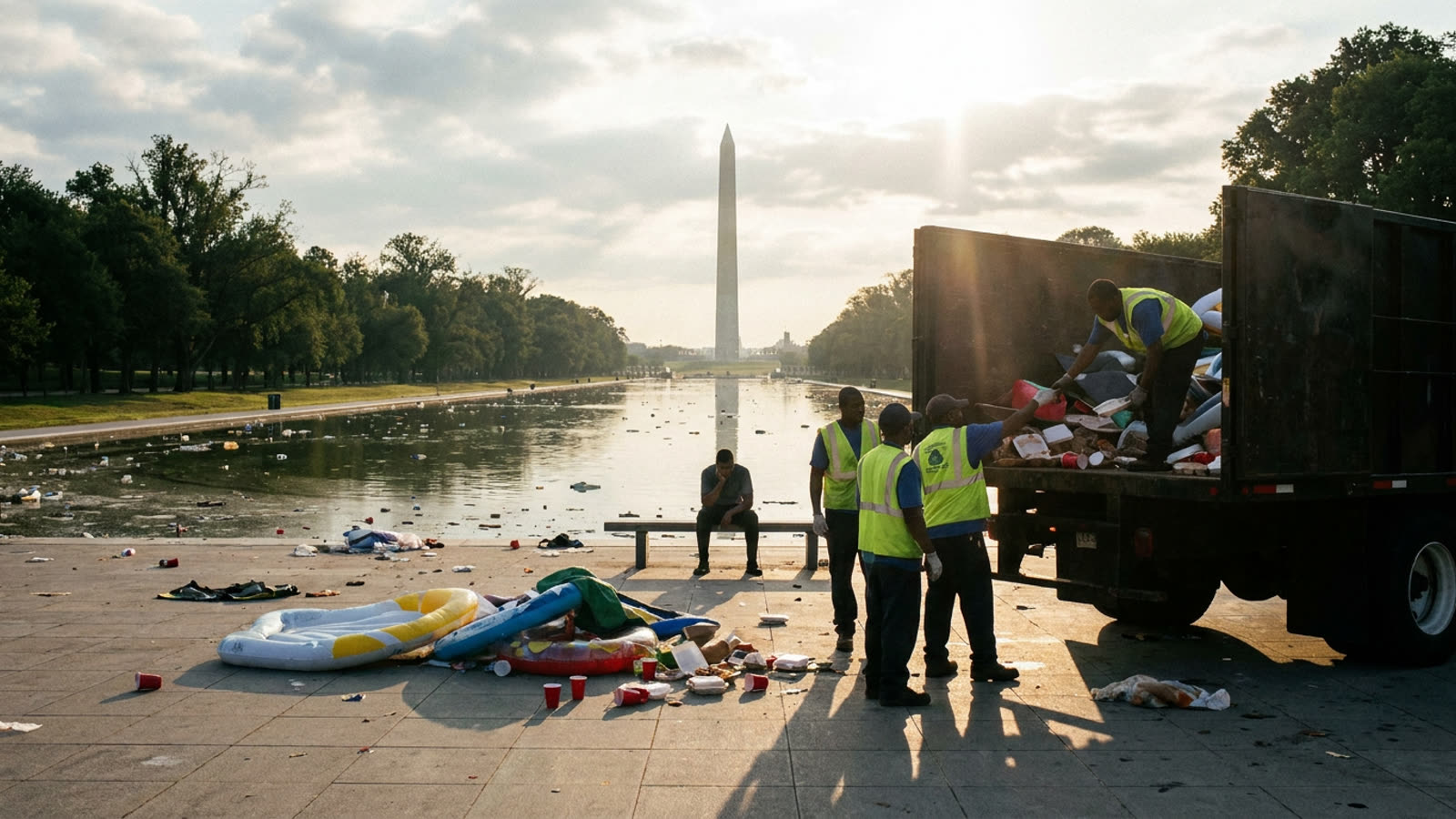
The morning-after photographs from Washington's National Mall tell a story no fireworks display can obscure. Visitors to the Reflecting Pool on July 5th encountered a landscape strewn with plastic bottles, food wrappers, abandoned blankets, and the general detritus of a nation that showed up to celebrate itself and left the mess for someone else to clean.
This is not, of course, a new phenomenon. Every major public gathering in every major city produces waste. But there is something particularly dissonant about the juxtaposition of patriotic fervor and environmental indifference, of waving flags and discarded beer cans, of celebrating freedom while treating shared spaces as disposable.
The cleanup industrial complex
The National Park Service, perpetually underfunded and overstretched, mobilizes small armies of workers after every major holiday to restore the Mall to its postcard-ready state. These crews work through the early morning hours, erasing evidence of the previous night's revelry before most tourists emerge from their hotels. The efficiency of this operation has an unintended consequence: it enables the behavior to continue unchecked, year after year.
The cost of these cleanups is absorbed into the general operations budget, invisible to the citizens who created the need. There are no fines for littering in the crush of a crowd, no social consequences when everyone around you is doing the same thing. The anonymity of mass gatherings creates a diffusion of responsibility that behavioral economists have studied for decades.
A mirror, not a monument
What makes the Reflecting Pool images particularly striking is their literalness. A pool designed to mirror the Lincoln Memorial instead reflected something far less flattering about the national character. The symbolism writes itself, which is perhaps why the photographs circulated so widely on social media, prompting the usual mixture of outrage, defensiveness, and whataboutism.
Other countries with strong traditions of public gathering manage to maintain cleaner spaces. Japanese stadiums empty with fans carrying their own trash. German festival-goers sort recyclables on site. These are cultural norms, not laws, and they suggest that the American approach is a choice rather than an inevitability.
Our take
The trash on the National Mall is not a crisis. It will be cleaned up, as it always is, and the monuments will gleam again by the time the next tour bus arrives. But the annual ritual of mess and cleanup reveals something worth examining: a culture that celebrates public spaces in the abstract while treating them carelessly in practice. The Reflecting Pool did its job perfectly this Independence Day. Americans just did not like what they saw.