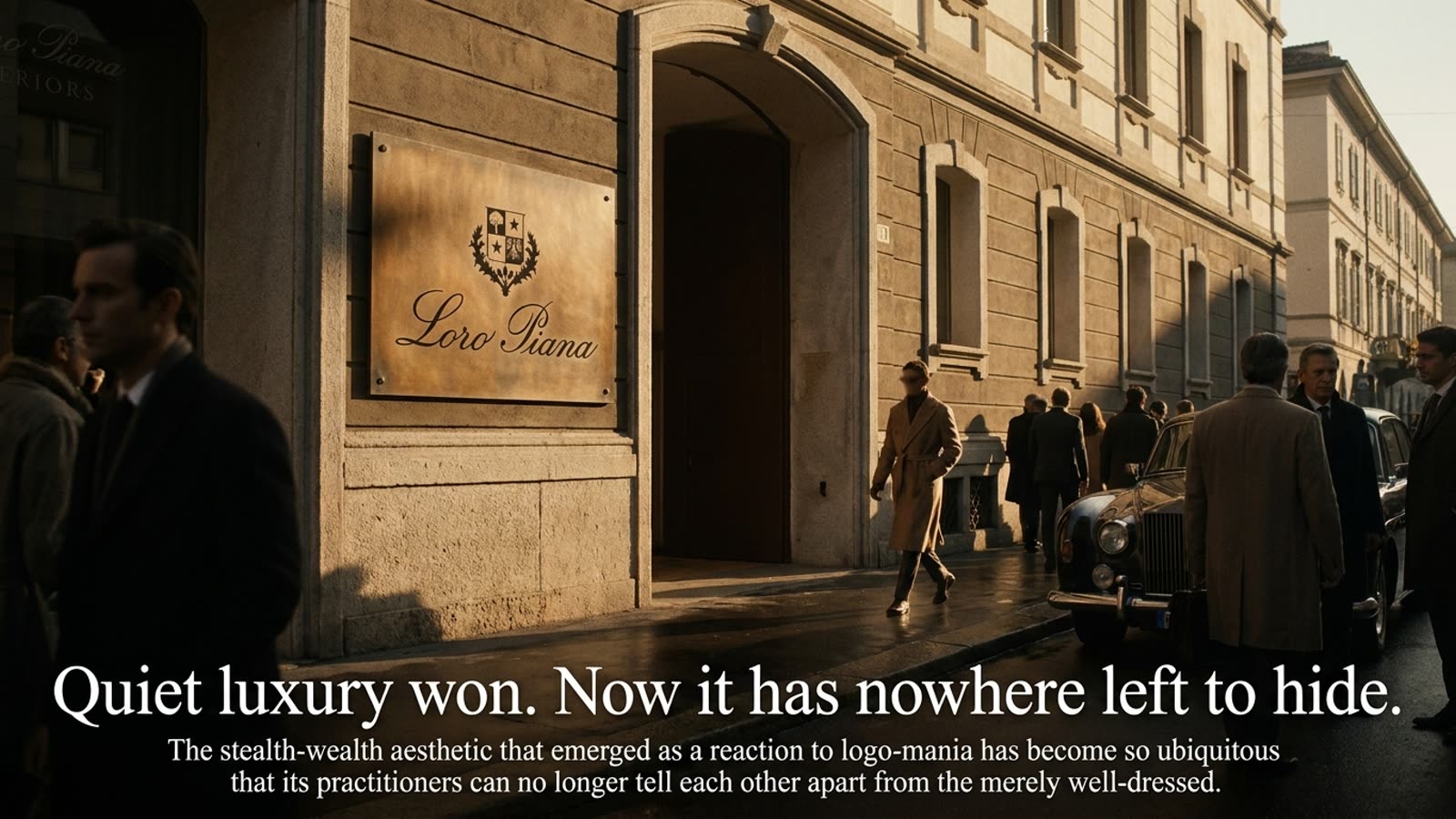
The defining fashion movement of the past decade was built on a paradox: broadcast your wealth by refusing to broadcast anything at all. No logos, no obvious designer signatures, no peacocking—just exquisitely cut cashmere in shades of oatmeal and greige, handbags recognizable only to those who already knew, and a general air of having better things to do than dress for attention. The aesthetic went by many names—quiet luxury, stealth wealth, old money style—but the premise was consistent. True sophistication meant looking expensive without looking like you tried.
It worked, for a while. Then it worked too well.
The Loro Piana problem
The Italian house Loro Piana, founded in the early nineteenth century as a wool merchant, became the movement's unofficial uniform supplier. Its butter-soft cashmere, its vicuña scarves, its unadorned leather goods carried price tags that communicated exclusivity to initiates while remaining invisible to everyone else. The brand's appeal was that nobody outside a certain income bracket had heard of it.
That anonymity evaporated. Social media accounts dedicated to identifying celebrity wardrobes turned Loro Piana into a searchable commodity. The brand's signature open-walk loafers and storm system jackets became as recognizable as any monogrammed tote—just to a different audience. LVMH, which acquired the house in 2013, has since expanded retail presence and reportedly pushed revenues well beyond the billion-euro mark. Quiet luxury, it turns out, scales.
When everyone whispers, no one hears
The trouble with an aesthetic defined by absence is that absence is easy to replicate. Fast-fashion retailers filled racks with unbranded camel coats and ribbed knit separates. Department stores merchandised entire floors around the concept. The look that once signaled membership in an economic elite now signals familiarity with a Pinterest board.
This presents a genuine problem for the consumers who adopted quiet luxury as a distinction strategy. The whole point was illegibility to outsiders. Once the codes become legible—once a $40 sweater from a mass retailer is indistinguishable at a glance from a $4,000 one—the signal collapses. You cannot quietly flex if everyone is speaking the same quiet language.
The inevitable backlash, and what comes next
Fashion abhors a vacuum, and the pendulum has already begun its return swing. Maximalism is creeping back: bold prints, visible hardware, the return of the logo as ironic statement rather than earnest flex. Some houses are leaning into craft markers that cannot be cheaply imitated—hand-stitching, bespoke tailoring, materials so rare they require waitlists measured in years rather than weeks.
The deeper shift may be philosophical. Quiet luxury assumed that the goal of dressing well was to communicate status to a narrow in-group while remaining invisible to everyone else. A younger cohort seems less interested in invisibility altogether. They dress for algorithm-friendly impact, for self-expression that photographs well, for aesthetics that change seasonally rather than endure.
Our take
Quiet luxury was never really about rejecting consumerism; it was about perfecting it. The movement offered a way to spend lavishly while performing restraint, to consume conspicuously while pretending otherwise. Its decline is not a tragedy but a clarification. Fashion, at bottom, is about being seen. The whisper was always meant to carry.