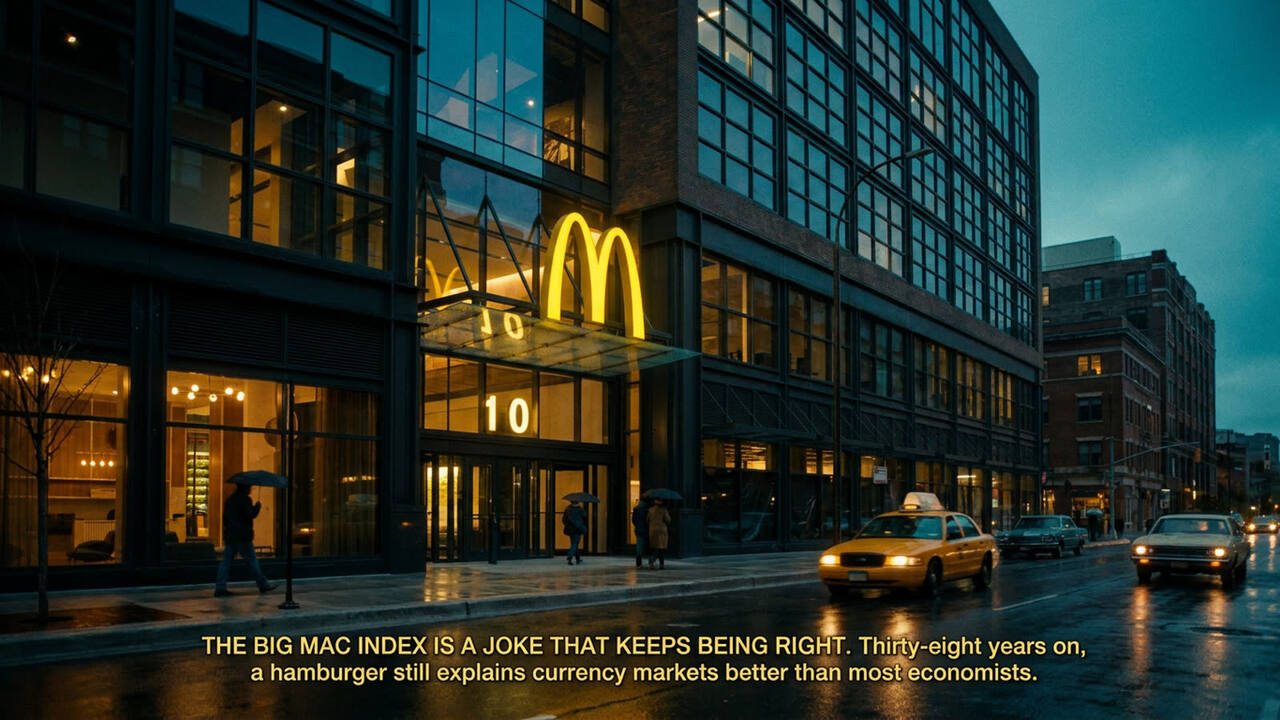
In 1986, an editor at The Economist invented a metric as a bit of end-of-year levity: compare the price of a McDonald's Big Mac across countries and you have a rough-and-ready gauge of whether currencies are overvalued or undervalued. Nearly four decades later, the Big Mac Index remains the single most accessible explanation of purchasing power parity — the idea that, over time, exchange rates should adjust so that identical goods cost the same everywhere. The hamburger, it turns out, is an accidental masterpiece of economic pedagogy.
The genius lies in the product itself. A Big Mac is standardized to an almost neurotic degree: the same sesame-seed bun, the same special sauce, the same two all-beef patties from São Paulo to Stockholm. It incorporates local labor, rent, ingredients, and taxes, making it a miniature basket of goods that captures the cost of doing business in a given economy. Economists call this a tradable proxy for the general price level. Everyone else calls it lunch.
Why currencies don't behave
Purchasing power parity theory suggests that if a Big Mac costs the equivalent of four dollars in one country and eight in another, the second country's currency is roughly twice as overvalued against the first. In practice, currencies rarely sit at their PPP-implied levels for long. Capital flows, interest rate differentials, and speculative sentiment yank exchange rates around far more violently than hamburger prices ever could. Yet over horizons of a decade or more, currencies do tend to drift toward their PPP benchmarks. The Big Mac Index is less a trading signal than a compass pointing toward where gravity eventually pulls.
Critics note the index ignores non-tradable services — you cannot ship a Bangkok haircut to Zurich — and that McDonald's itself adjusts local prices strategically, sometimes absorbing currency swings to protect market share. These objections are valid but miss the point. The index was never meant to be precise; it was meant to be legible. And legibility, in economics, is rarer than accuracy.
What the burger reveals about wealth
Beyond currency valuation, the index offers a visceral snapshot of living standards. A worker in a low-income country earning the local minimum wage might need to labor for an hour or more to afford a Big Mac; a counterpart in a wealthy nation might need ten minutes. This "Big Mac wage" reframing turns an abstract exchange-rate discussion into something immediate: how long must you work to eat? The answer varies by a factor of ten or more across the globe, a disparity that no amount of nominal GDP comparison quite captures.
The index also tracks convergence. As emerging economies develop, their Big Mac prices — measured in dollars — tend to rise, reflecting stronger currencies and higher local costs. China's Big Mac, once laughably cheap in dollar terms, has crept steadily upward over the decades, a hamburger-shaped chart of the country's economic ascent.
Our take
The Big Mac Index endures because it solves a communication problem that bedevils economics: how to make an abstract concept tangible without dumbing it down. Purchasing power parity is a foundational idea, but it is also dry and easily ignored. Wrap it in a sesame-seed bun and suddenly everyone from undergraduates to finance ministers can grasp it in a sentence. The best economic indicators are not always the most rigorous; sometimes they are simply the ones people remember. A hamburger, improbably, turned out to be one of the great teaching tools of modern economics.