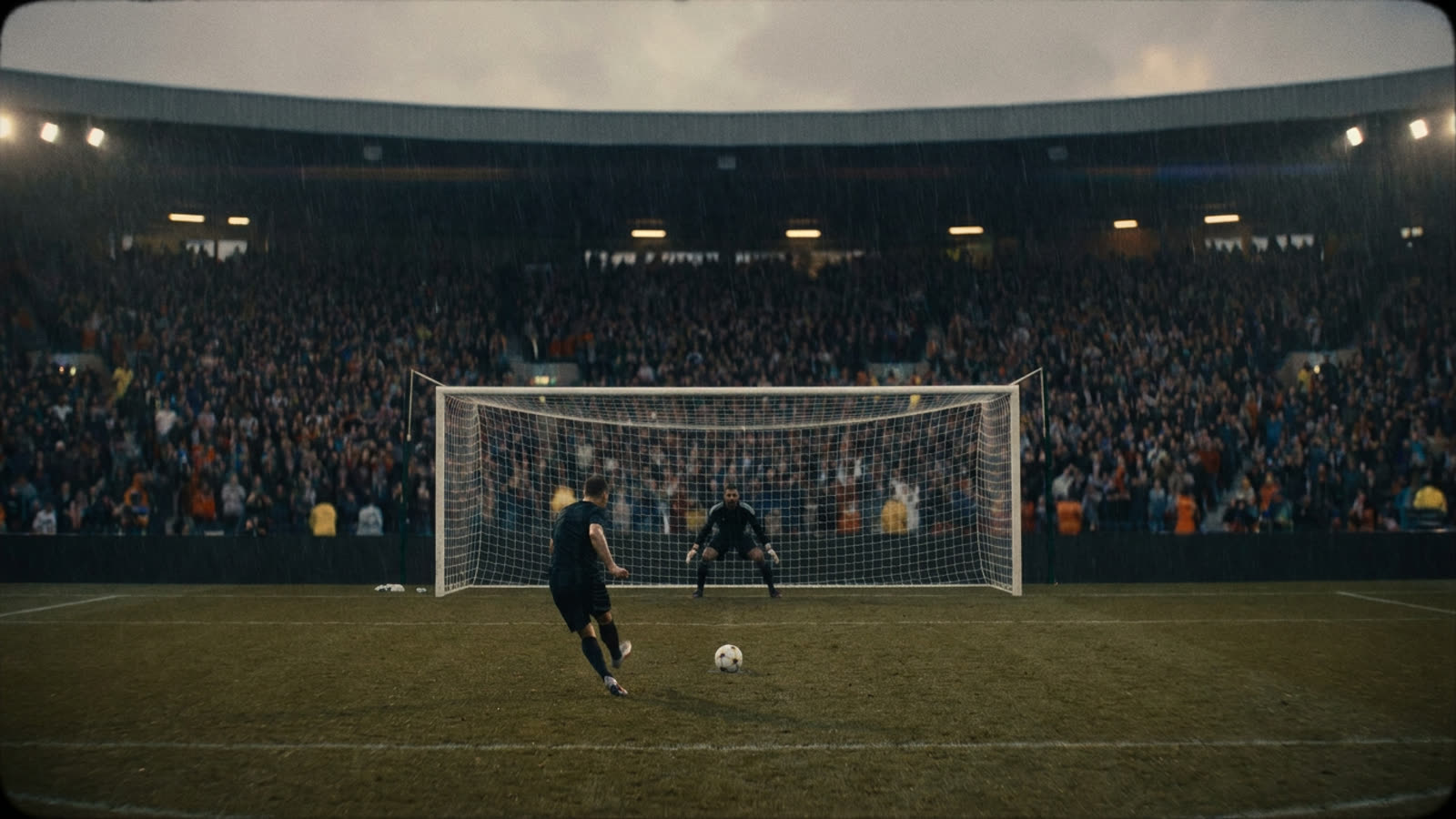
No other moment in sport compresses so much consequence into so little space. Twelve yards of grass, a goalkeeper who must guess before the ball moves, and a nation holding its breath — the penalty shootout is football's answer to the question of what happens when skill alone cannot separate two sides.
The mechanism itself is brutally simple. Five players from each team take turns. If still level, sudden death until someone blinks. Yet within this simplicity lies a psychological laboratory that has produced some of the World Cup's most indelible images: Roberto Baggio staring at the Pasadena sky in 1994, David Beckham's redemption in 2002, the inexplicable decision to let a teenager named Bukayo Saka shoulder England's hopes in 2021.
The numbers that haunt nations
Certain countries have developed reputations that seem to defy statistical probability. Germany, until their exit from the 2006 World Cup, had never lost a major tournament shootout. England, by contrast, became synonymous with shootout failure — a pattern so consistent it spawned academic papers and national therapy sessions. The explanation lies somewhere between sample size, selection bias, and something harder to quantify: the weight of expectation.
Research into penalty-taking suggests the conversion rate in normal play hovers around 75-80 percent. In shootouts, particularly at World Cups, that figure drops. The decline is not about technique — these are the same players who score routinely in league matches. It is about what happens when the amygdala floods the prefrontal cortex with cortisol, when muscle memory must compete with the knowledge that a hundred million people are watching.
The goalkeeper's impossible arithmetic
Goalkeepers face a different problem: physics. A well-struck penalty reaches them in roughly 0.4 seconds. Human reaction time is approximately 0.2 seconds. The mathematics are unforgiving — keepers must commit to a direction before the ball is struck, which means they are not saving penalties so much as predicting them. The best study the habits of opponents, looking for tells in run-up angles or eye movements. Some rely on gamesmanship, delaying the kick, making the taker wait, hoping anxiety does the work.
The introduction of VAR has added another layer. Goalkeepers must now keep at least one foot on the line until the ball is struck, eliminating the slight forward creep that once gave them precious milliseconds. The rule change, intended to level the playing field, has subtly shifted the advantage further toward penalty-takers — though the psychological burden they carry remains the great equalizer.
Our take
There are periodic calls to abolish the shootout, to extend extra time, to introduce golden goals, to do anything other than reduce the beautiful game to a binary test of nerve. These proposals miss the point. The shootout endures precisely because it is cruel, because it strips away the collective and exposes the individual, because it asks a question that ninety minutes of tactical sophistication cannot answer: can you do it when it matters most? Football needs its moments of irreducible drama. The twelve yards provide them.