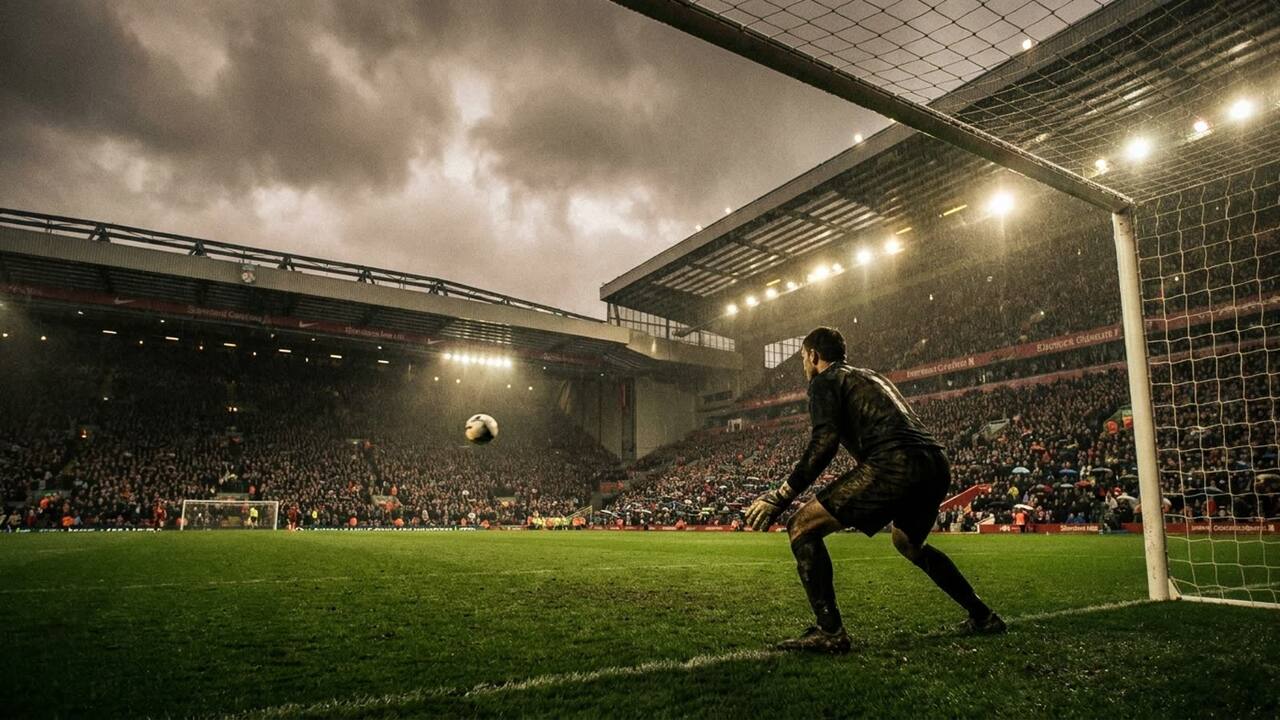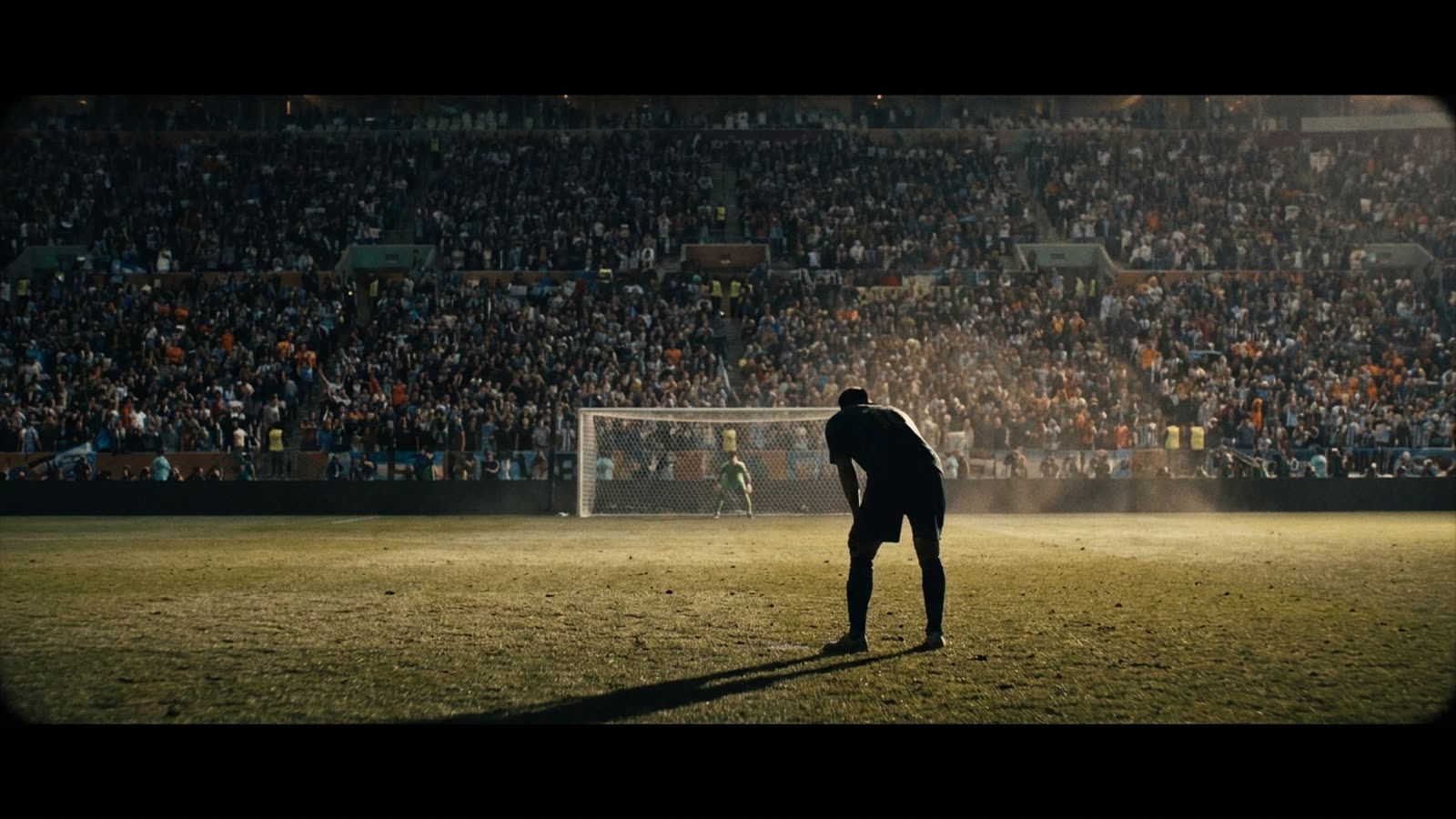
The penalty kick is football's great lie. From twelve yards, with a ball placed on a spot, facing a goalkeeper confined to a line until the moment of contact, a professional footballer should score nearly every time. The geometry is absurdly favorable to the shooter. The goal is eight feet high and twenty-four feet wide. The goalkeeper cannot move early. The ball, struck properly, can travel at speeds that make reaction physically impossible.
And yet. In World Cup shootouts, roughly a quarter of penalties are missed or saved. The conversion rate drops even further in finals and semifinals, when the stakes reach their apex. This is not a failure of technique. It is something far more interesting: a window into how pressure transforms the relationship between mind and body.
The paradox of expertise under pressure
Sport psychologists have spent decades studying what happens when highly trained motor skills meet acute stress. The phenomenon they describe—often called "choking"—occurs when conscious attention intrudes upon actions that normally operate below the threshold of awareness. A footballer who has taken thousands of penalties in training does not think about the mechanics of their run-up or the angle of their planted foot. But introduce a hundred million viewers, a tournament on the line, and the walk from the center circle to the penalty spot, and suddenly those automatic processes become objects of deliberation.
The walk itself is part of the cruelty. Unlike a penalty awarded during open play, where adrenaline and context provide momentum, the shootout forces contemplation. Each player must wait, watch teammates succeed or fail, then make the same journey. The interval between selection and execution can stretch to several minutes—an eternity for doubt to accumulate.
National mythologies and self-fulfilling prophecy
Certain footballing nations have acquired reputations for shootout fragility, and the weight of that history appears to compound the difficulty. When a team carries the memory of previous failures, each new shootout becomes an encounter with collective trauma as much as an individual test. Conversely, nations perceived as mentally resilient in these moments seem to benefit from the expectation of composure.
What makes this particularly fascinating is that penalty-taking ability in regular match situations shows no correlation with national identity. The skill is evenly distributed. Only in shootouts does the divergence appear, suggesting that the differentiating factor is not technical but psychological—and that psychology is shaped by narrative.
The goalkeeper's asymmetric advantage
The shooter bears all the pressure of expectation; the goalkeeper operates with the freedom of the underdog. Saving even one penalty is considered heroic. Missing the ball entirely carries no stigma. This asymmetry liberates goalkeepers to take risks, to guess early, to employ gamesmanship. Some delay the process, forcing shooters to wait. Others attempt conversation, trying to plant seeds of doubt. The rules nominally prohibit distraction, but enforcement is inconsistent, and the line between psychological warfare and unsporting conduct remains blurry.
Our take
The penalty shootout is routinely criticized as an unsatisfying way to decide important matches, a lottery dressed up as competition. This misses the point entirely. Shootouts are not random—conversion rates vary meaningfully by player, by context, by preparation. They are simply measuring something different from the preceding match: not collective tactical execution but individual capacity to perform under the specific pressure of isolation and consequence. Football resists this kind of individual accountability throughout its normal play, which is precisely why the shootout feels so alien to the sport's grammar. That alienation is the source of its drama. The cruelest twelve yards reveal truths that ninety minutes of collective effort can obscure.