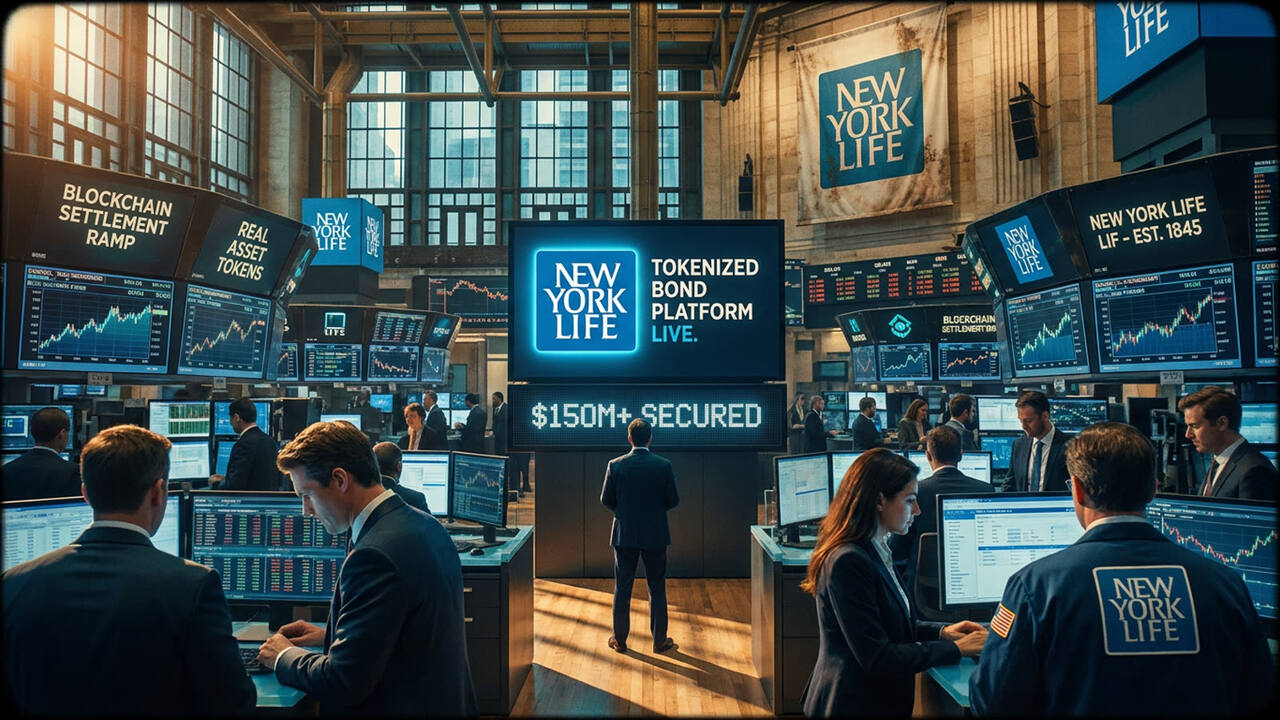
The most consequential blockchain development of the quarter has nothing to do with Bitcoin's price. New York Life, the 180-year-old mutual insurer managing over $700 billion in assets, has partnered with Centrifuge to launch a tokenized high-yield corporate bond strategy—marking the company's first foray into on-chain finance.
This is not a press release from a crypto startup hunting for legitimacy. It is a calculated infrastructure bet from one of the most conservative institutions in American finance.
Why insurers matter more than banks
When JPMorgan or Goldman experiments with tokenization, the market shrugs. Banks have innovation labs; they're supposed to tinker. But life insurers are different beasts entirely. They operate on multi-decade time horizons, matching assets to liabilities that stretch fifty years into the future. Their investment committees move with the urgency of continental drift.
New York Life's decision to put actual capital into tokenized bonds—not a pilot program, not a proof of concept—suggests the institution sees blockchain settlement as durable infrastructure rather than speculative technology. The choice of high-yield corporate bonds is telling: these are real assets with real credit risk, not Treasury bills dressed up for a demo.
The Centrifuge calculation
Centrifuge, the protocol New York Life selected, specializes in bringing real-world assets on-chain. Unlike platforms built for crypto-native trading, it focuses on the plumbing that institutional investors actually need: compliance frameworks, custody integration, and the ability to represent traditional securities in tokenized form.
The partnership reflects a broader pattern. Institutional adoption of tokenization isn't flowing through the flashy consumer-facing crypto exchanges. It's happening through specialized infrastructure providers that speak the language of regulated finance—boring terms like "qualified custodian" and "transfer agent" that make compliance officers comfortable.
The settlement thesis
The bull case for tokenized securities has always been about efficiency: faster settlement, reduced counterparty risk, and 24/7 markets. But efficiency gains alone rarely drive institutional adoption. What moves capital is risk reduction.
For an insurer like New York Life, the appeal may be less about trading speed and more about operational resilience. Tokenized assets can settle in minutes rather than days, reducing the window during which capital sits in limbo. In a credit crisis, that difference matters.
Our take
The crypto industry has spent years promising that traditional finance would eventually arrive on-chain. Most of those promises came from people selling tokens. New York Life isn't selling anything—it's allocating capital with the same deliberation it has applied since the Lincoln administration. When an institution that survived the Civil War, two World Wars, and the 2008 financial crisis decides blockchain infrastructure is ready for real money, the rest of Wall Street should pay attention. This isn't adoption by press release. It's adoption by fiduciary duty.