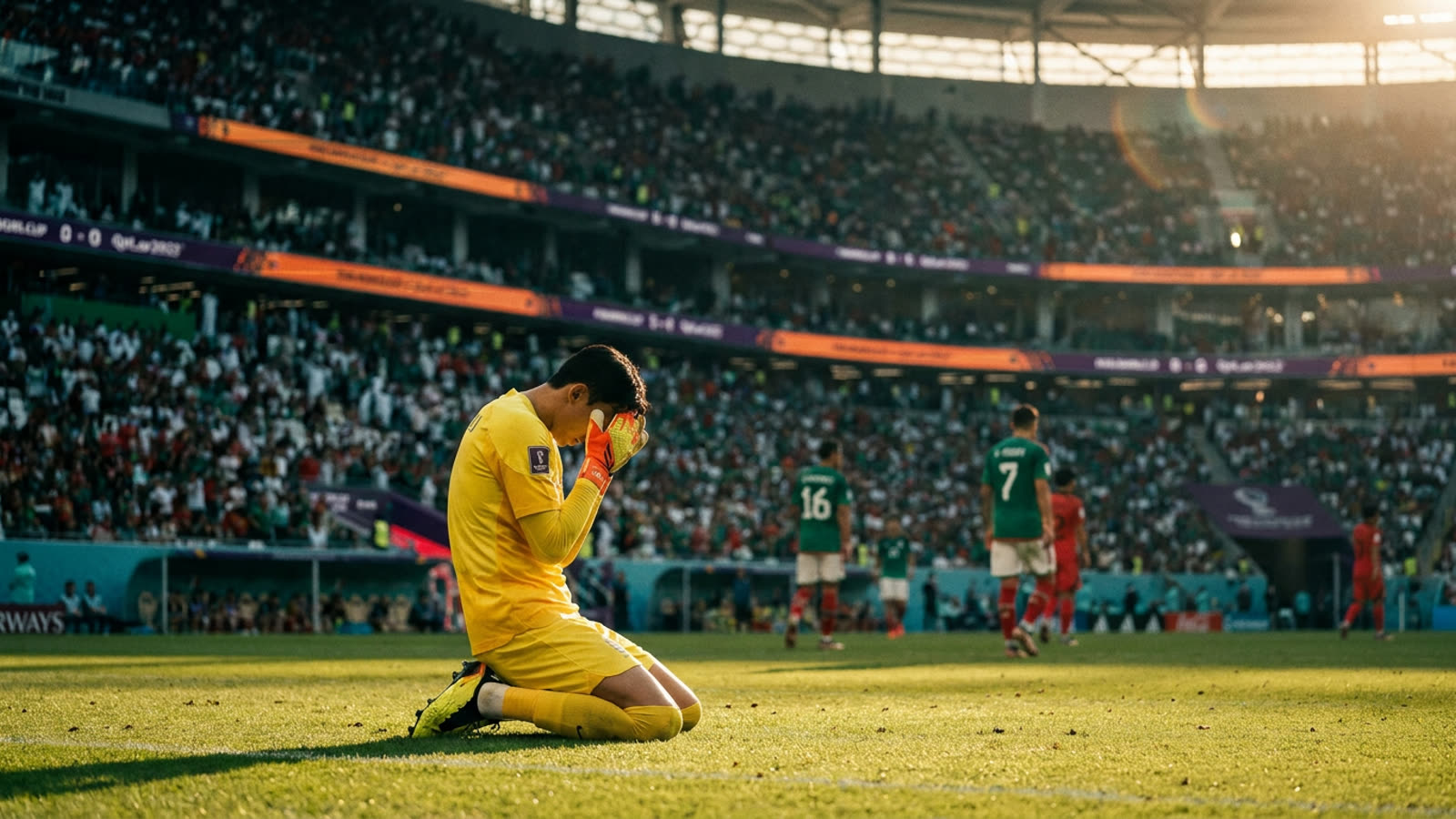
There is no lonelier position in sport than goalkeeper at a World Cup, and Kim Seung-gyu discovered this truth in the most public way possible during South Korea's Group F clash with Mexico. His hesitation on a routine back-pass—the kind of ball he has collected thousands of times in training—allowed a Mexican attacker to close the angle and force the error that opened the scoring. The stadium groaned in that particular register reserved for self-inflicted wounds.
Mexico, who entered the match needing a result to keep their knockout-round hopes firmly in their own hands, did not need to be asked twice. They took the lead and immediately dropped into the compact defensive shape that has characterized their tournament so far—pragmatic, disciplined, utterly unromantic football that nonetheless produces results.
The goalkeeper's burden
World Cup history is littered with the corpses of goalkeeping reputations. Robert Green's fumble against the United States in 2010, Thibaut Courtois's positioning failure against Japan in 2022, the various indignities suffered by keepers who simply picked the wrong moment to be human. Kim now joins this unhappy fraternity, though the tournament is young enough that redemption remains possible.
What makes these errors so devastating is their permanence. An outfield player can misplace a pass and recover; a striker can miss a sitter and score a hat-trick in the same match. But a goalkeeper's mistake often arrives gift-wrapped with a goal, and goals at World Cups carry the weight of nations. Kim will replay that moment for years, regardless of what happens next.
Mexico's calculated opportunism
For El Tri, the goal's origin mattered less than its existence. Manager Jaime Lozano has built a side that thrives on precisely this kind of chaos—they create little but concede less, and when fortune smiles, they know how to protect a lead. It is not football that will win aesthetic prizes, but Mexico have reached the Round of 16 in seven consecutive World Cups playing variations of this theme.
The South Koreans, for their part, pushed forward with increasing desperation as the half wore on, but Mexico's midfield discipline held firm. Every Korean attack seemed to break against a wall of green shirts positioned exactly where they needed to be.
Our take
There is something almost Greek about the goalkeeper's tragedy at major tournaments—the hero undone not by a superior opponent but by his own momentary lapse. Kim Seung-gyu is a fine goalkeeper who will likely have a long career, but this World Cup may already be defined for him by a single second of indecision. Mexico, meanwhile, will take their lead and their points without a shred of guilt. In tournament football, you do not choose how goals arrive; you only choose what to do with them.