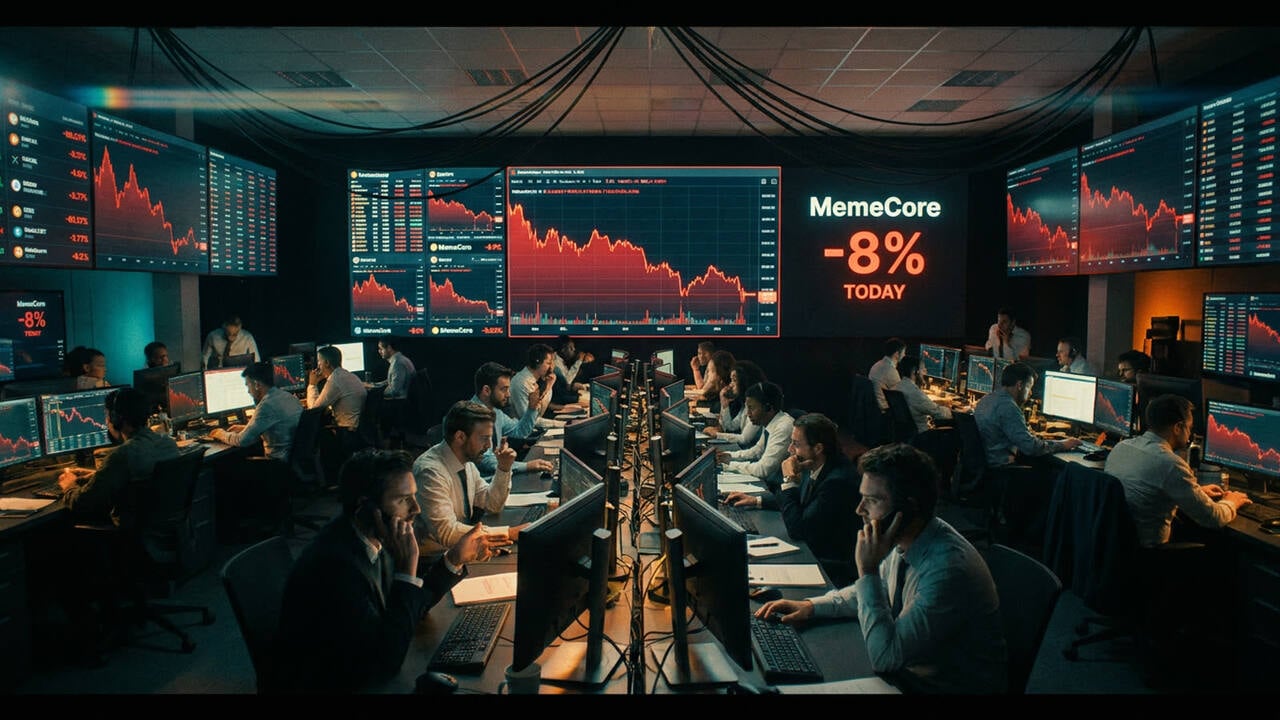
MemeCore's 8.3% plunge on Tuesday is the kind of move that separates meme coin tourists from true believers—and there may be fewer of the latter than the year-to-date chart suggests.
The token, which trades under the ticker M, fell to $1.36 amid broader weakness in speculative crypto assets. That price still represents a roughly 600% gain over the past twelve months, a return that would make any traditional asset manager weep with envy. But the single-day volatility underscores a persistent truth about meme coins: the same retail enthusiasm that drives parabolic gains can evaporate with equal speed.
The meme coin paradox
MemeCore sits at rank 44 by market capitalization, a position that grants it a veneer of legitimacy while obscuring its fundamental nature. Unlike Bitcoin or Ethereum, which have developed genuine network effects and institutional adoption narratives, meme coins derive value almost entirely from attention. They are financial instruments that function more like viral content than like equities or commodities.
This makes them extraordinarily difficult to value by any conventional metric. When the primary use case is speculation on future speculation, price becomes untethered from anything resembling fundamentals. MemeCore's 600% annual gain and 8% daily loss are not contradictory data points—they are two expressions of the same underlying reality.
The broader meme coin correction
MemeCore is not alone in its struggles. Shiba Inu, the original Dogecoin derivative, also declined sharply, continuing a year-long slide that has erased more than 60% of its value. The divergence between MemeCore's annual gains and Shiba Inu's losses illustrates how quickly fortunes can reverse in this corner of the market.
What separates winners from losers in the meme coin space often comes down to timing and narrative momentum rather than any intrinsic quality. Projects that capture the zeitgeist at the right moment can deliver extraordinary returns; those that lose the narrative thread can collapse just as dramatically.
The liquidity question
For traders, the real risk in meme coins is not volatility per se but liquidity. An 8% move in a top-50 asset might seem manageable, but meme coins often have thin order books that can gap violently during periods of stress. Retail investors who attempt to exit during a downturn may find that the quoted price and the execution price diverge significantly.
This liquidity fragility is baked into the meme coin structure. Without institutional market makers or significant utility-driven demand, these tokens depend on a constant influx of new buyers. When that flow reverses, the mechanics work in the opposite direction.
Our take
MemeCore's Tuesday plunge is neither the beginning of the end nor a buying opportunity—it is simply what meme coins do. The 600% annual return is real, but so is the 8% single-day drawdown, and both figures will likely be dwarfed by future moves in either direction. For those who understand the game, meme coins offer asymmetric risk-reward profiles that can be attractive in small allocations. For those who mistake volatility for value, they remain an efficient mechanism for transferring wealth from late entrants to early ones.