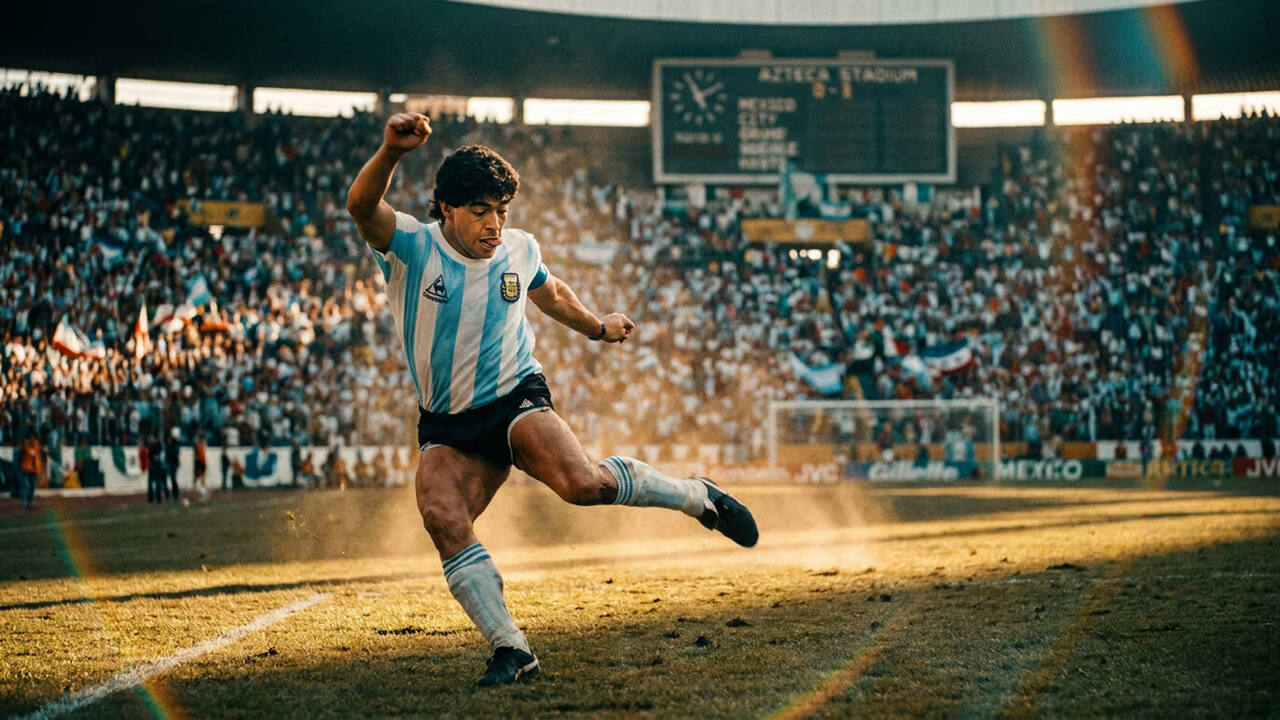
No single match in World Cup history has generated more philosophical debate than Argentina versus England on June 22, 1986, in Mexico City's Estadio Azteca. Not because of what happened—two goals by the same player—but because of what those goals represented: the full spectrum of football morality compressed into a six-minute window that still divides opinion nearly four decades later.
The first goal was a crime. The second was a miracle. Diego Maradona scored both, and he never apologized for either.
The context that made it combustible
Four years before that quarterfinal, Argentina and Britain had fought an actual war over the Falkland Islands. The conflict lasted ten weeks and killed nearly a thousand people. By 1986, the geopolitical wound remained raw, and FIFA's tournament bracket had delivered the cruelest possible matchup. This was never going to be just a football match.
Maradona understood this better than anyone. He later admitted that beating England felt like reclaiming something beyond sport, a sentiment that horrified purists but resonated across Latin America. The Azteca's 114,000 spectators weren't neutral observers; they were participants in a proxy rematch.
The hand, the head, the lie
In the 51st minute, Maradona challenged goalkeeper Peter Shilton for a looping ball. At 1.65 meters, Maradona had no business winning that aerial duel against a keeper who stood nearly two heads taller. He won it anyway—with his fist. The Tunisian referee saw nothing. The linesman saw nothing. Television cameras saw everything.
What followed was perhaps the most famous piece of post-match rhetoric in sports history. Asked about the goal, Maradona attributed it to "a little with the head of Maradona and a little with the hand of God." The phrase stuck because it captured something essential about its author: the refusal to separate cunning from genius, the insistence that getting away with it was part of the game.
The goal that silenced the argument
Four minutes later, Maradona rendered the controversy almost irrelevant. Collecting the ball in his own half, he embarked on a 60-meter run that eliminated six English players before depositing the ball past Shilton. FIFA later designated it the "Goal of the Century," and no serious candidate has emerged to challenge that title.
The run lasted roughly eleven seconds. In that time, Maradona touched the ball thirteen times, changed direction five times, and made decisions that seemed to exist outside normal human processing speed. Watching the footage today, what strikes you isn't the skill—though that remains staggering—but the certainty. He never hesitates. He never looks up to assess options. He simply knows.
Our take
The temptation is to separate the two goals, to celebrate the second while condemning the first. But that misses the point Maradona spent his entire career making. Football is not a morality play. It rewards the beautiful and the cynical in roughly equal measure, and the greatest players have always understood that the line between them is negotiable. Maradona's six minutes against England weren't an aberration; they were a thesis statement. The sport has never produced a more honest portrait of itself.