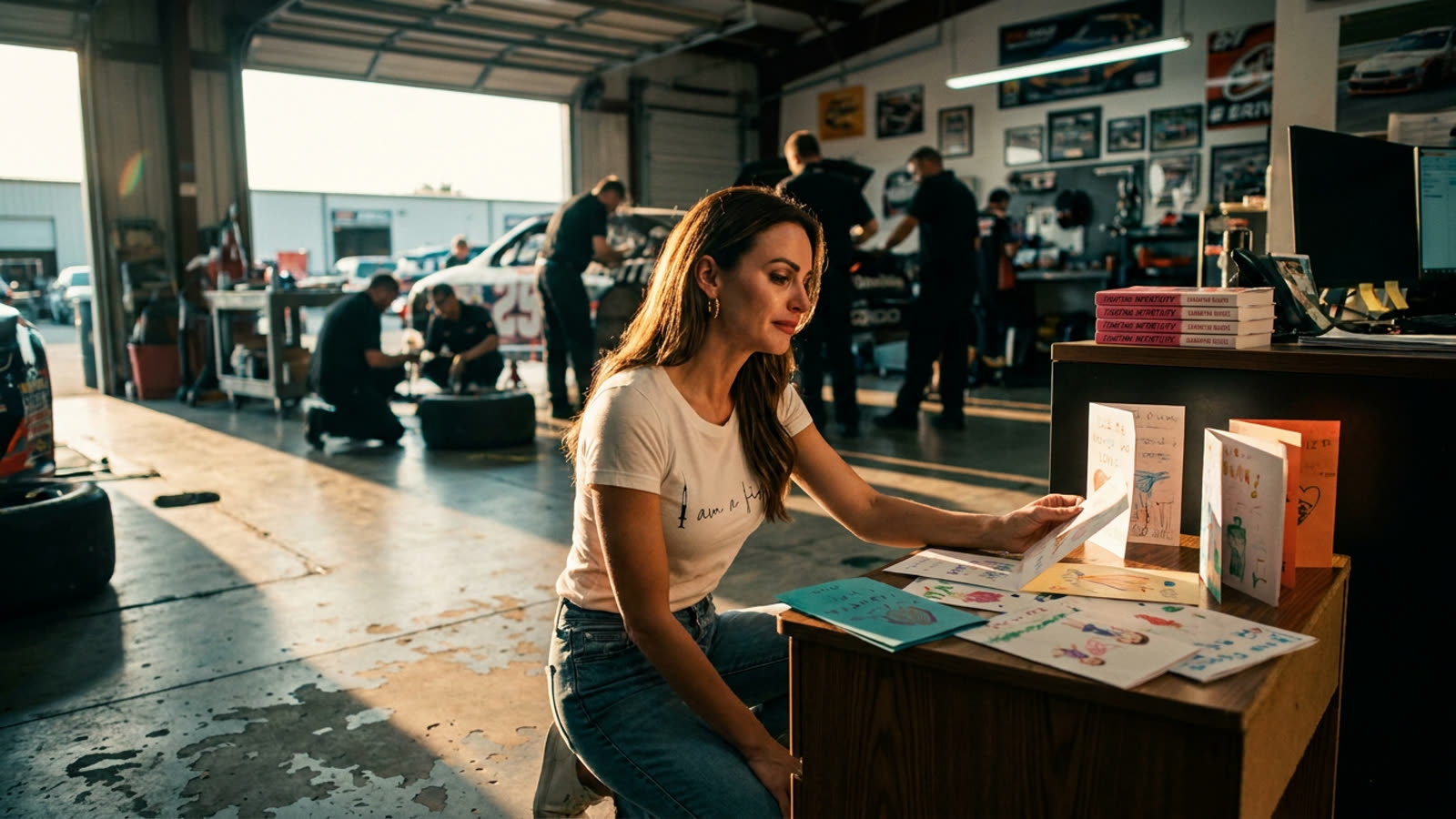
There is a particular cruelty to holidays that arrive on schedule regardless of who is no longer there to observe them. Samantha Busch, widow of NASCAR driver Kyle Busch, confronted that cruelty publicly this Father's Day, sharing that her children had already made cards for their father before his death—cards that now sit in a house where no one will open them.
The post, stripped of the usual celebrity-grief performance, landed with unusual force. No carefully lit memorial photo. No inspirational quote about angels. Just the devastating mundanity of construction paper and crayons prepared for a man who drove cars at two hundred miles per hour and still couldn't outrun whatever took him.
The choreography we expect
Celebrity grief has become its own genre, complete with conventions as rigid as a sonnet's. The black-and-white Instagram carousel. The "forever in our hearts" caption. The carefully timed return to public life, neither too quick (callous) nor too slow (concerning). We have watched this dance so many times that we can predict the steps before the music starts.
Samantha Busch broke the choreography by focusing not on her husband's legacy or her own pain, but on the small, terrible objects her children created in anticipation of a day that would never come as planned. It is the kind of detail that fiction writers know to include and publicists know to omit—too specific, too raw, too real.
NASCAR's complicated mourning
The racing world processes death differently than most industries, if only because death is never entirely abstract there. Drivers speak casually about the possibility of not coming home. Fans watch crashes with a mixture of horror and something harder to name. The sport has buried enough of its own that grief has institutional muscle memory.
Yet Kyle Busch was not killed on a track. He was a two-time Cup Series champion who survived decades of racing at speeds that make highways look like parking lots, only to be claimed by circumstances that had nothing to do with his profession. There is no narrative satisfaction in that, no way to fold it into the sport's mythology of acceptable risk.
What we talk about when we talk about tribute posts
The social media memorial has become so ubiquitous that we rarely pause to consider what it actually accomplishes. For the bereaved, it offers a controlled way to acknowledge loss publicly, to preempt the awkward condolences and redirect the conversation. For the audience, it provides permission to feel something about someone else's tragedy, a brief vacation from our own mortality before scrolling to the next post.
Samantha Busch's tribute resisted that easy exchange. By centering the children's cards—objects that exist whether or not anyone sees them, whether or not Instagram validates them—she reminded us that grief is not content. It is not engagement. It is construction paper sitting on a kitchen counter, waiting for hands that will never pick it up.
Our take
We have become so accustomed to celebrity grief as performance that we forget it can also be, simply, grief. Samantha Busch's Father's Day post was not optimized for virality or designed to protect a brand. It was a woman telling the truth about what happens when holidays keep coming and the person they were meant for does not. The cards were already made. That sentence contains more about loss than a thousand carefully composed tributes ever could.