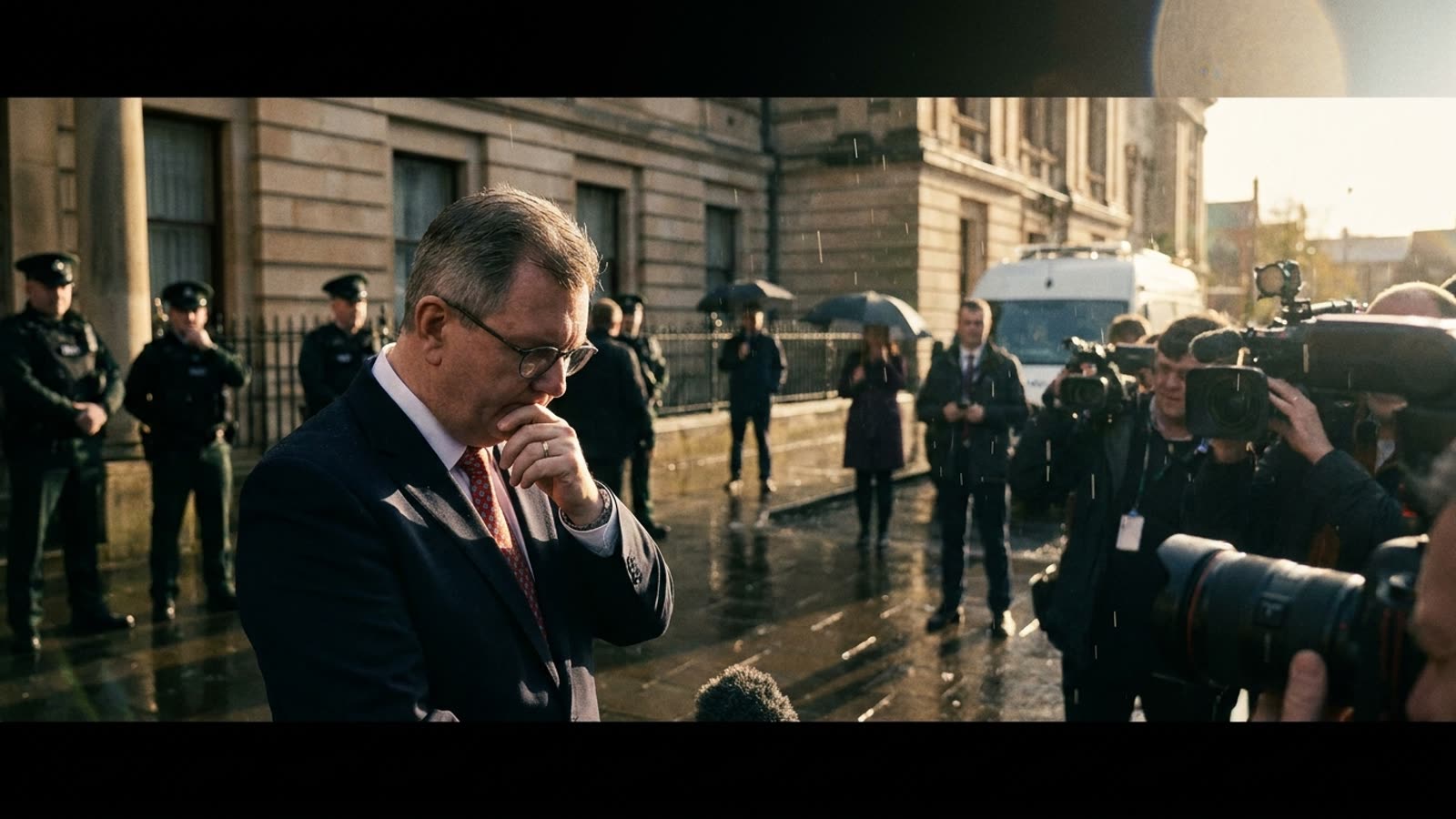
A man who once held the future of the Good Friday Agreement in his hands will now spend the next decade and a half in prison for crimes committed against children. Jeffrey Donaldson, the former leader of the Democratic Unionist Party, was sentenced on Thursday to 15 years for 18 counts of child sexual abuse, including one count of rape, against two women who were children when the offences occurred.
The sentence lands like a grenade in the middle of Northern Irish politics. Donaldson was not a backbencher or a minor figure; he was, until his arrest, the most powerful unionist politician in the region, the man who finally ended the DUP's boycott of Stormont and restored power-sharing government. His conviction does not merely embarrass his party—it forces a reckoning with how a man facing such allegations rose to lead it.
The arc of a career
Donaldson's political biography reads like a history of the Troubles and their aftermath. He served as an Ulster Unionist before defecting to the DUP in 2003, eventually becoming its leader in 2021. He was instrumental in negotiating the Windsor Framework and, more recently, in bringing the DUP back into government after a two-year standoff. His public persona was that of a pragmatic dealmaker with deep evangelical roots—a man who spoke frequently of faith, family, and the moral foundations of unionism.
That persona now lies in ruins. The abuse, according to court proceedings, took place over years and involved victims who were minors at the time. The details that emerged during the trial were harrowing, and the 15-year sentence reflects the severity with which the court viewed the pattern of offending.
The DUP's impossible position
The party has moved quickly to distance itself. Donaldson was suspended upon his arrest and expelled following conviction. But the questions will not stop there. How did a man facing such serious allegations ascend to the top of a party that has long positioned itself as the guardian of traditional values? Were there whispers, warnings, or wilful blindness?
The DUP's current leadership insists it knew nothing. That may be true. But in a region where politics is intensely personal and party structures are tight-knit, the claim of total ignorance will be tested. Sinn Féin and the SDLP have, for now, offered restrained statements—aware, perhaps, that the institutions of power-sharing are fragile enough without gleeful point-scoring. But the political fallout is only beginning.
Our take
There is no political angle that softens what happened here. A man who built a career on moral certainty committed acts of profound cruelty against children. The 15-year sentence is appropriate; the damage to his victims is incalculable. For the DUP, the question is not how to spin this but whether the party can survive the revelation that its most recent leader was, in private, a predator. Northern Ireland's politics have survived bombs and boycotts. Whether they survive this particular betrayal of trust is another matter.