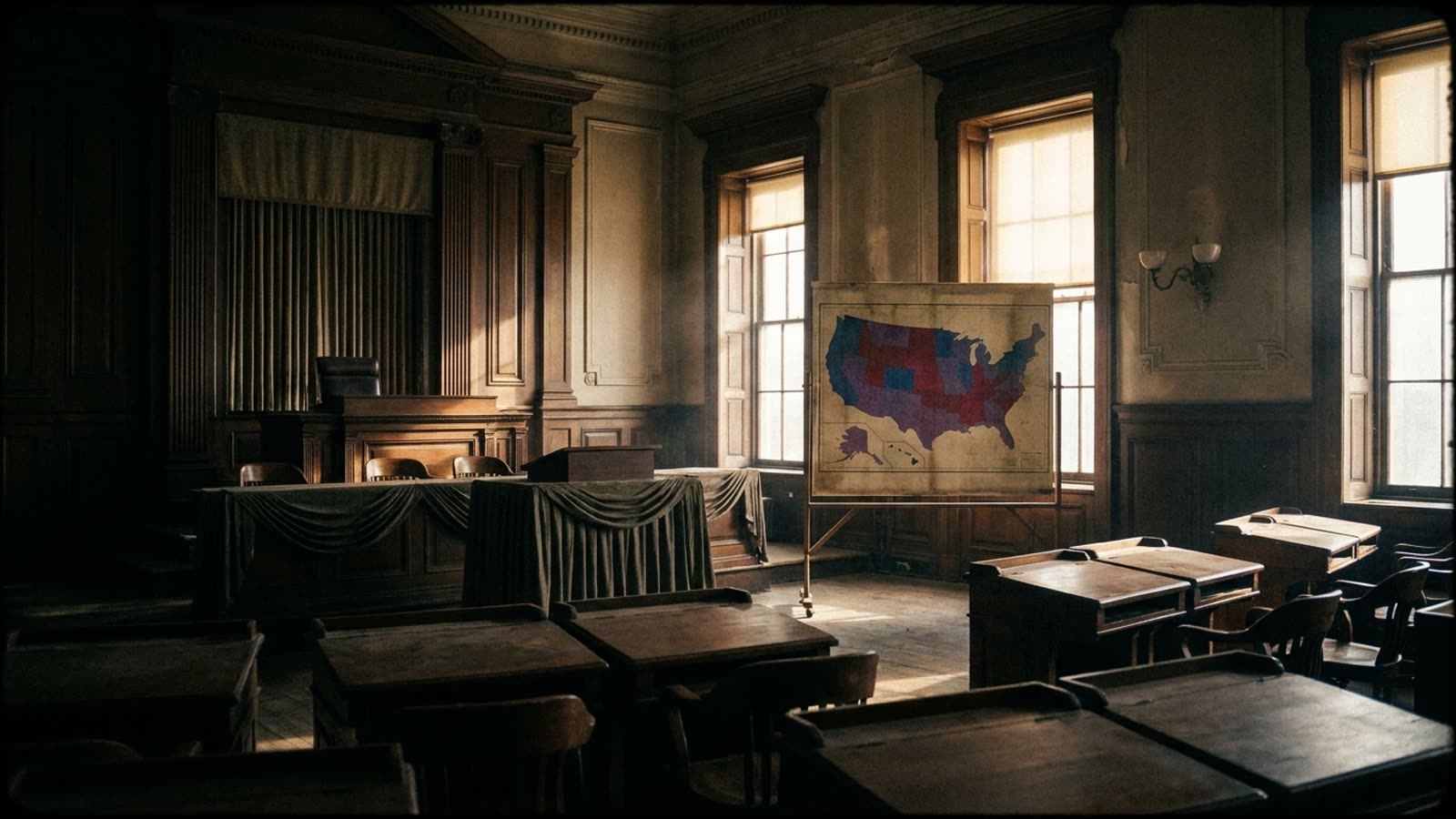
Every four years, Americans rediscover that they do not directly elect their president, and every four years they are freshly outraged. The Electoral College — that baroque mechanism whereby 538 electors cast the votes that actually matter — strikes most observers as either an anachronism or an affront. It is, in fact, neither. It is a deliberate architectural choice that has shaped American politics far more profoundly than any single election.
The system emerged from the Constitutional Convention of 1787, where delegates faced a genuine puzzle: how should a republic spanning thirteen fractious states choose a single executive? Direct popular vote was considered and rejected, partly because the founders distrusted pure democracy, and partly because Southern states wanted their enslaved populations counted for political power without granting them the vote. The infamous three-fifths compromise — counting each enslaved person as three-fifths of a free person for apportionment purposes — was baked into the Electoral College from its inception.
The mathematics of attention
The College's most consequential effect is not who wins but how campaigns are fought. Because most states award all their electors to the statewide winner, candidates rationally ignore the forty-odd states whose outcomes are foregone conclusions. The result is a political system where a voter in Phoenix matters enormously and a voter in San Francisco matters not at all. This is not a distortion of the system; it is the system working as designed.
Swing states accumulate disproportionate federal attention, infrastructure spending, and policy tailoring. Ethanol subsidies persist in part because Iowa votes early and competitively. Rust Belt manufacturing concerns dominate trade policy debates because Michigan, Pennsylvania, and Wisconsin decide elections. The Electoral College does not merely select presidents — it selects which Americans' concerns become presidential priorities.
The faithless elector problem
Electors are real people, and real people occasionally defy expectations. In the election of 2016, seven electors voted for someone other than the candidate who won their state — the most faithless electors since 1872. Some states have since passed laws binding electors to their pledged candidate, and the Supreme Court unanimously upheld such laws in 2020. But the underlying tension remains: the Constitution creates electors as independent actors, while contemporary practice treats them as rubber stamps. This gap between constitutional design and democratic expectation is the Electoral College in miniature.
Why reform fails
Amending the Constitution requires two-thirds of both congressional chambers and three-fourths of state legislatures. Small states, which benefit from the College's two-vote Senate bonus, have no incentive to abolish their own advantage. The National Popular Vote Interstate Compact — an agreement among states to award their electors to the national popular vote winner — has gained traction but remains short of the 270 electoral votes needed to take effect. More fundamentally, whichever party most recently won the presidency through the Electoral College has diminished appetite for changing it.
Our take
The Electoral College is neither sacred nor accidental. It is a political technology designed for a particular purpose — balancing state and federal power, managing regional diversity, and yes, accommodating slavery. That it survives owes less to reverence than to the difficulty of changing anything in a system designed to resist change. Americans who wish to understand their politics must first understand this: the rules are not neutral, and the people who wrote them knew exactly what they were doing.