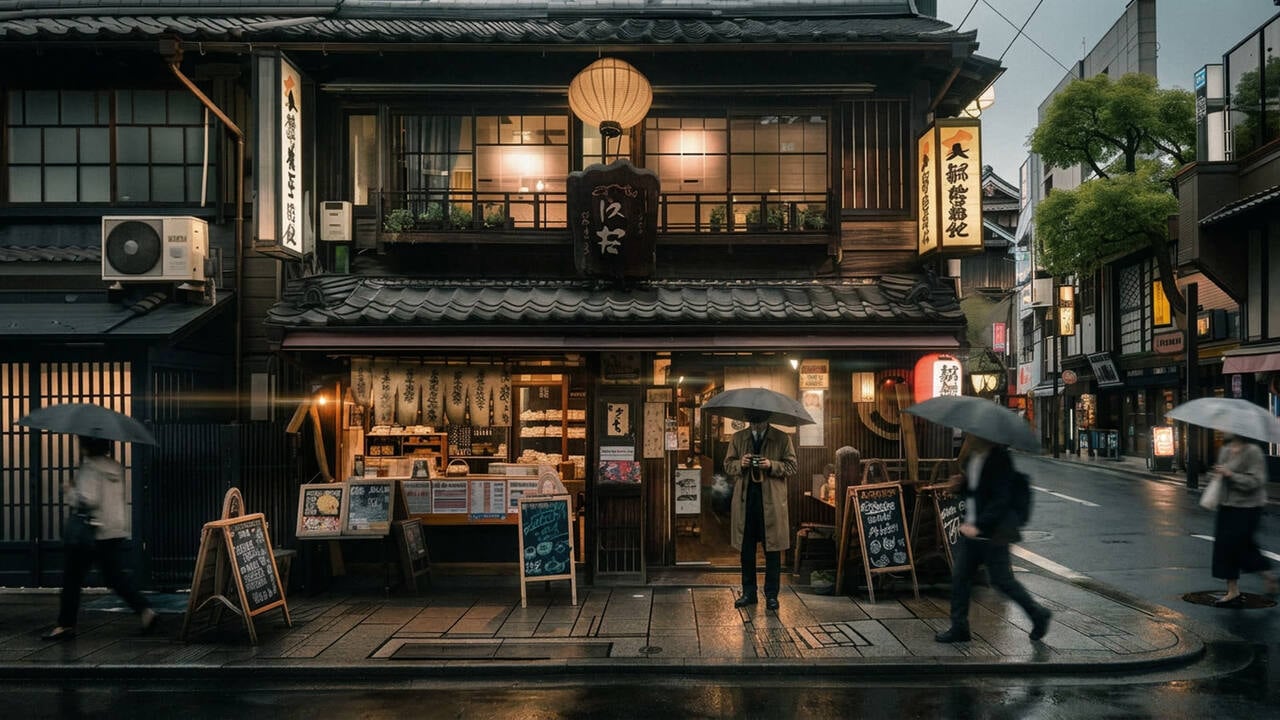
The kissaten is not a café. This distinction matters enormously to the Japanese, and increasingly to the foreign pilgrims who seek these dim, wood-paneled rooms where time moves at the speed of a hand-dripped pour-over. While Starbucks conquered Tokyo with ruthless efficiency and third-wave roasters brought Nordic minimalism to Shibuya, the kissaten—Japan's original coffee house—was supposed to become a relic, a sepia-toned memory of the Shōwa era. Instead, something stranger happened: it became the future.
The numbers told a story of extinction. Japan had roughly 160,000 kissaten at the category's peak in the early 1980s; by the mid-2010s, fewer than 70,000 remained. The masters who opened these shops in the postwar boom were aging out, their children uninterested in inheriting businesses that required fourteen-hour days and yielded modest returns. The aesthetic—velvet seats, oil paintings of European countryside, ashtrays on every table—felt impossibly dated.
The accidental preservation society
What the obituary writers missed was the kissaten's structural advantage: authenticity that cannot be manufactured. A third-wave coffee shop can open anywhere in the world with the same blonde wood, the same Kalita Wave drippers, the same sans-serif menu. A kissaten requires decades of accumulated atmosphere—the particular patina on a copper counter, the way morning light falls through frosted glass, the master's muscle memory for a siphon brew perfected over forty years.
Young Japanese, raised on convenience store coffee and chain uniformity, began discovering these spaces with the wonder of archaeologists. Social media accelerated the phenomenon, but not in the way one might expect. The kissaten's resistance to photography—low lighting, no-phone customs, masters who glare at cameras—created scarcity value. A grainy snapshot of a cream soda in a cut-glass goblet became more precious than any latte art.
The succession problem, partially solved
The more interesting development is happening behind the counter. A small but growing cohort of young entrepreneurs has begun acquiring kissaten from retiring owners, not to modernize them but to preserve them in amber. In Tokyo's Jimbocho district, the secondhand bookstore quarter, several legendary establishments have passed to new stewards who treat the original décor, the vintage audio equipment, and even the ashtrays as sacred objects.
This is preservation through commerce rather than nostalgia. The new owners understand that the kissaten sells an experience unavailable elsewhere: permission to sit for three hours with a single cup of coffee, to read a physical book, to exist outside the attention economy. The price of that cup—often surprisingly modest by international standards—is beside the point.
The smoke question
One element remains genuinely contested. The kissaten and the cigarette evolved together; the haze of tobacco smoke was part of the atmosphere, not an intrusion upon it. Japan's gradual tightening of indoor smoking regulations has forced painful choices. Some establishments have installed elaborate ventilation systems. Others have banned smoking entirely, accepting the aesthetic loss. A few operate in legal grey zones, their regulars understanding that discretion is expected.
The purists argue that a smoke-free kissaten is a contradiction in terms, like a pub without beer. The pragmatists note that younger customers, even those seeking analog experiences, have no desire to smell like an ashtray. There is no consensus, only adaptation.
Our take
The kissaten's unlikely persistence reveals something about the limits of convenience culture. Efficiency is a poor substitute for atmosphere, and atmosphere cannot be scaled. The young Japanese and foreign visitors queuing outside a seventy-year-old Ginza coffee house are not rejecting modernity—they carry smartphones, they will post about the experience later—but they are asserting that some pleasures require friction. The kissaten asks you to wait, to be patient, to accept that the master's rhythm is not negotiable. In an era when every app promises to save you time, the kissaten charges you for the privilege of wasting it. That turns out to be a product people will pay for.