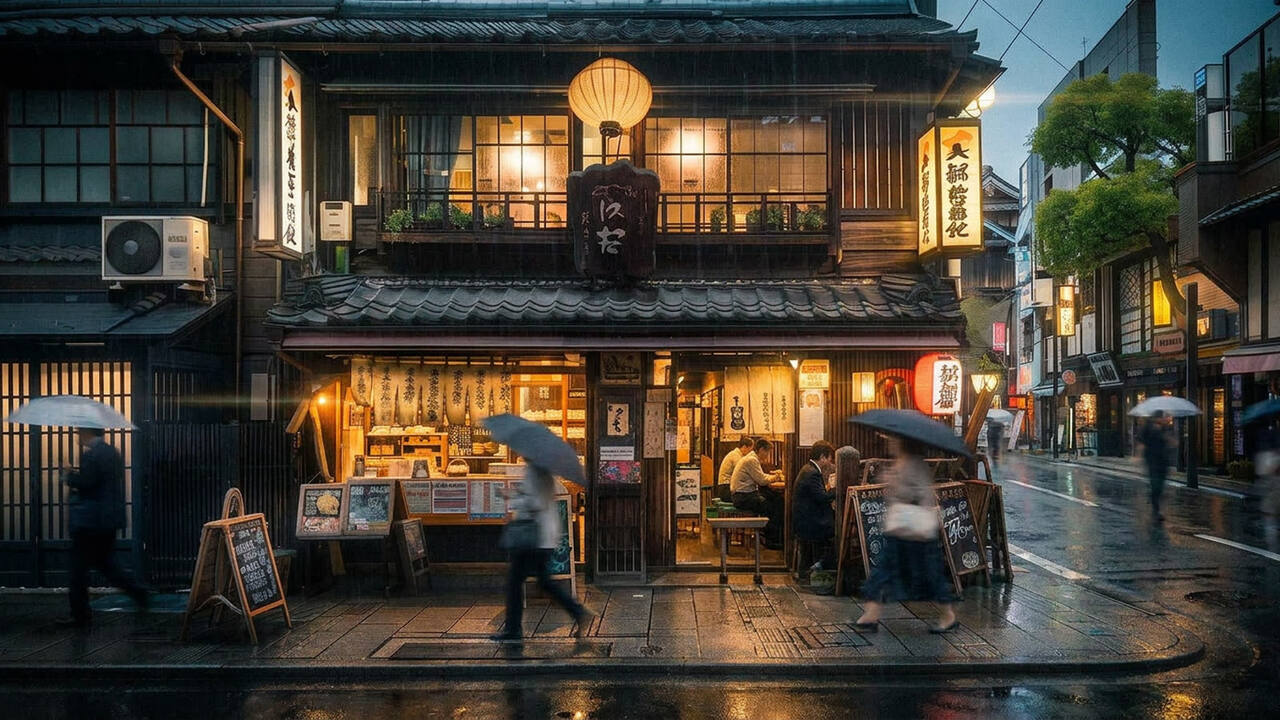
The kissaten is, by any rational business metric, an absurdity. A single proprietor, often elderly, operating a cramped space with perhaps eight seats, serving hand-dripped coffee that takes seven minutes to prepare, priced modestly, in neighborhoods where the rent has quintupled since the shop opened decades ago. The economics do not compute. And yet thousands persist across Japan, their survival suggesting that something beyond spreadsheet logic keeps them alive.
The word itself—喫茶店, literally "tea-drinking shop"—is a misnomer twice over. These establishments serve coffee, not tea, and "shop" implies a transactional efficiency that kissaten explicitly reject. What they sell, if we must use commercial language, is atmosphere: the particular quality of light through frosted glass, the weight of a ceramic cup, the sound of a hand grinder, the understanding that no one will ask you to leave.
The accidental counterculture
Kissaten emerged in the early twentieth century as Japan's answer to European café society, spaces where intellectuals and artists could linger over Western beverages and feel cosmopolitan. By the postwar decades, they had multiplied into the tens of thousands, each developing eccentric personalities—jazz kissaten with museum-quality sound systems, manga kissaten with floor-to-ceiling libraries, "pure" kissaten that banned conversation entirely.
Then came Starbucks in 1996, Doutor's aggressive expansion, convenience store coffee that cost a third as much and took thirty seconds. The kissaten population collapsed. What remains are the stubborn holdouts, shops where the owner would rather close than modernize, and—increasingly—a new generation of pilgrims who have discovered that inefficiency can be a luxury.
The choreography of slowness
Watch a kissaten master work and you understand that the seven-minute pour-over is not a bug but the entire point. The kettle's arc, the bloom of grounds, the spiral pattern—these are not affectations but a performance that gives the customer permission to do nothing. In a culture that invented the concept of karoshi, death by overwork, the kissaten offers a socially sanctioned pause. You are not being lazy; you are appreciating craft.
The food, too, resists efficiency. Kissaten cuisine is its own genre: improbably thick toast, Neapolitan spaghetti that no Italian would recognize, cream sodas in colors that do not exist in nature. These dishes are not good in any contemporary culinary sense. They are good in the way that childhood memories are good—specific, unreproducible, immune to criticism.
Our take
The kissaten's persistence is not nostalgia, or not only nostalgia. It is a quiet argument that some human needs cannot be optimized. The third-wave coffee movement, for all its virtues, treats coffee as a problem to be solved—better beans, better extraction, better scores. The kissaten treats coffee as a pretext for something else entirely: the right to sit still in a world that has forgotten how. That the economics make no sense is precisely the point. Some things should not make sense.