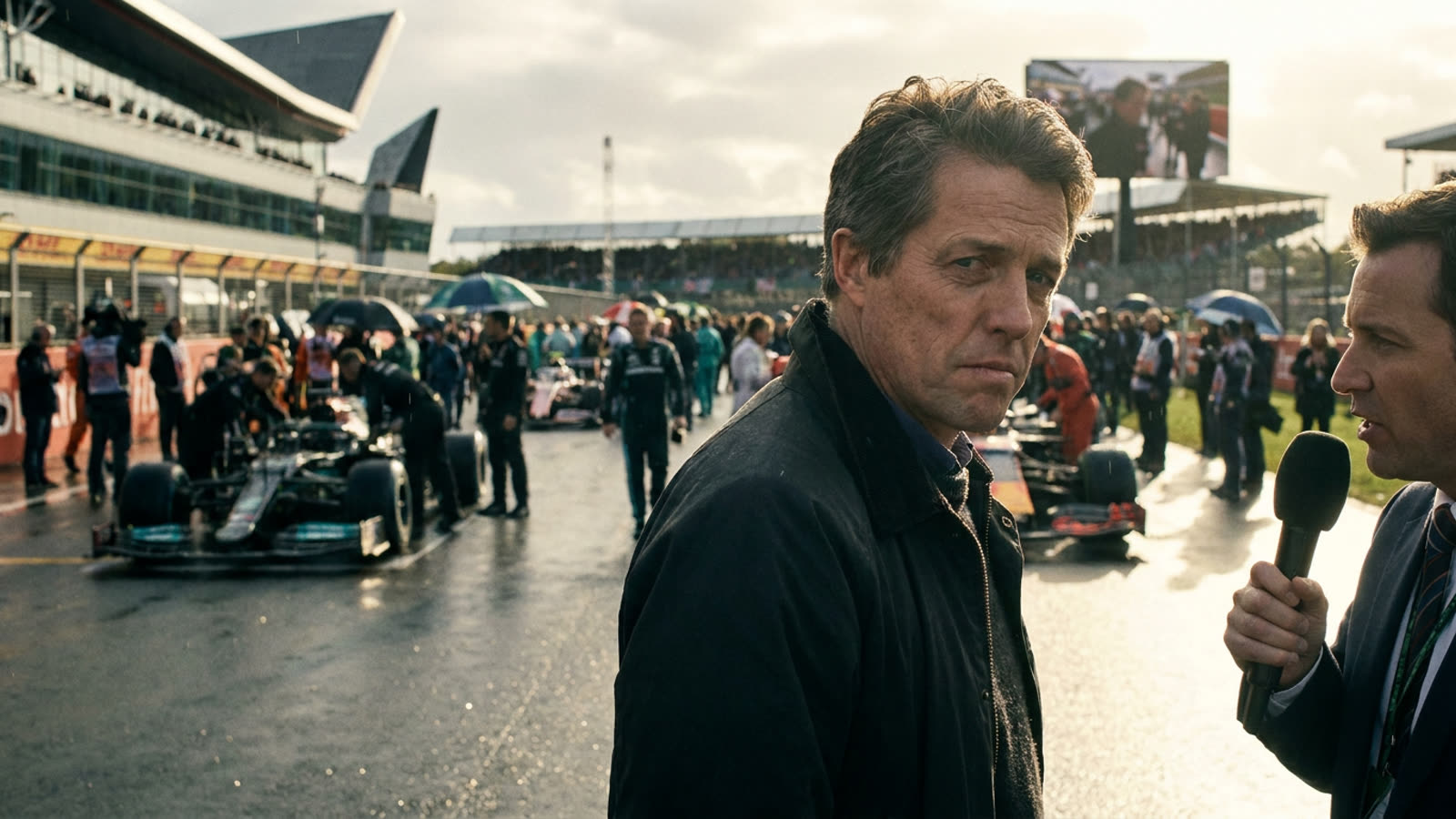
Hugh Grant does not want to talk to you about his movie. He does not want to tell you which driver he's supporting. He would prefer, if it's all the same, to simply stand on the grid at Silverstone looking vaguely inconvenienced, as though someone has served him room-temperature champagne at his own birthday party.
The actor's latest encounter with Sky Sports' Martin Brundle—a ritual as predictable as British summer rain—produced the kind of politely hostile non-interview that has become Grant's signature contribution to the promotional circuit. Monosyllabic answers. A facial expression suggesting mild digestive distress. The unmistakable energy of a man who would rather be literally anywhere else, including perhaps a dentist's chair.
The Brundle gauntlet
Martin Brundle's grid walks have evolved into something stranger and more compelling than mere pre-race coverage. They are, in effect, a live stress test of celebrity composure. The former driver weaves through the starting grid with a cameraman in tow, ambushing famous people who have come to be seen but not necessarily heard. Some play along beautifully—Lewis Hamilton's mother is reliably gracious, various tech billionaires attempt relatability with varying success. Others treat the microphone like a subpoena.
Grant belongs firmly to the latter camp, and he is hardly alone. Megan Thee Stallion once walked away mid-question. Martin's encounter with the rapper's security team became briefly more interesting than the race itself. But Grant's particular brand of reluctance carries different cultural baggage: he is performing a very specific kind of English upper-middle-class discomfort with overt self-promotion, the suggestion that actually trying to sell something is rather vulgar.
The dying art of promotional reluctance
There was a time when this posture was standard issue for serious actors. Marlon Brando refused to collect his Oscar. Katharine Hepburn gave interviews approximately never. The implication was that the work should speak for itself, and anyone who needed to explain or promote it was admitting a kind of failure.
That world is gone. The modern celebrity economy runs on access, content, and the appearance of accessibility. Instagram stories from film sets. Podcast appearances discussing creative process. TikTok duets with fans. The expectation now is that famous people will participate enthusiastically in their own commodification, that they will be grateful for every microphone thrust in their direction.
Grant's grid walk performances read as a refusal of these terms—or perhaps an inability to meet them. At sixty-five, he came up in an industry that still maintained some separation between the work and the worker. His discomfort is genuine, which is precisely what makes it compelling. He is not performing reluctance; he is reluctant.
Our take
There is something almost nostalgic about watching Hugh Grant visibly suffer through thirty seconds of mandatory pleasantries. In an era when most celebrities have been media-trained into smooth, frictionless content generators, his awkwardness feels almost subversive—a reminder that fame and the desire to perform fame are not actually the same thing. Whether this makes him refreshingly authentic or simply rude depends largely on your tolerance for watching a grown man act as though basic conversation is a war crime. Either way, he's more interesting than the race.