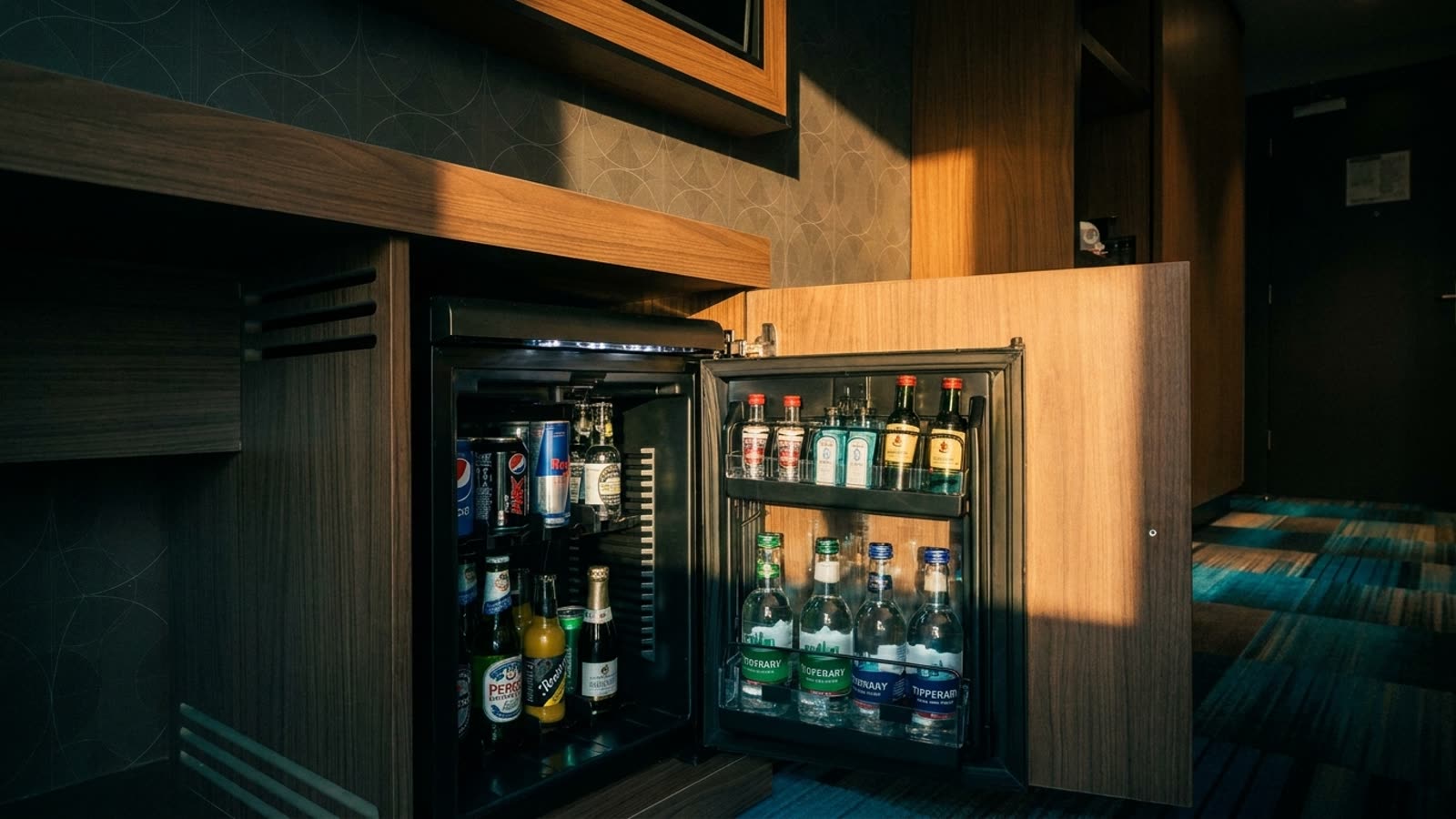
The minibar is perhaps the most psychologically sophisticated object in any hotel room. Not the bed, with its elaborate pillow menu. Not the television, with its pay-per-view architecture. The minibar—that small, humming appliance stocked with overpriced snacks and half-bottles of mediocre wine—represents a half-century of hospitality industry experimentation in extracting revenue from exhausted travelers who cannot be bothered to put their shoes back on.
The genius is not the markup, though that is substantial. A can of Coca-Cola that costs seventy cents at a convenience store routinely sells for six dollars from a minibar, a markup that would be considered usurious in almost any other retail context. The genius is the friction architecture: the minibar succeeds because it has systematically eliminated every obstacle between desire and purchase.
The invention of convenient regret
The modern minibar emerged in Hong Kong in 1974, when the Hong Kong Hilton installed small refrigerators stocked with beverages in its guest rooms. The innovation spread rapidly through the luxury segment, and by the early 1980s, no self-respecting business hotel could operate without one. The original proposition was straightforward: room service was slow, hotel bars closed, and guests wanted a nightcap without leaving their rooms.
But hoteliers quickly discovered something more interesting. The minibar's power lay not in satisfying genuine need but in manufacturing impulse purchases. A guest who would never pay twelve dollars for a small bottle of vodka at a bar would pay it from the minibar, because the minibar caught them at their most vulnerable—tired, slightly bored, and already in a spending frame of mind. The transaction required no social interaction, no waiting, no decision more complex than reaching forward.
The sensor wars
The industry's great technological arms race of the 1990s and 2000s concerned not the minibar's contents but its surveillance capabilities. Hotels introduced sensor systems that automatically charged guests the moment an item was lifted from its designated spot, regardless of whether it was consumed. The theory was loss prevention; the practice was a customer service nightmare. Guests who merely examined a candy bar found charges on their bills. The backlash was sufficient that many properties retreated to honor-system models or removed minibars entirely.
The sensors revealed an uncomfortable truth: the minibar's profitability depended partly on ambiguity. Guests who consumed items but forgot to report them were pure margin. Guests who disputed charges cost more in staff time than the items were worth. The minibar worked best as a guilt-delivery mechanism, not a surveillance apparatus.
Our take
The minibar endures because it understands something fundamental about human behavior: we will pay remarkable premiums to avoid minor inconveniences, especially when we are tired and the charge will appear on an expense report or a credit card statement we will not scrutinize until we are home. It is not a beverage service. It is a tax on exhaustion, levied with precision by an industry that has spent decades studying exactly how much friction a traveler will tolerate before simply giving in. The $14 peanuts are not a mistake. They are the point.