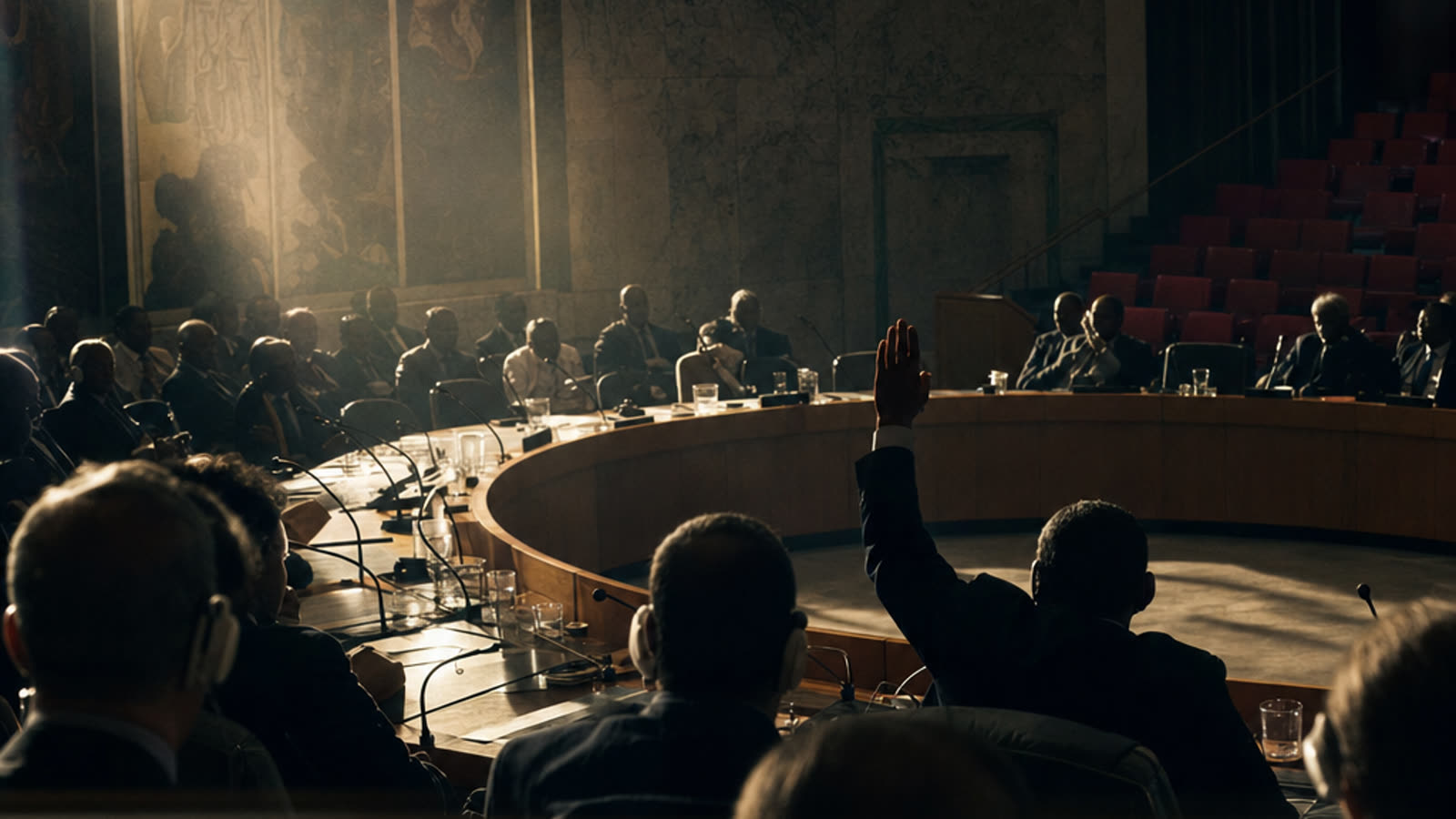
The United Nations Security Council veto is perhaps the most reviled mechanism in international diplomacy. Critics call it antidemocratic, paralytic, a relic of 1945 power arrangements that have long since shifted. They are correct on all counts. What they miss is that the veto was never designed to be fair — it was designed to keep great powers inside the tent, and by that narrow measure, it has worked for eight decades.
The logic is brutally simple: any international body that can compel action against a major military power will either be ignored by that power or trigger a war. The League of Nations learned this when Japan walked out in 1933 and Italy in 1937. The architects of the UN — primarily American, British, Soviet, and Chinese diplomats meeting at Dumbarton Oaks in 1944 — concluded that a weaker organization with buy-in from the powerful was preferable to a stronger one that the powerful would abandon.
The mechanics of paralysis
The veto applies only to "substantive" matters, not procedural ones, though the distinction has always been contested. Any of the five permanent members — the United States, Russia, China, France, and the United Kingdom — can block a resolution by voting against it. Abstention does not count as a veto, a nuance that has occasionally allowed resolutions to pass when a P5 member wished to signal disapproval without outright obstruction.
The numbers tell the story of shifting geopolitics. In the UN's first two decades, the Soviet Union cast the overwhelming majority of vetoes, often blocking new member admissions. From the 1970s onward, the United States became the most frequent user, predominantly to shield Israel from condemnation. More recently, Russia and China have coordinated vetoes on Syria, Sudan, and other interventions they view as Western overreach. The pattern is consistent: whoever feels most threatened by the prevailing international consensus uses the veto most.
Why reform proposals fail
Proposals to reform the veto are perennial and uniformly unsuccessful. Some suggest expanding the P5 to include India, Brazil, Germany, or Japan. Others advocate limiting veto use to cases involving a member's vital interests, or requiring two vetoes to block a resolution. The fundamental problem is that any change to the UN Charter requires ratification by all five permanent members, and none has an incentive to dilute its own power.
France and the United Kingdom have occasionally gestured toward voluntary veto restraint in cases of mass atrocities, but these pledges remain non-binding and untested. The United States, Russia, and China have shown no interest in any constraint. The veto, in other words, is protected by the very mechanism it creates.
Our take
The Security Council veto is indefensible by any principle except the one that matters most in international relations: preventing great-power war. It has not stopped proxy conflicts, humanitarian catastrophes, or flagrant violations of sovereignty. But it has kept the United States, Russia, and China engaged in a common forum for nearly eighty years, which is more than the League managed. The veto is not a flaw in the system — it is the load-bearing wall. Knock it out, and you do not get a more just international order. You get no international order at all.