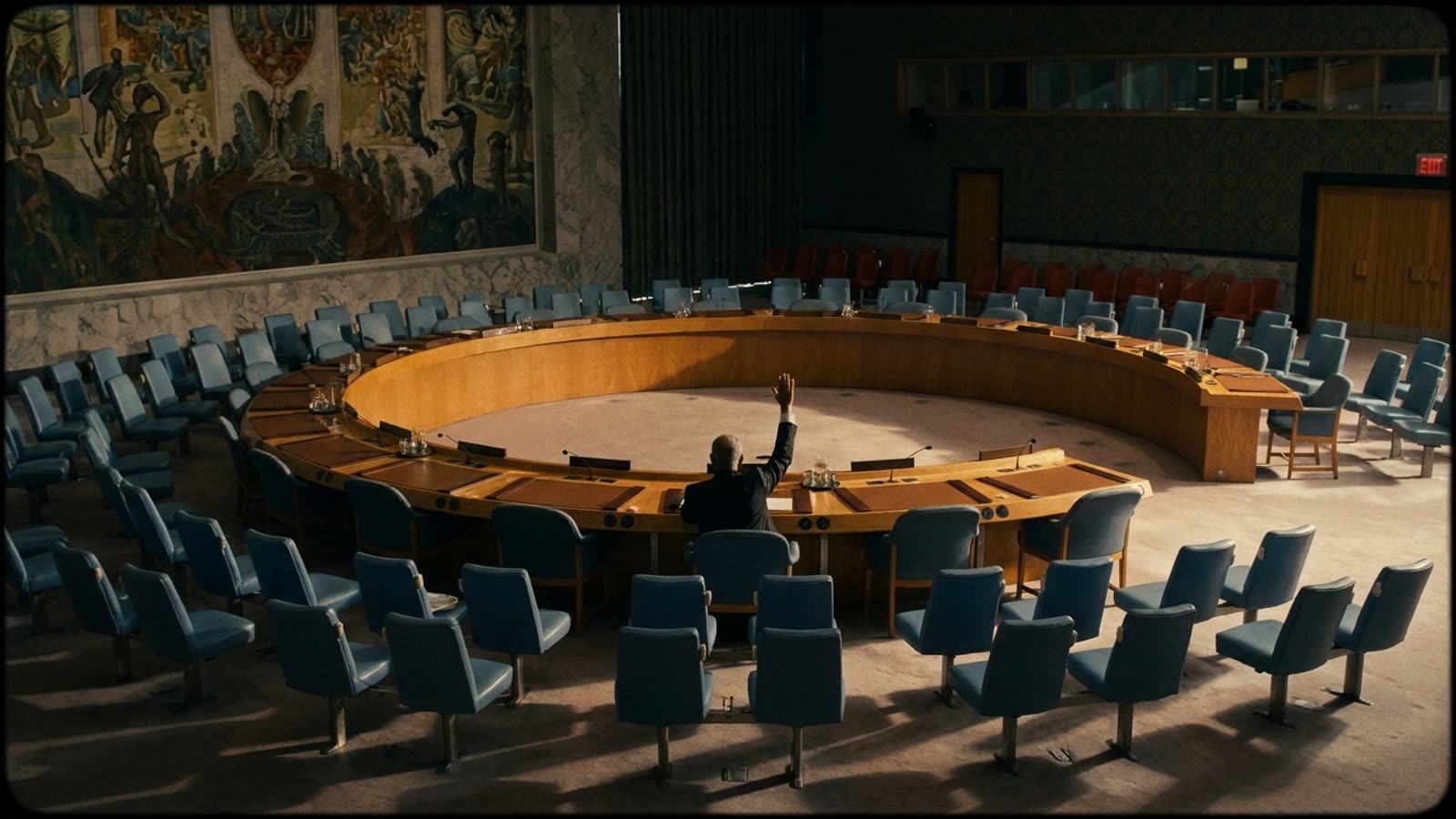
The United Nations Security Council has failed to act on Syria, on Ukraine, on countless crises where the moral imperative seemed overwhelming and the geopolitical will evaporated into a single raised hand. Critics call this dysfunction. They are missing the point entirely. The veto power granted to the five permanent members—the United States, Russia, China, France, and the United Kingdom—was never designed to produce action. It was designed to prevent the great powers from going to war with each other by giving them an off-ramp from any collective decision they found intolerable.
This distinction matters enormously. The League of Nations collapsed in part because it required unanimity from all members, which meant small states could obstruct great powers, and great powers responded by simply leaving. The architects of the UN Charter in 1945 learned from that failure. They created a system where the most dangerous actors—the ones capable of starting world wars—would always have a seat and always have an escape valve.
The mechanics of paralysis
The Security Council has fifteen members, but only five are permanent. The other ten rotate on two-year terms and have no veto. For any substantive resolution to pass, it needs nine affirmative votes and zero vetoes from the P5. This means a single permanent member can block action regardless of how the other fourteen vote.
The veto has been used roughly three hundred times since 1945, though counting methods vary depending on whether you include the Soviet Union's prolific early vetoes during the Cold War. Russia and the United States have been the most frequent users in recent decades, often on predictable subjects: Russia blocking resolutions on Syria or its own territorial disputes, the United States blocking resolutions critical of Israel.
What the public rarely sees is the veto's shadow—the resolutions that are never introduced because sponsors know they will be blocked. This anticipatory effect shapes the entire diplomatic landscape. Ambassadors negotiate knowing exactly where the red lines are, which means the Council's output is pre-filtered for great-power acceptability.
Why reform never happens
Every few years, momentum builds to reform the Security Council. Proposals include adding new permanent members (Germany, Japan, India, Brazil are perennial candidates), eliminating the veto, or limiting its use in cases of mass atrocities. None of these efforts have succeeded, and none are likely to.
The reason is structural: amending the UN Charter requires ratification by two-thirds of member states, including all five permanent members. The P5 have no incentive to dilute their own power. Even proposals that seem modest—like requiring a veto-wielding member to publicly explain their reasoning—face resistance because they establish precedents of accountability that could erode the veto's absolute character over time.
The General Assembly has occasionally routed around the Council through mechanisms like the "Uniting for Peace" resolution, which allows the Assembly to recommend collective measures when the Council is deadlocked. But Assembly resolutions are not binding. The enforcement power—the authority to authorize military action or mandatory sanctions—remains exclusively with the Security Council.
Our take
The Security Council veto is the honest part of international relations. It makes visible what would otherwise happen invisibly: great powers do what they want, and collective action requires their consent. The alternative to a veto is not a more functional Council—it is a Council that the United States, Russia, or China simply ignores, or a system that collapses under the weight of its own ambitions. The veto is a monument to the lesson of 1945: better a paralyzed peace than an active war.