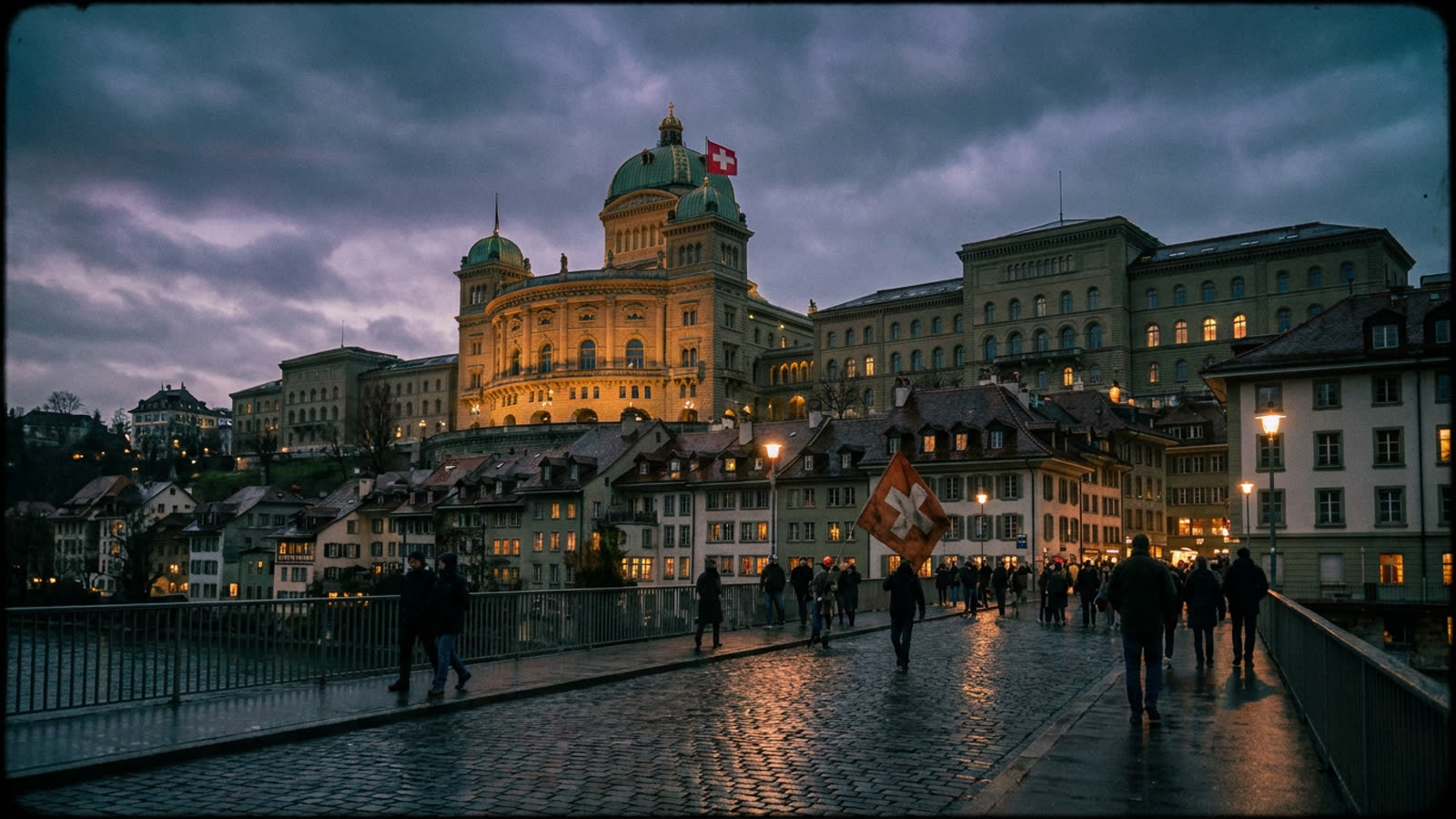
The Swiss Federal Council has no prime minister, no president in any meaningful sense, and no opposition. Seven ministers from four different parties govern by consensus, rotating a ceremonial presidency among themselves each year. Most Swiss citizens cannot name their current head of state. This is not a bug but the entire point.
While democracies worldwide grapple with executive overreach, personality cults, and the fragility of norms, Switzerland has spent nearly two centuries perfecting the art of making power as unexciting as possible. The Federal Council, established in 1848, operates on a principle that would horrify modern political consultants: collective responsibility, permanent coalition, and the systematic suppression of individual ambition.
The magic formula that refuses to die
Since 1959, seats on the Federal Council have been allocated according to an informal agreement called the "magic formula," distributing positions among the largest parties roughly in proportion to their electoral strength. The formula has been adjusted only twice in over six decades, and even then, the changes were marginal. A party can lose votes, gain votes, rage against the establishment, and still find itself governing alongside its supposed enemies.
This creates a peculiar incentive structure. Populist parties that elsewhere thrive on opposition find themselves absorbed into the machinery of consensus. The Swiss People's Party, a nationalist-conservative force that would be in permanent opposition in most European systems, has held two Federal Council seats for years. Its ministers attend the same Wednesday meetings, sign off on the same collective decisions, and publicly defend policies they might privately despise.
Why individual ambition goes to die
Federal councillors serve indefinitely until they choose to resign—there are no term limits, no votes of confidence, no dramatic reshuffles. Yet the role offers none of the usual rewards of high office. Ministers cannot claim personal credit for successes; all decisions are announced as unanimous even when they were not. They cannot build independent power bases; the rotating presidency lasts exactly one year and confers almost no additional authority. They cannot even reliably pursue ideological agendas; the requirement for consensus means every initiative arrives pre-compromised.
The result is that Switzerland attracts a particular type of politician to its highest office: competent, patient, and fundamentally uninterested in glory. Occasionally a more ambitious figure slips through, and the system grinds them down or waits them out. The institution is stronger than any personality within it.
The costs of engineered boredom
This model is not without critics. Decision-making can be glacially slow; Switzerland took years longer than its neighbors to respond to various international pressures precisely because consensus must be built across ideological lines. The system also struggles with issues that split the country along linguistic or cultural fault lines, where compromise satisfies no one. And the magic formula can entrench parties whose support has genuinely collapsed, delaying democratic accountability.
Moreover, the Swiss model is almost impossible to export. It relies on a small, wealthy, homogeneous-enough population with strong cantonal identities and a tradition of direct democracy that acts as a pressure valve. Countries that have attempted similar power-sharing arrangements—Belgium's endless coalition negotiations, Lebanon's confessional system—have discovered that forced consensus can produce paralysis rather than stability.
Our take
The Federal Council works because it was designed by people who had witnessed what happened when executive power became exciting. In an age when charisma is mistaken for competence and disruption for reform, Switzerland's boring government offers a quiet rebuke. Power shared is power constrained, and power constrained is power that lasts. The lesson is not that every democracy should adopt a seven-headed executive, but that the features we find most thrilling in politics—the drama, the winners and losers, the cult of personality—may be precisely the features most likely to destroy it.