Every four years, Americans rediscover that they do not actually vote for president. They vote for electors who vote for president, a distinction that feels academic until it isn't—until a candidate wins the popular vote by millions and loses the White House anyway. The Electoral College is routinely described as an anachronism, a glitch in the constitutional software. This framing misses the point entirely. The system is working precisely as designed; the problem is that it was designed for a republic that ceased to exist sometime around 1865.
The original logic
The framers of the Constitution did not trust direct democracy. They did not particularly trust voters, whom they assumed would be parochial, poorly informed, and susceptible to demagogues. The Electoral College was conceived as a deliberative body—a collection of distinguished citizens who would exercise independent judgment in selecting the executive. Alexander Hamilton, in Federalist No. 68, praised the system for ensuring that the presidency would never fall to someone with "talents for low intrigue." The electors were meant to be a filter, not a rubber stamp.
Equally important was the compromise between large and small states, and between slave and free. The infamous three-fifths clause inflated the electoral power of Southern states by counting enslaved people—who obviously could not vote—toward congressional apportionment, and therefore toward electoral votes. Virginia dominated early presidential politics not despite the Electoral College but because of it.
The mechanical reality
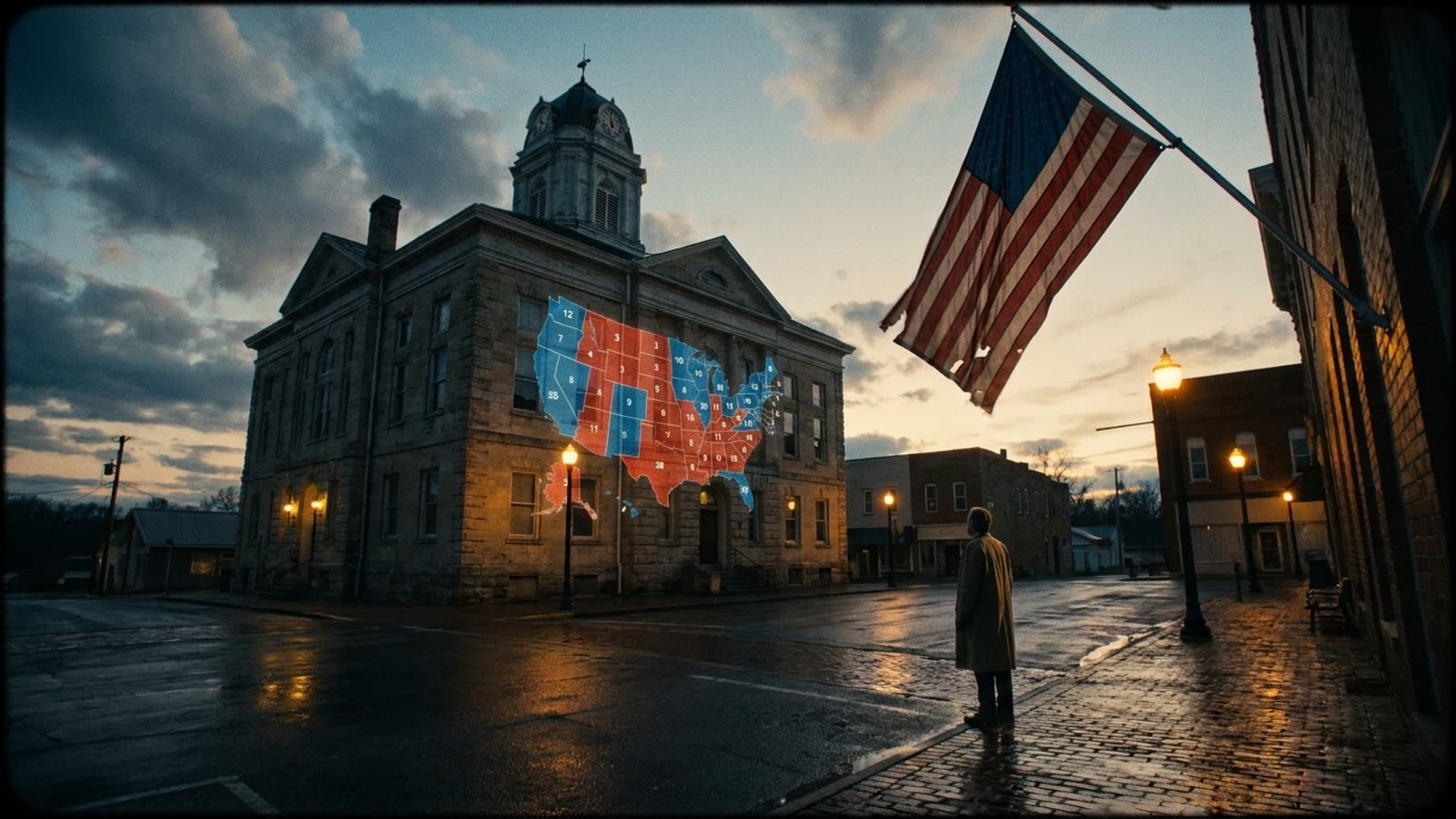
The deliberative vision collapsed almost immediately. By the election of 1800, electors had become party loyalists pledged to specific candidates. Today, the notion of a "faithless elector" exercising independent judgment is treated as a constitutional crisis rather than the system functioning as intended. What remains is the mechanical residue: 538 electoral votes allocated by state, with 48 states using winner-take-all rules that transform narrow pluralities into sweeping mandates.
This architecture creates the familiar distortions. Campaigns ignore safe states and saturate battlegrounds. A voter in Wisconsin exercises vastly more influence over the outcome than a voter in California. The system does not merely fail to reflect the popular will; it actively discourages participation in states where the outcome is predetermined.
Why reform fails
Amending the Constitution requires two-thirds of Congress and three-fourths of state legislatures—a threshold that gives small states veto power over any change that would diminish their disproportionate influence. The National Popular Vote Interstate Compact offers a workaround, with states pledging their electors to the national popular vote winner once enough states join to reach 270 electoral votes. Progress has been glacial, and the compact's constitutionality remains untested.
More fundamentally, the parties that benefit from the current system have no incentive to change it. The Electoral College is not a neutral mechanism that occasionally produces quirky results; it is a structural advantage for whichever coalition happens to be efficiently distributed across competitive states.
Our take
The Electoral College endures not because Americans believe in it but because the barriers to changing it are nearly insurmountable. It is a monument to compromises made by men who owned other human beings and feared the judgment of common citizens. Understanding this history does not resolve the democratic tension at the system's core, but it does clarify the stakes. The question is not whether the Electoral College is broken—it is whether a mechanism designed to constrain democracy should continue to do so in a nation that now claims to celebrate it.