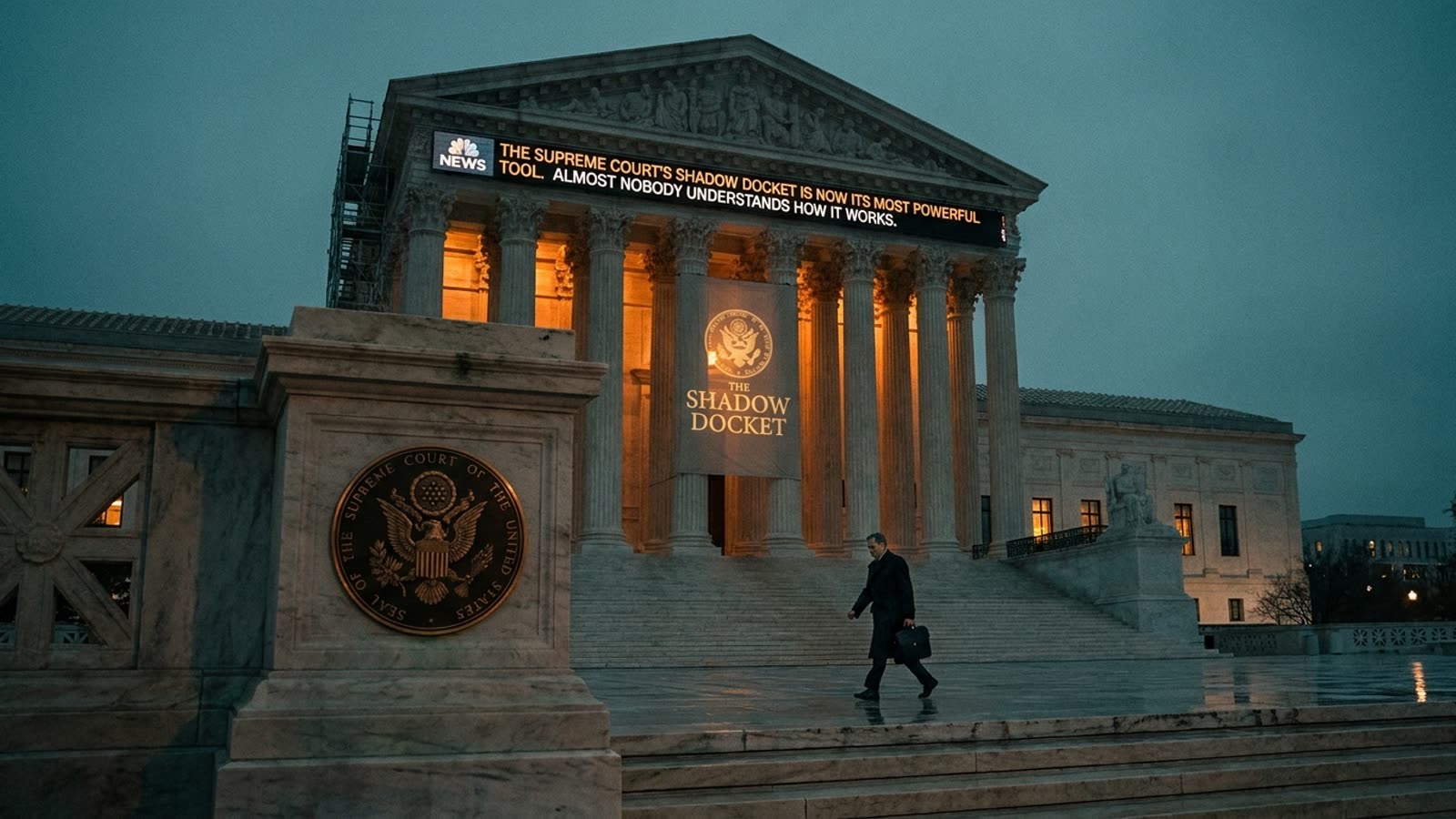
The Supreme Court's most consequential work increasingly happens in the dark. While the public fixates on blockbuster rulings delivered each June, the Court's emergency docket—what scholars now call the shadow docket—has become the primary vehicle for reshaping American law in real time, with minimal explanation and zero accountability.
The term itself is relatively new, coined by University of Chicago law professor William Baude in 2015, but the practice has ancient roots. Emergency applications have always existed for death penalty stays and other time-sensitive matters. What changed is scope, frequency, and ambition. Orders that once numbered in the dozens annually now arrive by the hundreds, and they no longer confine themselves to procedural housekeeping.
The mechanics of invisible power
When a party seeks emergency relief from the Supreme Court, the application typically lands first on the desk of the circuit justice—the individual justice assigned to that geographic region. That justice can grant or deny the request alone, or refer it to the full Court. If the full Court takes it up, the justices vote, usually within days or even hours. There is no oral argument. Briefing is truncated, sometimes to a matter of pages. And the resulting order—often a single paragraph, sometimes a single sentence—carries the force of law without explaining why.
This matters enormously because these orders frequently involve stays of lower court rulings, which effectively determine outcomes. A law blocked for two years while litigation proceeds may never recover politically even if ultimately upheld. A policy allowed to take effect during appeal becomes entrenched. The shadow docket lets the Court pick winners and losers while maintaining plausible deniability about the merits.
Why justices prefer the shadows
The appeal is obvious: speed without commitment. A full merits decision requires months of preparation, oral argument, conference deliberation, opinion drafting, and the circulation of concurrences and dissents. It creates a permanent record that future courts must grapple with. Shadow docket orders do none of this. They resolve the immediate dispute, signal the Court's sympathies to lower courts, and leave almost no doctrinal fingerprints.
For a Court wary of appearing political, this is convenient. Justices can reshape abortion access, immigration enforcement, voting rules, and pandemic restrictions without ever having to articulate a coherent legal theory. When critics complain, the response is always the same: these are merely procedural interventions, not decisions on the merits. The distinction has become a legal fiction that everyone inside the building understands and nobody outside it believes.
The accountability vacuum
The shadow docket's rise coincides precisely with the Court's declining public approval, and this is not coincidental. Democratic legitimacy depends on reasoned explanation. When nine unelected lawyers exercise veto power over the elected branches, the minimum expectation is that they say why. The shadow docket abandons this expectation entirely.
Lower court judges, meanwhile, are left to divine meaning from silence. A stay granted without explanation becomes a Rorschach test: did five justices think the lower court was wrong on the law, or merely that the equities favored a pause? Nobody knows, and the justices seem content with the ambiguity.
Our take
The shadow docket is not a bug in the system; it is the system working exactly as the current majority prefers. It allows the Court to exercise maximum power with minimum transparency, reshaping American law through procedural maneuvers that evade the scrutiny applied to merits decisions. The solution is straightforward—require written explanations for all orders affecting substantive rights—but it will never come from within. The justices have discovered that darkness is comfortable, and they have no intention of turning on the lights.