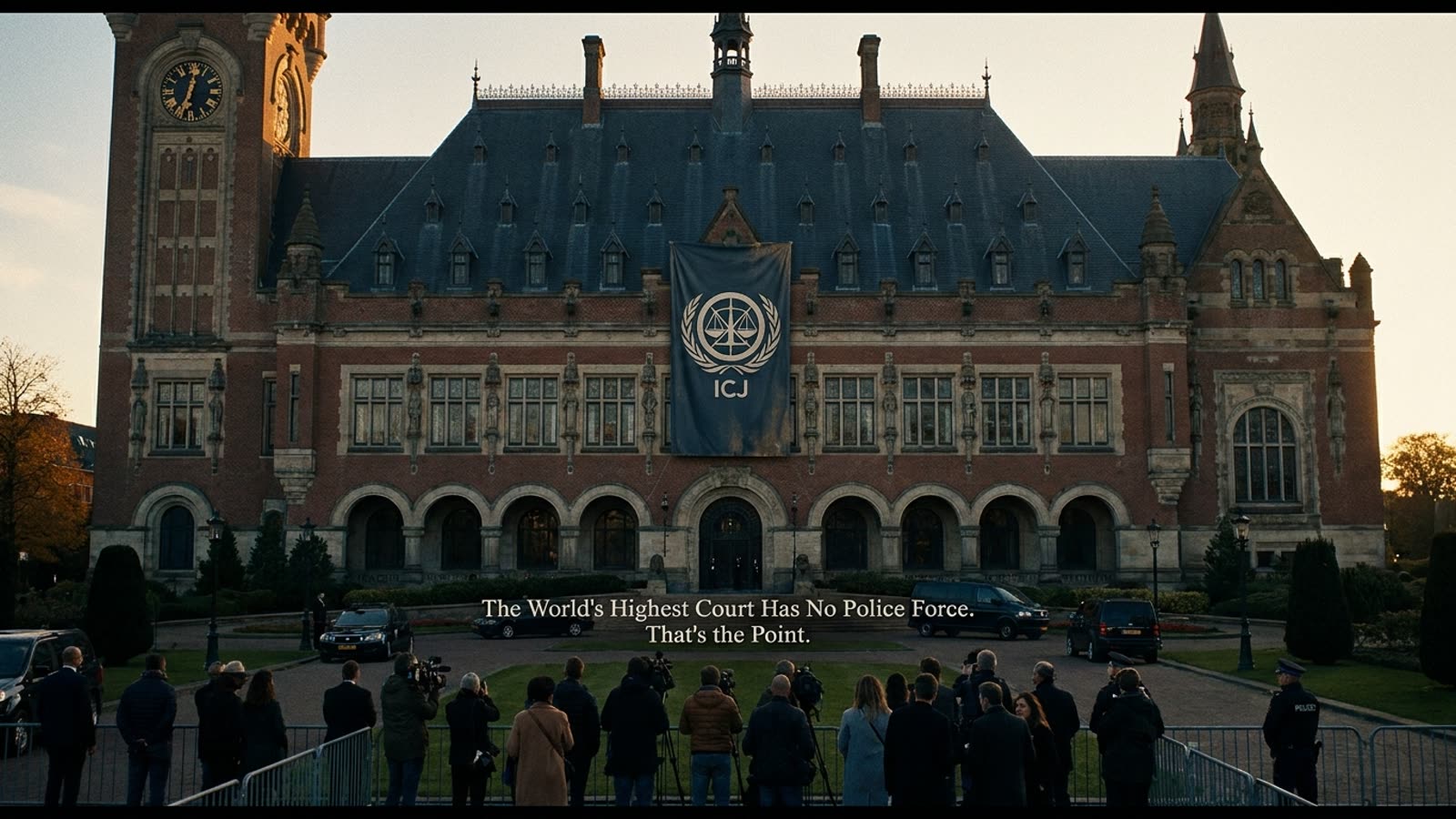
When a nation sues another nation, the case lands on the desks of fifteen judges in a Dutch palace, and the entire enforcement mechanism consists of moral suasion and the theoretical possibility that the UN Security Council might do something about it. This arrangement strikes most people as either charmingly naive or functionally useless. Both reactions miss what the International Court of Justice actually does.
The ICJ, seated in the Peace Palace in The Hague since 1946, is the principal judicial organ of the United Nations. It hears two types of cases: contentious disputes between states that have consented to its jurisdiction, and advisory opinions requested by UN bodies. It cannot prosecute individuals for war crimes (that's the separate International Criminal Court down the road), cannot hear cases brought by private citizens, and cannot compel any state to appear before it. These limitations are not bugs in the system. They are the system.
The architecture of voluntary submission
The court's jurisdiction rests on consent, which can arrive through several doors. States may accept the court's compulsory jurisdiction in advance through declarations under Article 36 of the ICJ Statute — roughly seventy nations have done so, though often with significant reservations. Alternatively, states can agree to jurisdiction through bilateral treaties, multilateral conventions with dispute-resolution clauses, or special agreements for specific cases. The United States famously withdrew its compulsory jurisdiction acceptance in 1986 after the court ruled against it in the Nicaragua case. It still appears before the court when treaty obligations require it.
This opt-in architecture frustrates those who want international law to function like domestic law. But it reflects a basic truth about sovereignty: states powerful enough to ignore international judgments will do so when core interests are threatened, regardless of what any charter says. The court's designers understood this. They built an institution that could accumulate legitimacy precisely because it doesn't pretend to powers it cannot exercise.
What compliance actually looks like
The conventional criticism holds that ICJ rulings are toothless because they lack enforcement mechanisms. The record is more complicated. Studies of ICJ judgments show that states comply fully or substantially in the majority of cases — not because they fear punishment, but because the reputational costs of defiance are real and because most cases that reach judgment involve disputes where both parties have already signaled willingness to accept an outcome. The cases of dramatic non-compliance tend to involve existential security concerns or great powers protecting client states.
The court's provisional measures — emergency orders issued before final judgment — have become increasingly significant. These carry legal binding force, as the court clarified in the LaGrand case, and create immediate pressure on states to halt contested actions. Whether states comply varies, but the measures establish a legal baseline that shapes diplomatic negotiations and third-party responses.
The long game of international adjudication
The ICJ's influence operates on timescales that frustrate news cycles. Its rulings on maritime boundaries, territorial disputes, and treaty interpretation become reference points that structure negotiations for decades. The court's advisory opinion on the legality of nuclear weapons, delivered in 1996, remains a touchstone in disarmament debates. Its rulings on genocide conventions have shaped how states frame accusations and defenses in subsequent conflicts.
The fifteen judges — elected by the UN General Assembly and Security Council to nine-year terms, with no two from the same country — develop a jurisprudence that evolves slowly and cautiously. The court is institutionally conservative, reluctant to make sweeping pronouncements, attentive to the limits of what states will accept. This caution is strategic. An international court that consistently overreached would find its docket empty within a generation.
Our take
The ICJ works because it doesn't try to be what it cannot be. It offers states a dignified exit from disputes that have become too costly to sustain, provides legal frameworks that make future conflicts marginally less likely, and maintains a continuous assertion that international law exists and means something. The court's critics want it to be a world government with a standing army. Its defenders understand that the choice is between this modest institution and nothing at all. In a system of sovereign states, that's not nothing — it's the architecture of whatever order we have.