Every four years, Americans rediscover that they do not directly elect their president, and every four years they are freshly outraged. The Electoral College has become a punching bag for reformers who see it as an anachronistic barrier to democracy and a sacred totem for defenders who view it as the republic's last guardrail against mob rule. Both camps tend to misunderstand what the system actually does and why it has proven so resistant to change.
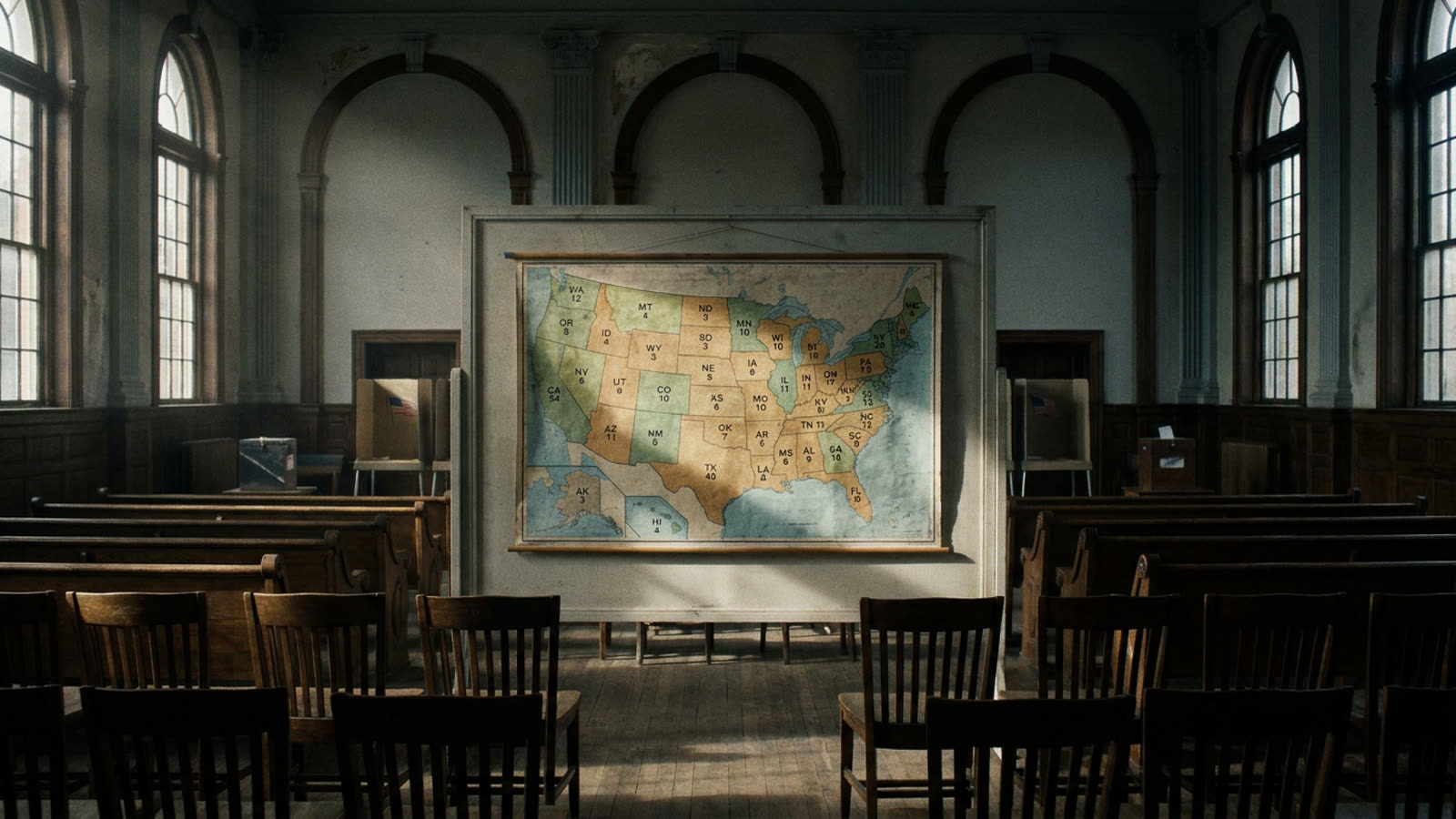
The mechanism itself is deceptively simple. Each state receives electoral votes equal to its congressional delegation — two senators plus however many representatives its population warrants. The District of Columbia, thanks to the Twenty-Third Amendment, gets three. This produces 538 total electors, meaning 270 wins the presidency. In practice, 48 states and Washington award all their electors to whichever candidate wins the statewide popular vote; only Maine and Nebraska split theirs by congressional district.
The Philadelphia compromise
The Constitutional Convention of 1787 considered and rejected both direct popular election and selection by Congress. The delegates' solution was characteristically baroque: a temporary body of electors, chosen however each state legislature saw fit, would convene once, vote, and dissolve. The founders imagined these electors as deliberative figures exercising independent judgment. That vision died almost immediately. By 1800, electors had become party loyalists pledged to specific candidates, and the rise of the winner-take-all system — adopted state by state to maximize local influence — transformed the Electoral College into something its designers never anticipated.
The small-state advantage is real but often overstated. Wyoming's roughly 580,000 residents get three electoral votes, or one per 193,000 people; California's 39 million get 54 votes, or one per 722,000 people. Yet this arithmetic matters less than the winner-take-all rule, which makes a handful of competitive states the only real battleground. A Republican vote in Massachusetts and a Democratic vote in Oklahoma are equally irrelevant to the outcome.
Why reform keeps failing
More than 700 proposals to abolish or reform the Electoral College have been introduced in Congress. None has succeeded, and the reason is structural rather than ideological. Any constitutional amendment requires two-thirds of both chambers and three-fourths of state legislatures. Small states have no incentive to surrender their slight overrepresentation, and whichever party benefits from the current map — a designation that shifts over decades — has no incentive to change it. The National Popular Vote Interstate Compact, an ingenious workaround in which states pledge their electors to the national popular vote winner, has been adopted by jurisdictions totaling 209 electoral votes. It needs 270 to take effect, and the remaining states are almost uniformly those where the compact would disadvantage the locally dominant party.
The system's defenders argue it forces candidates to build geographically diverse coalitions and protects federalism. Its critics counter that it effectively disenfranchises the majority of voters who live in non-competitive states and has twice this century installed presidents who lost the popular vote. Both arguments contain truth, which is precisely why the debate never resolves.
Our take
The Electoral College is neither a democratic outrage nor a stroke of genius — it is a negotiated settlement from a pre-industrial era that has calcified into something its creators would not recognize. The real question is not whether it is fair but whether Americans possess the political will to change any constitutional structure, ever. The answer, for now, is no. The system persists not because it is beloved but because it is entrenched, and in American governance, entrenchment is its own form of legitimacy.