Patent law was supposed to be automation-proof. The field demands mastery of both technical subject matter and legal doctrine, the ability to translate engineering concepts into claims language that will survive litigation, and the judgment to navigate the peculiar bureaucracy of patent offices worldwide. It requires, in short, exactly the kind of hybrid expertise that machines were never supposed to replicate.
That assumption is aging poorly.
The quiet revolution in prior art
The most labor-intensive task in patent prosecution has always been the prior art search—the exhaustive trawl through existing patents, academic literature, and technical documentation to determine whether an invention is actually novel. Junior associates once spent weeks on these searches, billing handsomely while developing the pattern recognition that would eventually make them valuable partners.
Today, AI systems can perform comparable searches in hours. They scan millions of documents, identify semantic similarities that keyword searches miss, and flag potential conflicts with a thoroughness that human reviewers struggle to match. The technology is not perfect—it still requires experienced attorneys to evaluate results and make judgment calls—but it has fundamentally altered the economics of patent work. What once justified substantial associate billing now barely warrants paralegal time.
The downstream effects are rippling through firm structures. Several major intellectual property practices have quietly reduced their associate classes while investing heavily in AI tools. Partners who built careers on their ability to supervise large teams of junior lawyers are discovering that the teams have shrunk beneath them.
Drafting and the illusion of creativity
More surprising is AI's encroachment on patent drafting itself. Writing patent claims was long considered an art form—the careful construction of language broad enough to provide meaningful protection but specific enough to survive examination. It demanded creativity, strategic thinking, and deep familiarity with how patent offices interpret particular phrasings.
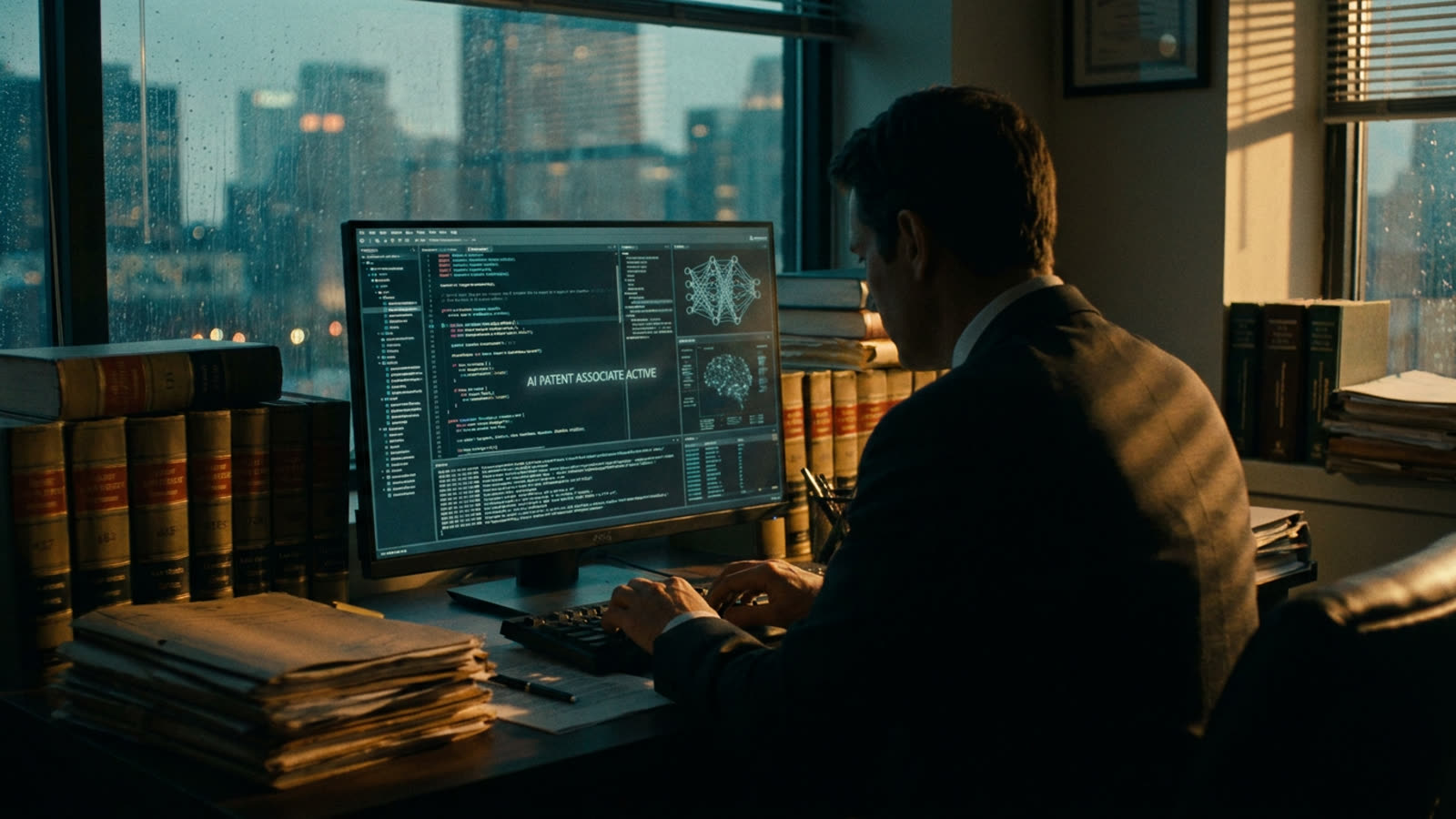
Current AI systems can now generate serviceable first drafts of patent applications from technical descriptions. They have absorbed decades of granted patents and can mimic the linguistic patterns that tend to succeed. The output still requires substantial human revision, particularly for complex inventions or strategically important filings. But the starting point has shifted. Attorneys increasingly find themselves editing AI-generated text rather than creating from scratch.
This raises an uncomfortable question: how much of patent drafting was genuine expertise, and how much was pattern-matching dressed up as craft? The answer matters for how the profession values its practitioners and trains its successors.
What remains irreducibly human
Not everything has yielded to automation. Client counseling—helping inventors understand what is worth patenting and why—still demands human judgment about business strategy, competitive dynamics, and risk tolerance. Litigation, with its adversarial complexity and procedural maneuvering, remains largely beyond AI's current capabilities. And prosecution interviews, where attorneys negotiate directly with patent examiners, require the kind of real-time persuasion that machines cannot yet manage.
The profession is bifurcating. Routine patent work is becoming cheaper and faster, which benefits clients and arguably expands access to intellectual property protection. But the premium on genuinely strategic advice is increasing. Attorneys who can integrate AI tools while providing judgment that machines cannot replicate are thriving. Those whose value proposition was primarily volume are finding the ground shifting beneath them.
Our take
Patent law offers a preview of how AI will reshape knowledge work more broadly. The technology does not eliminate expertise so much as expose which parts of expertise were always mechanical. The attorneys adapting best are those honest enough to recognize what they actually contributed versus what they merely performed. That self-awareness, ironically, may be the most human skill of all.