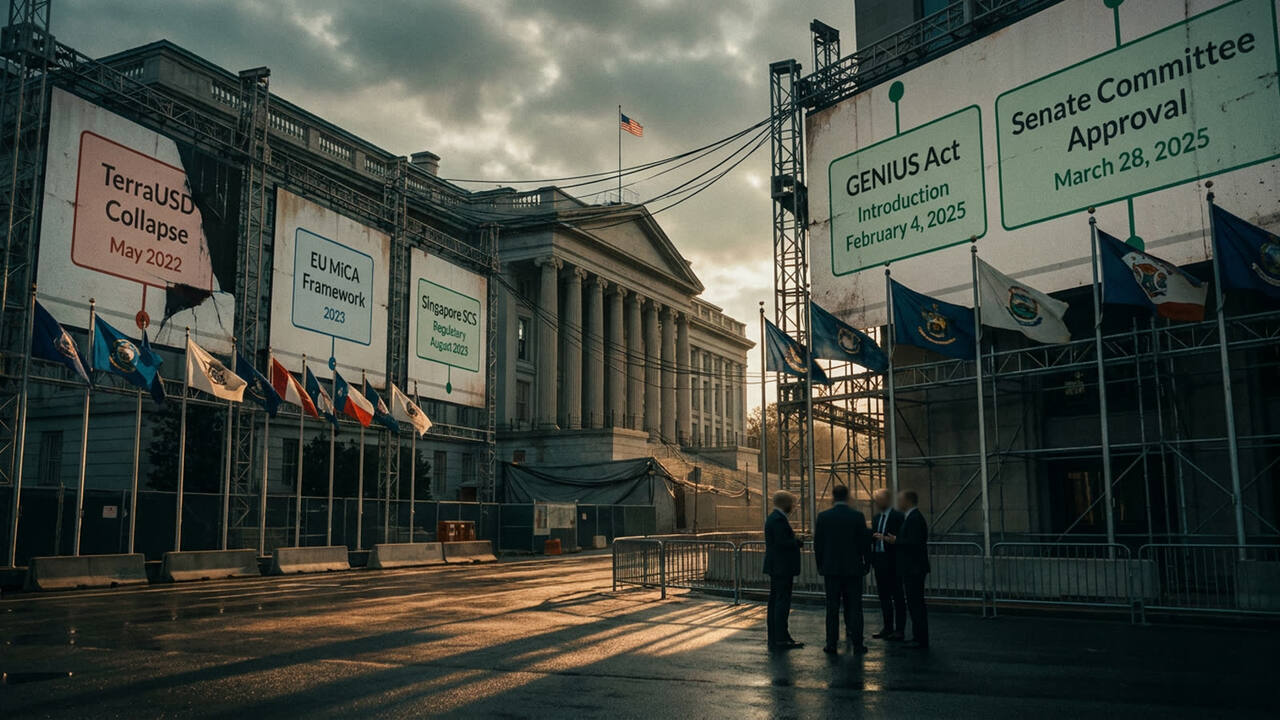
The GENIUS Act was supposed to be the moment Washington finally got serious about stablecoin regulation. Now it risks becoming another lesson in how federal agencies quietly expand their turf at the expense of functioning state systems.
A bipartisan coalition of US senators has sent a pointed letter to Treasury Secretary Scott Bessent, urging the department not to sideline state regulators as it implements the Guiding and Establishing National Innovation for US Stablecoins Act. The concern is straightforward: Treasury appears inclined to interpret the law in ways that would effectively federalize stablecoin oversight, despite explicit statutory language preserving state authority.
The regulatory turf war
The GENIUS Act, which passed with rare bipartisan support earlier this year, was designed as a dual-track system. Large stablecoin issuers—those with market caps exceeding $10 billion—would fall under federal oversight through the Office of the Comptroller of the Currency. Smaller issuers could choose state-level regulation, provided their home states met baseline federal standards.
This was not an accident. States like New York, Wyoming, and Texas have spent years building sophisticated digital-asset regulatory frameworks. New York's BitLicense, whatever its critics say about compliance costs, has become a de facto global standard. Wyoming's special-purpose depository institution charter has attracted serious institutional interest. The senators' letter argues that Treasury's draft guidance threatens to render these frameworks irrelevant.
Why states matter here
The case for preserving state authority goes beyond federalism pieties. State regulators have developed genuine expertise in digital-asset supervision—expertise the federal government largely lacks. The OCC has supervised exactly zero stablecoin issuers at scale. State money-transmitter examiners, by contrast, have years of experience with the operational realities of crypto custody, reserve management, and redemption mechanics.
There is also a competition argument. A purely federal regime would likely favor the largest incumbents—Circle, Tether, and whichever bank-backed entrants emerge. State-level pathways keep the door open for smaller, innovative issuers who cannot afford the compliance apparatus that federal supervision demands. The senators' letter explicitly invokes this concern, warning that Treasury's approach could "entrench existing market participants at the expense of competition."
Our take
Treasury's instinct to centralize is understandable—stablecoins are increasingly systemic, and the last thing regulators want is a race to the bottom among permissive state charters. But the GENIUS Act's compromise was carefully negotiated, and the states that have taken digital-asset regulation seriously deserve better than a bureaucratic end-run. If Treasury wants a purely federal regime, it should ask Congress for one. Until then, the law means what it says.