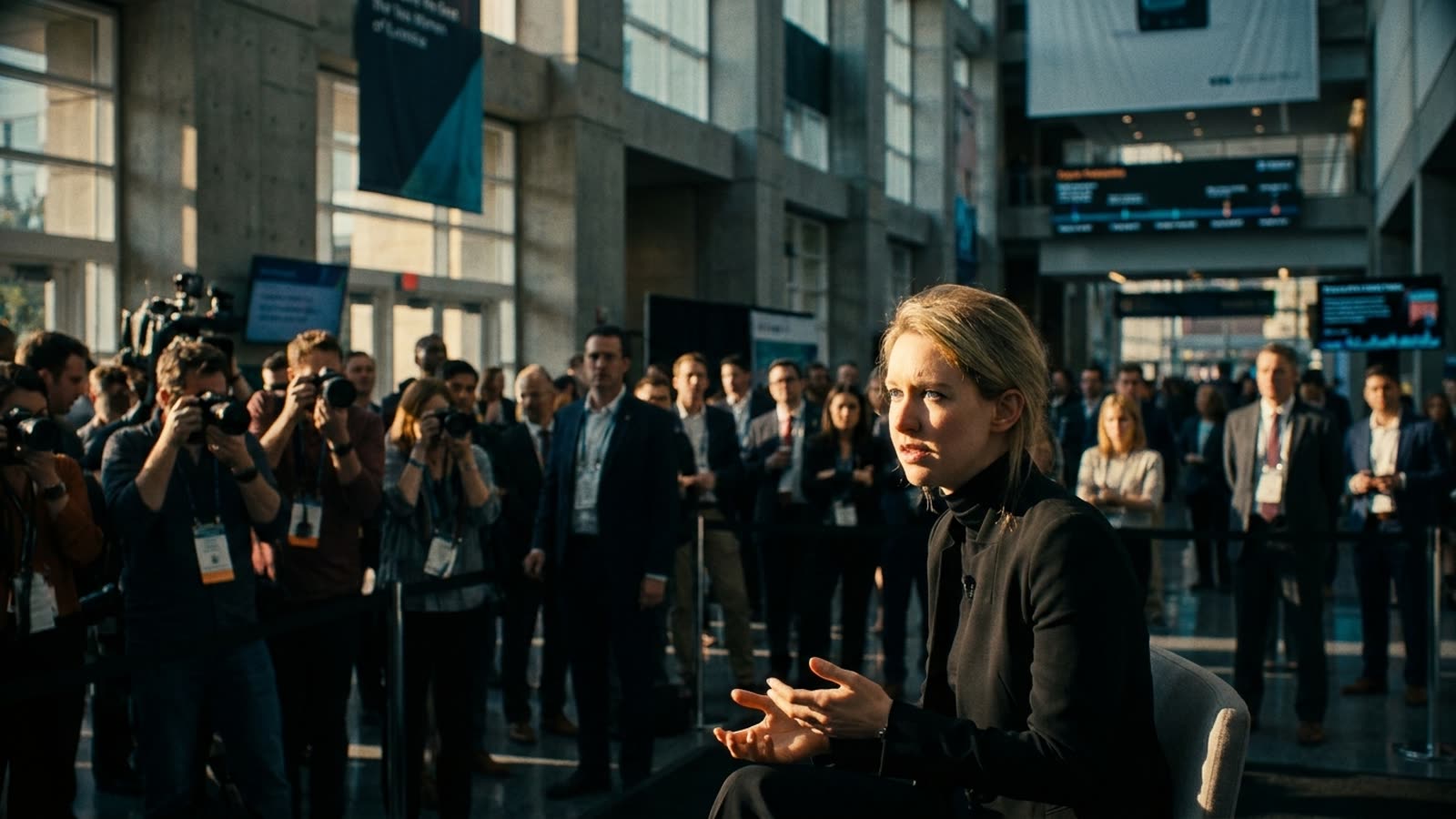
The most unsettling moment in Alex Gibney's new Elizabeth Holmes documentary isn't the fraud, the ruined lives, or even the footage of Holmes practicing her infamous baritone in front of a mirror. It's Charlie Kirk, the Turning Point USA founder, appearing on screen to declare that Holmes was "railroaded by the deep state" and that Theranos "probably worked."
This is where "You Can See Everything," A24's surprise Telluride premiere now in theatrical release, transcends the true-crime documentary formula. Gibney, whose previous work includes the Enron exposé "The Smartest Guys in the Room," understands that the Holmes story stopped being about blood-testing technology years ago. It's about what happens when a society loses the ability to distinguish between vision and delusion.
The uncomfortable intimacy
The documentary's title refers to its most controversial element: previously unseen footage that includes Holmes in states of undress, material reportedly obtained from her former partner Sunny Balwani's personal archives. The full-frontal nudity has generated predictable outrage, but Gibney's deployment of it serves a deliberate purpose—stripping away the black turtleneck mythology to reveal the person beneath the performance.
What emerges is neither the girlboss icon nor the cartoon villain, but something more recognizable and therefore more troubling: a true believer who convinced herself before she convinced anyone else. The film suggests Holmes's greatest deception was self-deception, which makes her less exceptional and more representative of a particular American archetype.
The complicity question
Gibney reserves his sharpest critique not for Holmes but for the ecosystem that enabled her: the venture capitalists who didn't ask basic questions, the board members—including Henry Kissinger and George Shultz—who lent credibility without conducting diligence, the journalists who amplified the myth, and the regulators who arrived years too late.
The Kirk cameo, brief as it is, crystallizes the film's thesis. Even after conviction and imprisonment, Holmes retains defenders who view her prosecution as persecution. The documentary asks whether a culture that produces both Elizabeth Holmes and her post-conviction apologists has any capacity for learning.
Our take
The film is not easy viewing, and it shouldn't be. Gibney has made a documentary that refuses to let audiences enjoy the schadenfreude of watching a fraudster fall. By the end, you're implicated too—in the worship of founders, the suspension of skepticism, the willingness to believe that someone in a black turtleneck might actually change the world. Holmes is serving her sentence. The conditions that created her remain at large.