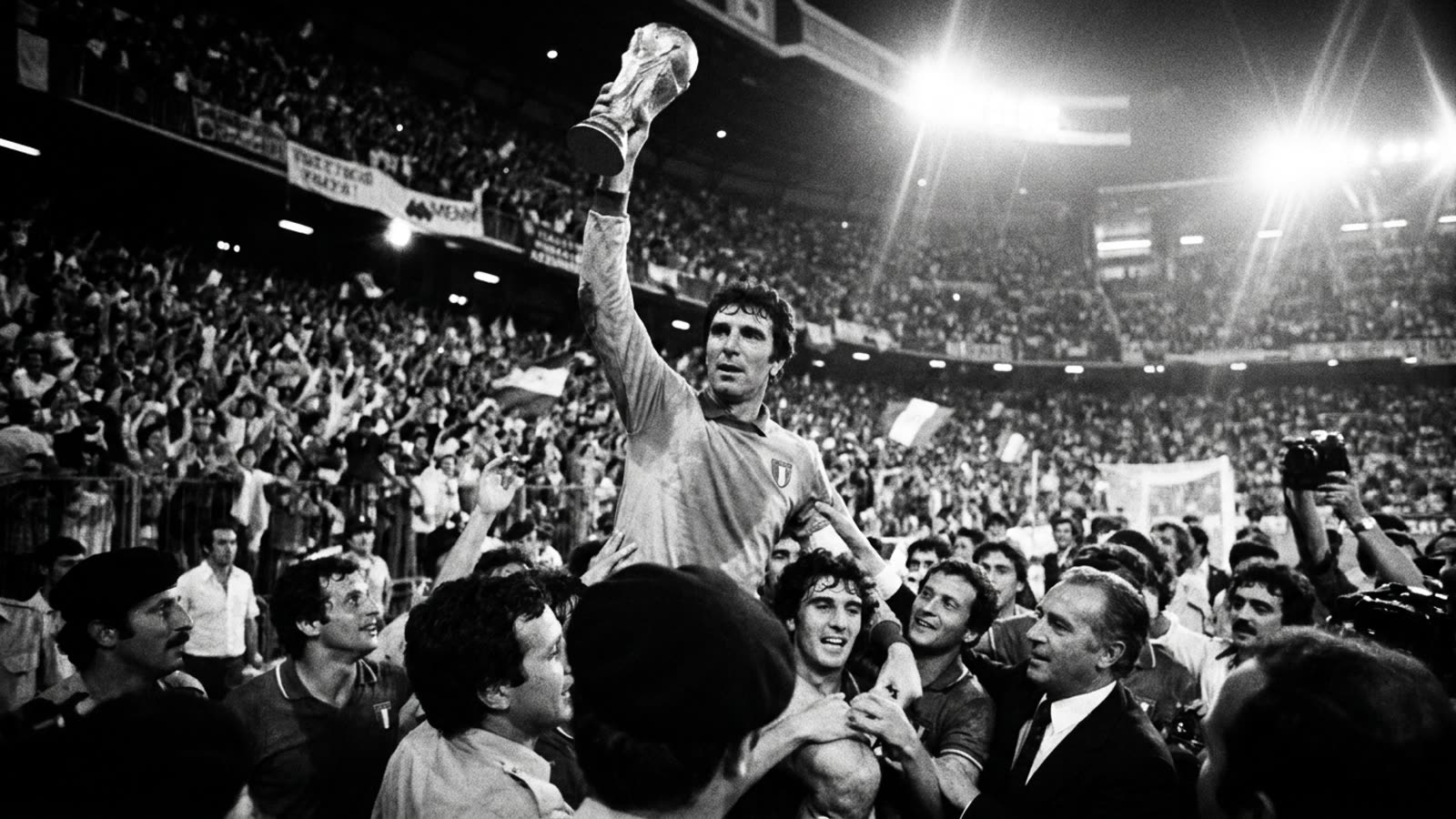
Goalkeepers age differently. Outfield players lose a yard of pace and retire; goalkeepers lose a yard and become better judges of angles. Dino Zoff, who captained Italy to the 1982 World Cup title at 40 years and 133 days, understood this better than anyone. He remains the oldest player ever to lift the trophy, and the gap between him and the next-oldest winner—Nilton Santos, 37 in 1962—suggests his record will stand for decades more.
Zoff's triumph was not a sentimental farewell tour. Italy entered España '82 in crisis: a match-fixing scandal had tarnished Serie A, the squad was ageing, and the group stage produced three draws. Zoff conceded goals to Poland, Peru, and Cameroon but never panicked. In the second round, Italy dismantled Argentina and Brazil in successive matches—Paolo Rossi scored five goals, but Zoff's saves against Zico and Maradona were the foundation. The final against West Germany was scoreless until the 57th minute; Italy won 3-1, and Zoff, grey-haired and expressionless, became the oldest World Cup winner in history.
The goalkeeper as monument
Zoff's career spanned 22 years at the top level, most of it with Juventus, where he won six Serie A titles and a UEFA Cup. Between 1972 and 1974, he went 1,142 minutes without conceding a goal in international football—a record that still stands. He was not athletic in the modern sense; he did not dive theatrically or punch balls into the stands. He positioned himself correctly, caught crosses, and distributed the ball with minimal fuss. His game was about eliminating risk, not courting glory.
This approach aged well. By 1982, Zoff had seen every type of striker, every set-piece variation, every referee quirk. He read the game faster than younger goalkeepers could move. When Brazil's Falcao unleashed a low shot in the second round, Zoff was already down, palms spread. When Karl-Heinz Rummenigge charged through in the final, Zoff narrowed the angle and made himself large. He made 112 appearances for Italy and never received a red card.
Why no one has matched him
Modern football is faster, more physical, and less patient with age. Clubs invest in younger goalkeepers earlier; international managers rotate squads to manage workload. The 1982 Italy team had five players over 30 in the starting XI; contemporary World Cup winners skew younger. Buffon came close—he was 38 at the 2006 final—but even he retired from international football before 40. Zoff played on until 41, retiring only after Italy failed to qualify for the 1984 Euros.
The record also reflects a shift in goalkeeper training. Zoff's generation learned by repetition and instinct; today's goalkeepers are coached on biomechanics, nutrition, and sports science from adolescence. They peak earlier and decline more predictably. Zoff's longevity was partly genetic, partly the product of an era when experience mattered more than explosiveness.
Our take
Zoff's World Cup win is a monument to the idea that football rewards wisdom as much as speed. He was not the most spectacular goalkeeper of his generation—Yashin, Banks, and Maier all had more highlight-reel moments—but he was the most reliable, and reliability wins tournaments. His record will likely stand until football slows down again, which is to say: indefinitely. The game has moved on, but no one has moved past him.