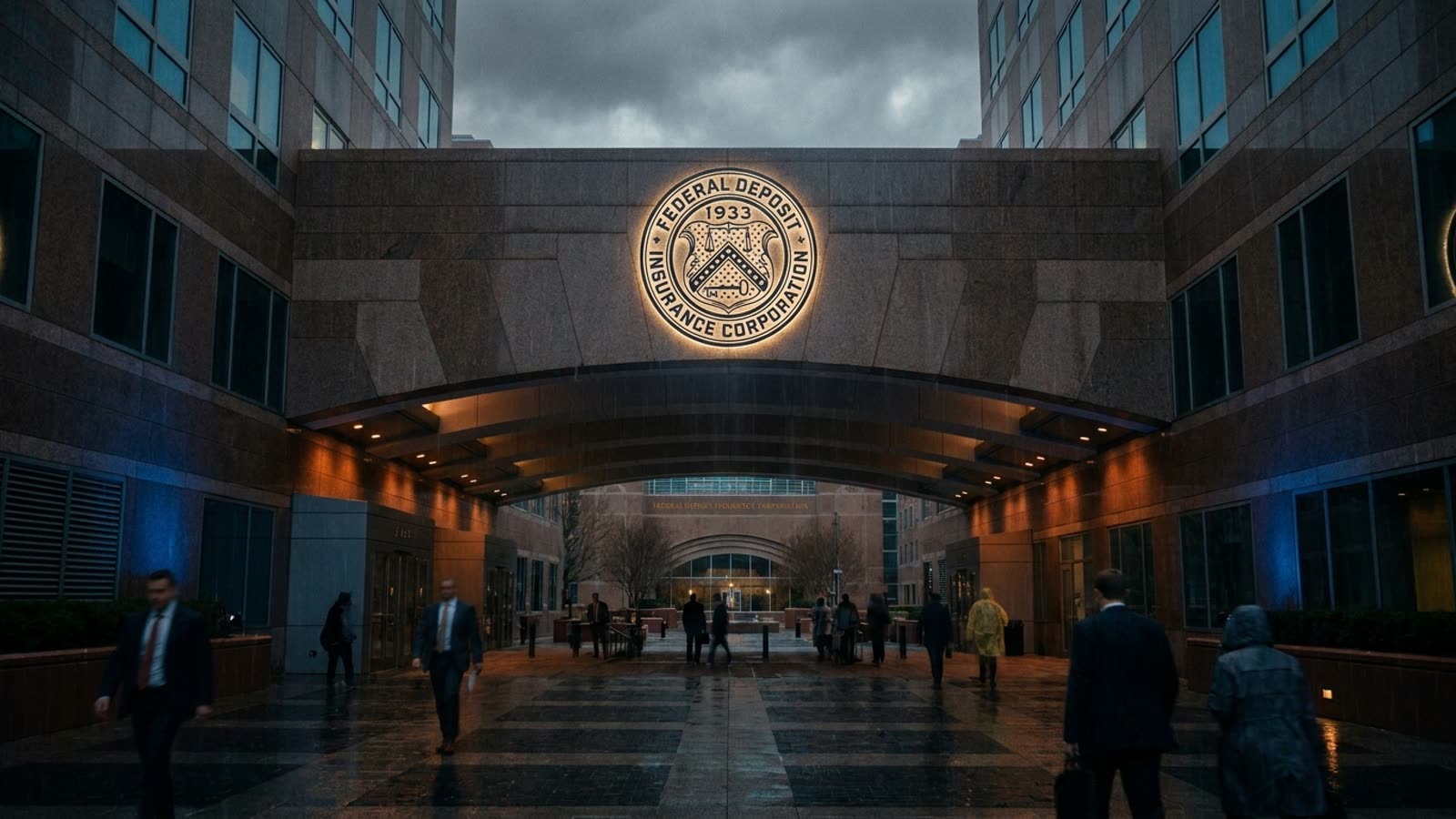
Banking is, at its core, a confidence trick in the most literal sense: it works only because people believe it will. Your bank does not keep your money in a vault with your name on it. It lends most of it out the moment you deposit it, keeping only a fraction on hand. This arrangement — fractional reserve banking — has powered economic growth for centuries. It has also, periodically, destroyed it. The innovation that finally tamed the bank run, that most destructive of financial pandemics, is deposit insurance: a government promise so effective that most people forget it exists.
The mechanics are deceptively simple. In the United States, the Federal Deposit Insurance Corporation guarantees deposits up to a statutory limit — currently $250,000 per depositor, per institution. If your bank fails, the FDIC pays you back, typically within days. Similar schemes exist in virtually every developed economy, from the UK's Financial Services Compensation Scheme to the European Union's harmonized deposit guarantee. The premiums funding these systems come not from taxpayers but from the banks themselves, assessed based on their deposit bases and risk profiles.
Why bank runs happen
Without deposit insurance, banking contains a fatal flaw. If depositors suspect their bank might fail, the rational response is to withdraw immediately — not because the bank is necessarily insolvent, but because being last in line means getting nothing. This creates a self-fulfilling prophecy: even a healthy bank cannot survive if all depositors demand their money simultaneously. The United States experienced over 9,000 bank failures between 1930 and 1933, many of them solvent institutions killed by panic rather than poor lending.
Deposit insurance breaks this doom loop by removing the incentive to run. If your deposits are guaranteed regardless of whether you withdraw today or next month, there is no advantage to being first. The mere existence of the guarantee prevents the scenario that would trigger it. This is why deposit insurance payouts, relative to the banking system's size, remain remarkably small in normal times.
The moral hazard trade-off
Deposit insurance solves one problem while creating another. If depositors face no risk of loss, they have no reason to scrutinize their bank's lending practices. Why check whether your bank is making reckless loans when the government will make you whole regardless? This is textbook moral hazard: insurance that encourages the very behavior it protects against.
Regulators address this through supervision, capital requirements, and risk-based premiums — banks that take more risks pay more into the insurance fund. But the tension never fully resolves. The savings and loan crisis of the 1980s demonstrated what happens when deposit insurance combines with lax oversight and perverse incentives: institutions gambled with insured deposits, knowing taxpayers would absorb the losses. The eventual cleanup cost exceeded $120 billion.
The coverage ceiling matters
The $250,000 limit is not arbitrary. It aims to protect ordinary savers while leaving large depositors — corporations, wealthy individuals, institutional investors — with skin in the game. Uninsured depositors, the theory goes, will monitor bank health and flee at the first sign of trouble, imposing market discipline that complements regulatory oversight.
This theory collides with reality when a bank's failure threatens broader contagion. When Silicon Valley Bank collapsed in early 2023, regulators invoked a systemic risk exception to guarantee all deposits, not just those under the limit. The precedent raises uncomfortable questions. If large depositors believe they will always be rescued, the coverage ceiling becomes fiction, and moral hazard expands to the entire deposit base.
Our take
Deposit insurance represents a rare case of financial engineering that actually works as intended — most of the time. It transformed banking from a perpetual confidence crisis into something resembling a utility. But its success depends on a delicate calibration: enough coverage to prevent runs, not so much that it subsidizes recklessness. The recent habit of rescuing uninsured depositors whenever a failure looks scary enough threatens that balance. Either the coverage limit means something, or it does not. Pretending otherwise invites the worst of both worlds: the complacency of full insurance with none of the fiscal honesty.