Football has always struggled to celebrate what doesn't happen. Goals are replayed endlessly, assists are tracked to decimal points, and expected goals models have turned attacking football into a quantifiable science. But the art of stopping all that—the perfectly timed slide tackle, the body position that closes a passing lane before the attacker even sees it—remains stubbornly resistant to metrics. Paolo Maldini spent a quarter-century at the highest level proving that defending could be just as beautiful as scoring, and the sport's ongoing inability to properly value his craft says something uncomfortable about what we choose to see.
The geometry of anticipation
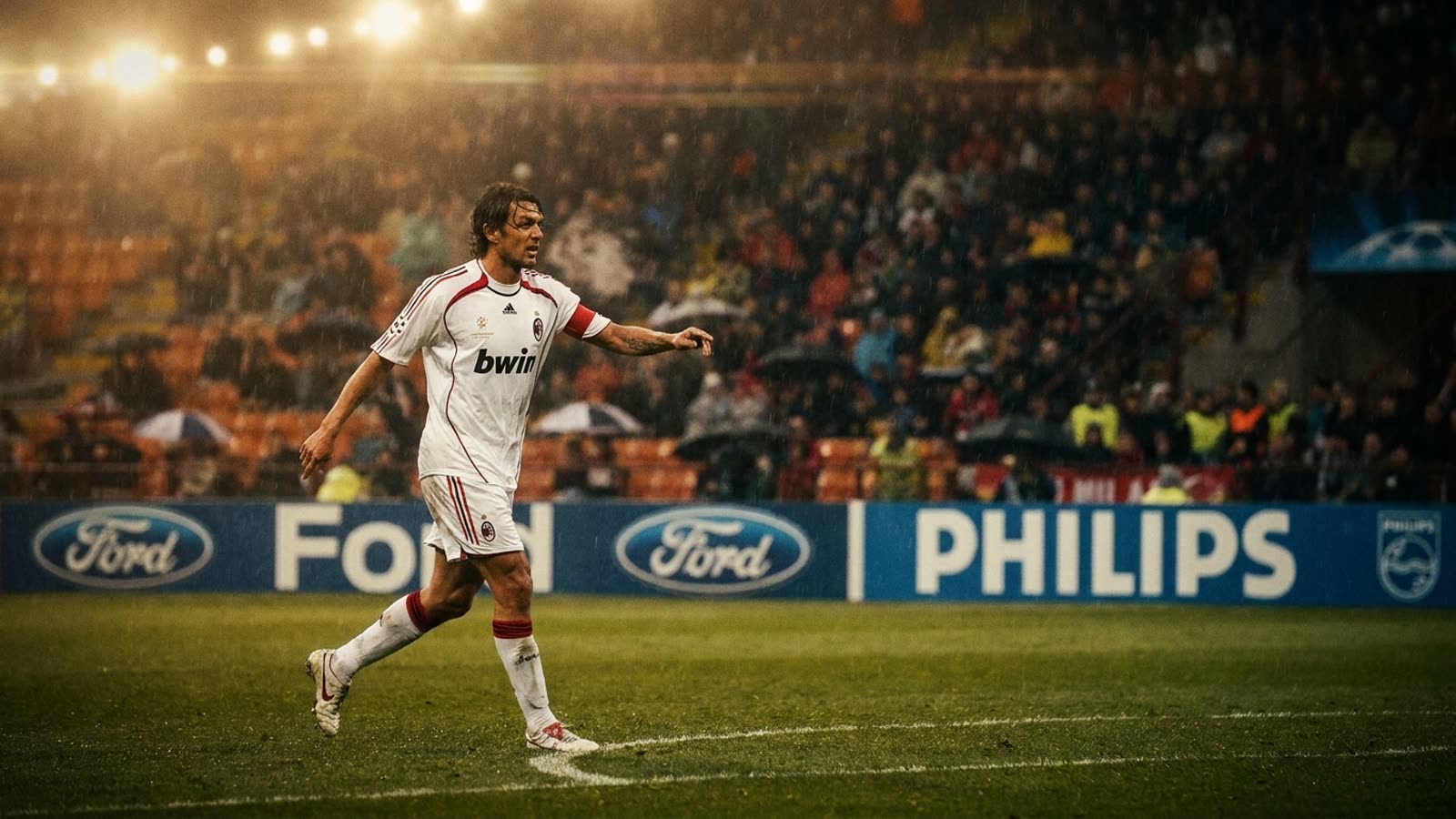
Maldini's signature was making the difficult look inevitable. Where other defenders relied on recovery pace or physical intimidation, the Italian operated through spatial intelligence—reading the geometry of attacks before they fully formed. His famous observation that "if I have to make a tackle, I have already made a mistake" wasn't false modesty; it was a genuine philosophy of positioning so precise that contact became unnecessary. Attackers would find themselves herded into dead ends, their options quietly eliminated by a defender who seemed to exist slightly ahead of time. This anticipatory style meant Maldini rarely appeared in highlight reels. His greatest moments were defined by their absence—the crosses that were never delivered, the through balls that died in the space he had already occupied.
The longevity paradox
That Maldini played at elite level until age 41 remains one of football's most underexamined achievements. His career at AC Milan spanned 1985 to 2009, encompassing five Champions League finals and 126 appearances for Italy. Unlike forwards who can compensate for declining pace with experience, defenders face an unforgiving physical reality: the moment they lose a step, strikers exploit it mercilessly. Maldini's solution was to have never relied on that step in the first place. His game was built on cognitive rather than athletic foundations, which meant the usual decline curve simply didn't apply. By his late thirties, he was still starting Champions League knockout matches, his reading of the game having deepened even as his body aged.
The inheritance question
Modern football has produced exceptional defenders—Virgil van Dijk's aerial dominance, Sergio Ramos's competitive fury—but none who quite replicate Maldini's particular elegance. The tactical evolution toward high pressing and aggressive defensive lines has created a different archetype: defenders who are essentially auxiliary midfielders, valued for their passing range and comfort on the ball. This isn't a decline in quality, but it is a shift in aesthetics. The patient, positional defending that Maldini perfected requires a team structure that modern managers rarely employ. His style has become not obsolete exactly, but orphaned—still theoretically possible, just no longer supported by the surrounding system.
Our take
The difficulty of appreciating Maldini's greatness is the difficulty of appreciating all defensive excellence: it requires noticing absence rather than presence. We remember Ronaldo's dribbles and Zidane's pirouettes because they happened; we forget the countless attacks that Maldini quietly suffocated because they didn't. This is a bias built into how we watch football, and it's one the sport has made little effort to correct. Maldini's career stands as both a monument to defensive artistry and a reminder of how poorly we reward it. The game's most elegant defender spent decades proving that prevention could be poetry. We still haven't developed the vocabulary to describe what he did.