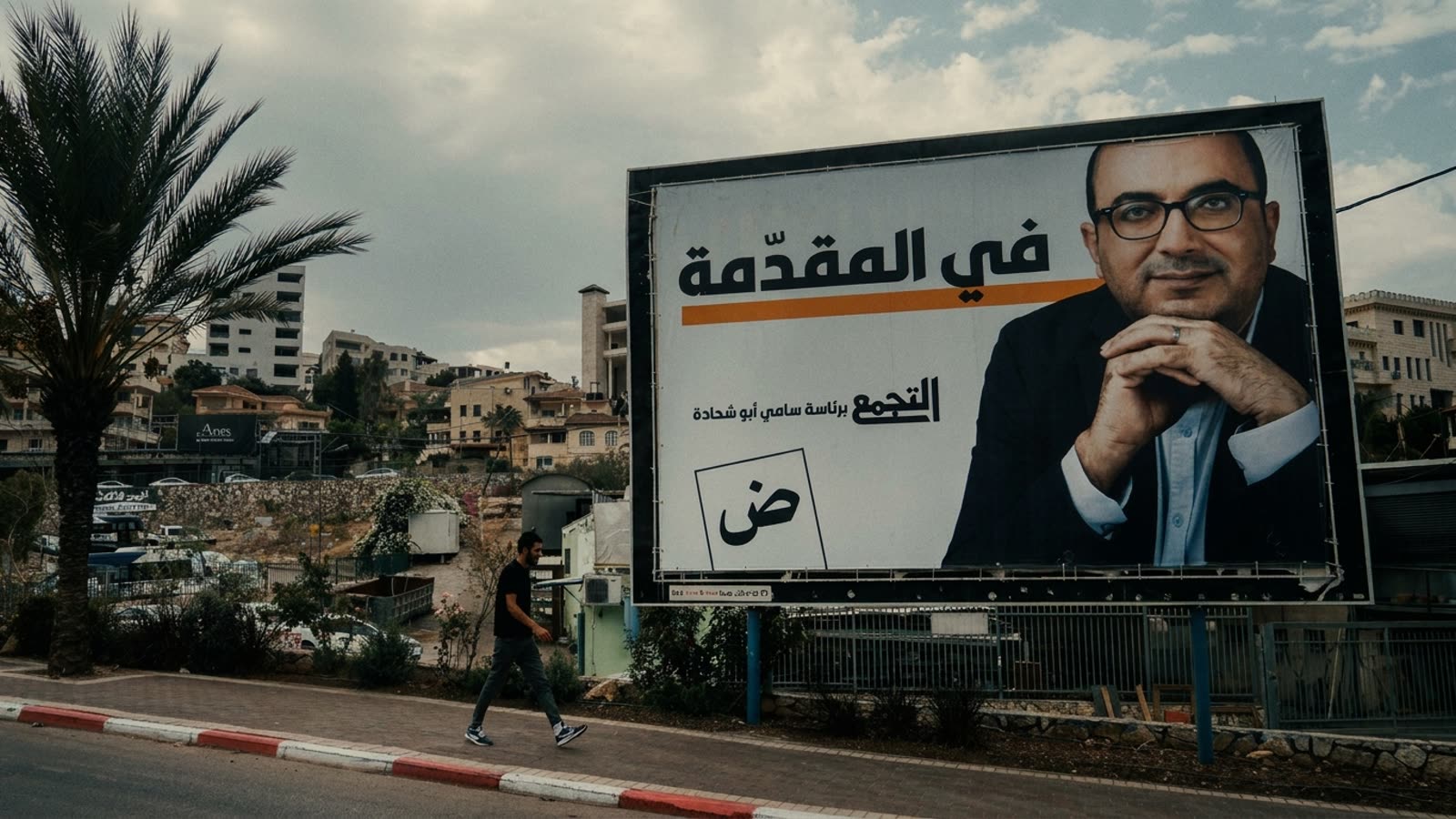
The most consequential story emerging from Israel's snap election is not the stalemate between Benjamin Netanyahu and Gadi Eisenkot—it is the eighteen seats now projected for Arab-led parties, a result that rewrites the arithmetic of Israeli coalition-building and challenges decades of political marginalization.
With exit polls showing both major blocs stuck at roughly 51 seats each, well short of the 61 needed for a governing majority, the Joint List and its allies have vaulted from perpetual outsiders to the most courted faction in the Knesset. The surge was powered by turnout figures that veteran pollsters called unprecedented: approximately 80 percent of eligible Palestinian citizens of Israel cast ballots, compared with historical averages hovering around 50 percent.
Why turnout exploded
The mobilization was not spontaneous. Grassroots campaigns in Nazareth, Umm al-Fahm, and the Negev Bedouin towns framed this election as existential, citing the previous government's judicial overhaul, the Gaza war's civilian toll, and creeping annexation rhetoric. Younger voters, many of whom sat out the 2022 and 2024 cycles, showed up in numbers that overwhelmed polling stations in mixed cities like Haifa and Jaffa. Social-media organizing—particularly on TikTok and WhatsApp—outpaced traditional party infrastructure.
The coalition calculus
Neither Netanyahu nor Eisenkot can form a stable government without either winning over defectors or, more radically, negotiating with the Arab bloc. Historically, Zionist parties have treated the Joint List as untouchable—too politically toxic to include in a coalition, too ideologically distant on security matters. That taboo now collides with mathematical reality. Eisenkot's center-left allies are already floating the idea of a minority government supported externally by Arab parties, a fragile arrangement that collapsed the Bennett-Lapid coalition in 2022 but may be the only path forward.
Netanyahu, meanwhile, faces the opposite problem: his natural partners—Religious Zionism, Jewish Power, and the ultra-Orthodox factions—are ideologically incompatible with any Arab participation, leaving him dependent on peeling off a single defector or forcing a fifth election in four years.
What the bloc wants
Arab party leaders have signaled they will not offer support cheaply. Their demands include a freeze on West Bank settlement expansion, increased infrastructure funding for Arab municipalities, and formal recognition of Bedouin villages in the Negev. Whether any Jewish-majority party is willing to pay that price—and whether its voters would tolerate the optics—remains the central question of the coming coalition talks.
Our take
Israel's political class spent years treating its Arab citizens as a demographic inconvenience rather than a constituency. That condescension now looks like strategic malpractice. Eighteen seats is not a protest vote; it is a bloc large enough to dictate terms. The next government, whatever its composition, will be shaped by voters whom the establishment spent decades ignoring. Democracy, it turns out, has a way of punishing contempt.