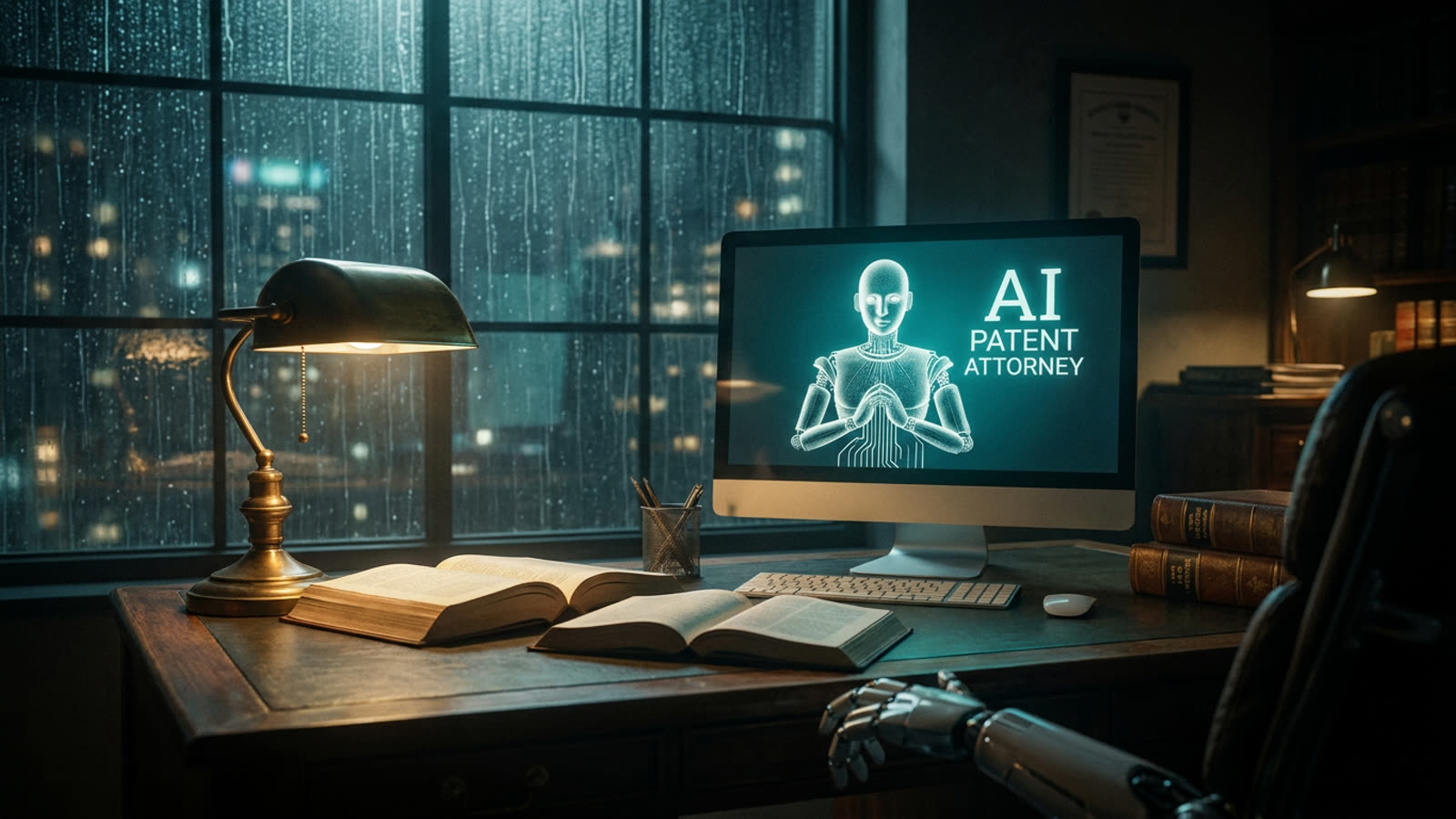
Patent law was meant to be the last redoubt. While contract review and legal research fell to automation years ago, patent prosecution — the arcane art of shepherding inventions through the United States Patent and Trademark Office — seemed immune. The work demands fluency in both law and deep technical domains: semiconductor physics, molecular biology, machine learning itself. Patent attorneys command salaries north of $200,000 precisely because their expertise is rare, hard-won, and supposedly irreplaceable. That assumption is now collapsing.
The transformation began not with headline-grabbing AI announcements but with quiet efficiency gains. Large language models, trained on millions of patent documents, can now draft initial patent claims in minutes rather than hours. They cross-reference prior art across databases that would take a human days to search. They flag potential obviousness rejections before examiners do. The work that once justified a patent attorney's hourly rate — the painstaking translation of an inventor's napkin sketch into legally defensible claims — is increasingly a matter of prompting and editing rather than original composition.
The expertise paradox
What makes patent law's transformation so instructive is that it inverts the conventional wisdom about AI-resistant professions. The standard reassurance has been that jobs requiring deep expertise, judgment, and creativity would remain human. Patent prosecution requires all three. Yet those very qualities make it vulnerable in unexpected ways.
Patent claims follow rigid syntactic conventions. The language is formulaic by design — "comprising," "wherein," "configured to" — because legal clarity demands predictability. This formalism, meant to reduce ambiguity, also makes the domain legible to machines. An AI trained on successful patents learns not just vocabulary but the underlying logic of claim construction. The expertise that took a human years to acquire becomes, for the machine, a pattern-recognition problem.
More troubling for practitioners: the technical depth that distinguishes patent attorneys is precisely what large language models handle well. Explaining how a novel semiconductor architecture differs from prior art is easier for a system that has ingested the entire corpus of semiconductor patents than for a human who must rely on memory and search skills.
The new division of labor
Patent firms have not emptied their offices. What has changed is the shape of the work and who captures its value. Junior associates once spent years grinding through claim drafting, building the intuition that would eventually make them partners. That apprenticeship is evaporating. Firms now need fewer juniors, and those they hire spend more time supervising AI output than producing original work.
The partners who remain valuable are those who can do what machines cannot: manage client relationships, argue before the Patent Trial and Appeal Board, and exercise the strategic judgment about which inventions to pursue and how aggressively to defend them. The technical drafting that once defined the profession is becoming a commodity.
This bifurcation mirrors what has happened in other AI-touched fields. Radiologists who once read scans now oversee AI systems that read scans. Translators who once rendered text now post-edit machine translations. The pattern is consistent: the middle of the skill distribution gets compressed while the top and bottom diverge.
Our take
Patent law's quiet upheaval offers a sharper lesson than the usual AI disruption narratives. The profession was not undone by robots taking over rote tasks; it was reshaped because its most sophisticated work turned out to be more formalizable than anyone admitted. The real question for any expert profession is not whether the work is complex but whether its complexity follows learnable rules. Patent attorneys discovered, too late, that theirs did. Other professions should be asking the same question now, while they still have time to answer it honestly.