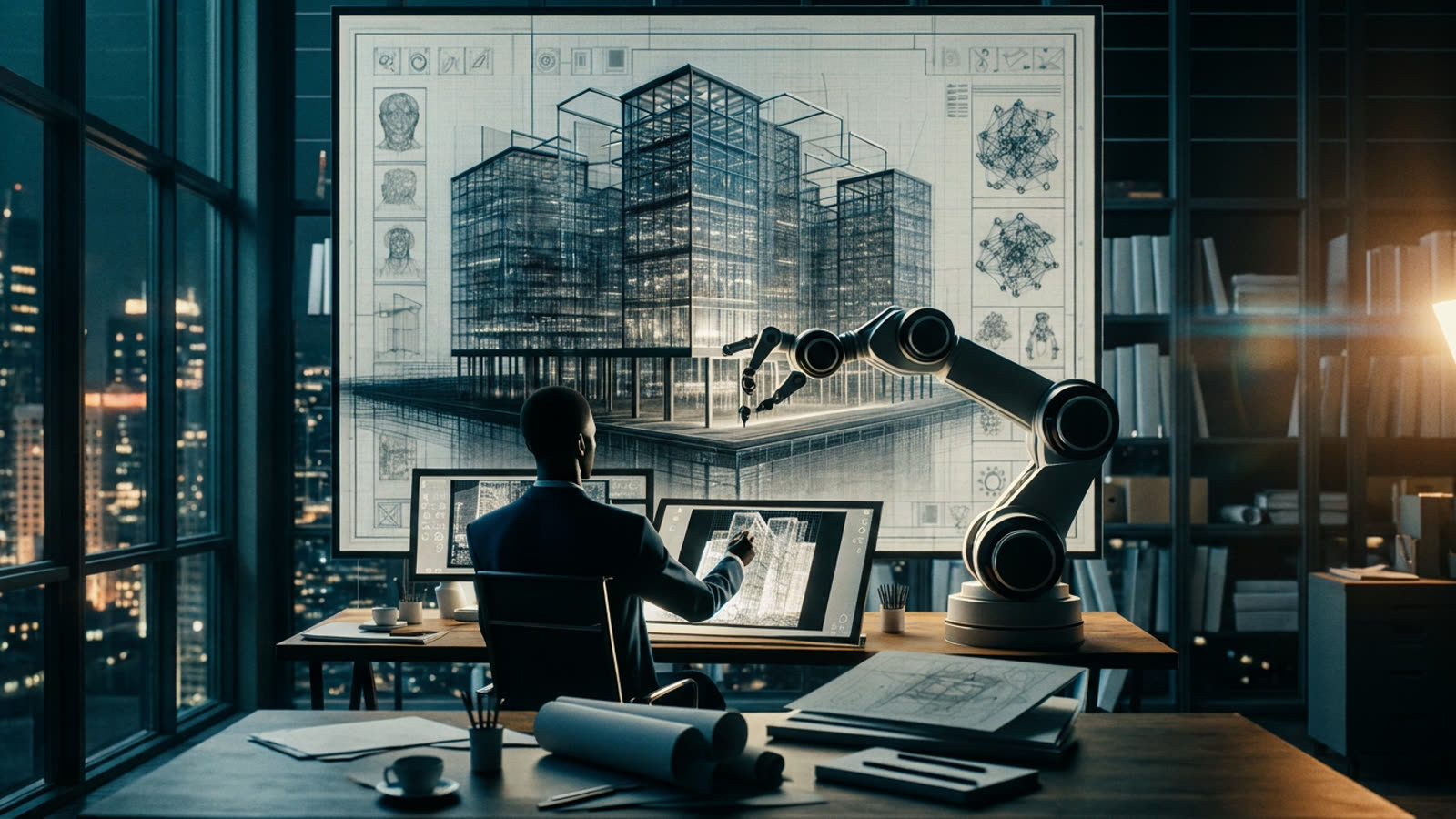
Architecture has always been a profession caught between art and commerce, between the vision of the solitary genius and the grinding reality of building codes, client budgets, and structural physics. Now artificial intelligence is forcing a reckoning with that tension in ways the profession hasn't fully processed.
The transformation isn't happening in the flashy renderings that populate design magazines. It's happening in the unglamorous middle of the process: the compliance checks, the iterative massing studies, the endless variations that used to consume junior architects' nights and weekends. AI tools now generate dozens of building envelope options in minutes, each one automatically checked against local zoning requirements, solar exposure calculations, and rough cost estimates.
The grunt work revolution
For decades, architectural education has followed a familiar hazing ritual. Young graduates spend years on repetitive tasks—redlining drawings, adjusting door schedules, running code compliance checks—before earning the privilege of conceptual design work. The implicit promise was that this drudgery built intuition, that understanding the constraints at a granular level made you a better designer.
AI tools are collapsing that apprenticeship timeline. A second-year associate can now produce work that would have required a decade of accumulated knowledge about setback requirements, egress calculations, and accessibility standards. The software doesn't replace judgment, but it dramatically reduces the cost of exploring options. Where a firm might once have presented three schemes to a client, they can now show thirty.
Some principals see this as democratisation. Others worry they're training a generation of architects who understand buildings the way GPS users understand cities—functionally competent but fundamentally disconnected from the underlying logic.
The creativity question
The more interesting disruption is happening upstream, in the conceptual phase that architects have traditionally guarded as their irreducible contribution. Generative tools can now produce surprisingly coherent design concepts from text prompts, mood boards, or even rough sketches. They're not replacing the architect's vision, but they're changing how that vision gets developed.
The best practitioners describe using AI as a kind of sophisticated sparring partner—a way to rapidly externalize and test ideas that might otherwise remain vague intuitions. The danger, they acknowledge, is that the tool's aesthetic biases become invisible constraints. Every generative model carries the fingerprints of its training data, and architecture's training data skews heavily toward certain typologies, materials, and spatial relationships. The risk isn't that AI will produce bad buildings; it's that it will produce buildings that are subtly, boringly similar.
The billable hour problem
Architecture firms have traditionally charged based on a percentage of construction costs or hourly rates for professional services. Both models assume that design requires substantial human time. When AI compresses weeks of work into days, the economic logic of the profession starts to wobble.
Some firms are experimenting with value-based pricing—charging for outcomes rather than hours. Others are using efficiency gains to take on more projects at lower margins. The profession hasn't yet found a stable equilibrium, and the firms that figure it out first will have significant competitive advantages.
Our take
The honest answer is that nobody knows whether AI will elevate architecture or flatten it. The technology is genuinely useful for the parts of design that are more engineering than art, and that's not a small portion of what architects do. The profession's future probably depends less on the tools themselves than on whether architects can articulate—to clients, to regulators, to themselves—what exactly they contribute that a well-prompted algorithm cannot. That's a harder question than it sounds, and the architects who take it seriously will be the ones worth hiring.