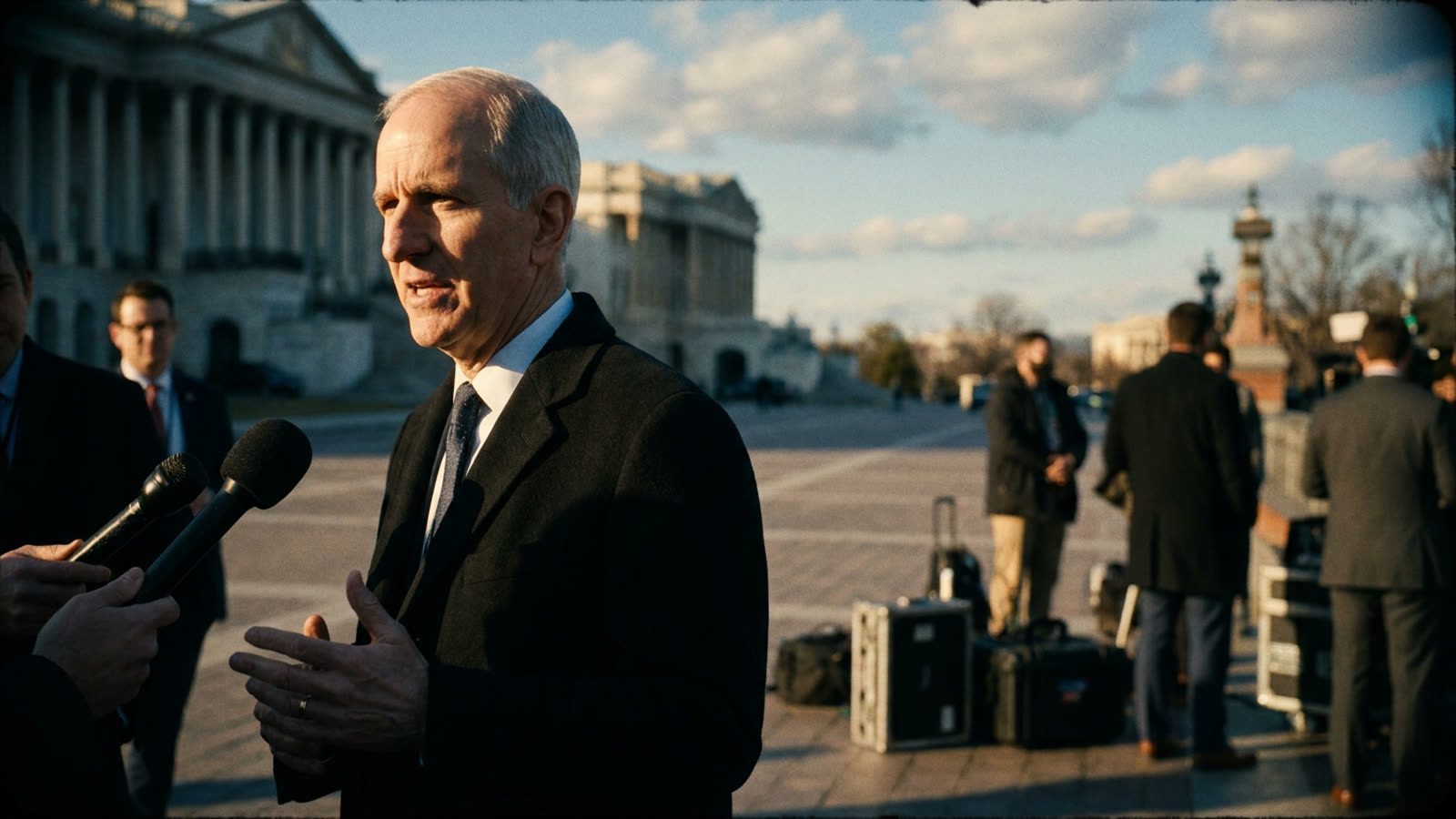
When a senior member of the House Armed Services Committee accuses a sitting president of being 'disconnected from reality,' the phrase lands differently than when it comes from a cable-news pundit or a campaign surrogate. Representative Adam Smith of Washington, the committee's ranking Democrat, chose those words deliberately this week to describe President Trump's handling of the Iran situation—and the restraint of the venue makes the charge more damning, not less.
Smith's critique arrives at a moment when the administration's Iran policy appears to be collapsing under the weight of its own contradictions. The president has simultaneously claimed credit for a diplomatic breakthrough, threatened military escalation, and left allies guessing which version of American intent they should believe. Vice President Vance's abrupt cancellation of his travel schedule to focus on peace talks only deepens the sense that the White House is improvising in real time.
The hawk's complaint
Smith is not a dove. He has supported military interventions when he believed the strategic logic held together. His criticism, therefore, carries a particular sting: this is not reflexive opposition to the use of force but an objection to the apparent absence of any coherent theory connecting means to ends. When he says the president is detached from reality, he means that the administration cannot articulate what victory looks like, what costs it is prepared to bear, or what happens the morning after any military action.
The charge echoes concerns that have surfaced among Republicans as well. As details of the administration's Iran agreement have leaked, some GOP lawmakers have gone conspicuously quiet—a silence that speaks louder than any press release. The bipartisan discomfort suggests that Smith's accusation, however blunt, reflects a broader unease on Capitol Hill about whether anyone in the executive branch has thought more than one move ahead.
The institutional stakes
Congress has spent decades ceding war-making authority to the presidency, and members of both parties bear responsibility for that drift. Smith's public rebuke is an attempt to claw back some of that ground—not through legislation, which would require Republican cooperation, but through the blunter instrument of political pressure. By framing the president as unmoored from facts, he is inviting voters and colleagues alike to question whether the commander-in-chief can be trusted with the decisions that may soon land on his desk.
The timing matters. With the administration reportedly pursuing back-channel talks while simultaneously rattling sabers, the window for congressional influence is narrow. Once missiles fly, oversight becomes post-hoc. Smith's intervention is an attempt to shape the debate before that threshold is crossed.
Our take
Smith's language was calculated to provoke, and it should. The phrase 'disconnected from reality' is not a clinical diagnosis; it is a political weapon designed to shift the burden of proof onto the White House. Whether the accusation sticks will depend less on Smith's rhetoric than on whether the administration can produce a coherent explanation for its Iran strategy—something it has so far failed to do. In the meantime, the spectacle of a ranking Armed Services Democrat publicly questioning the president's grip on events is itself a data point. When the people with access to classified briefings start sounding alarmed, the rest of us should probably pay attention.