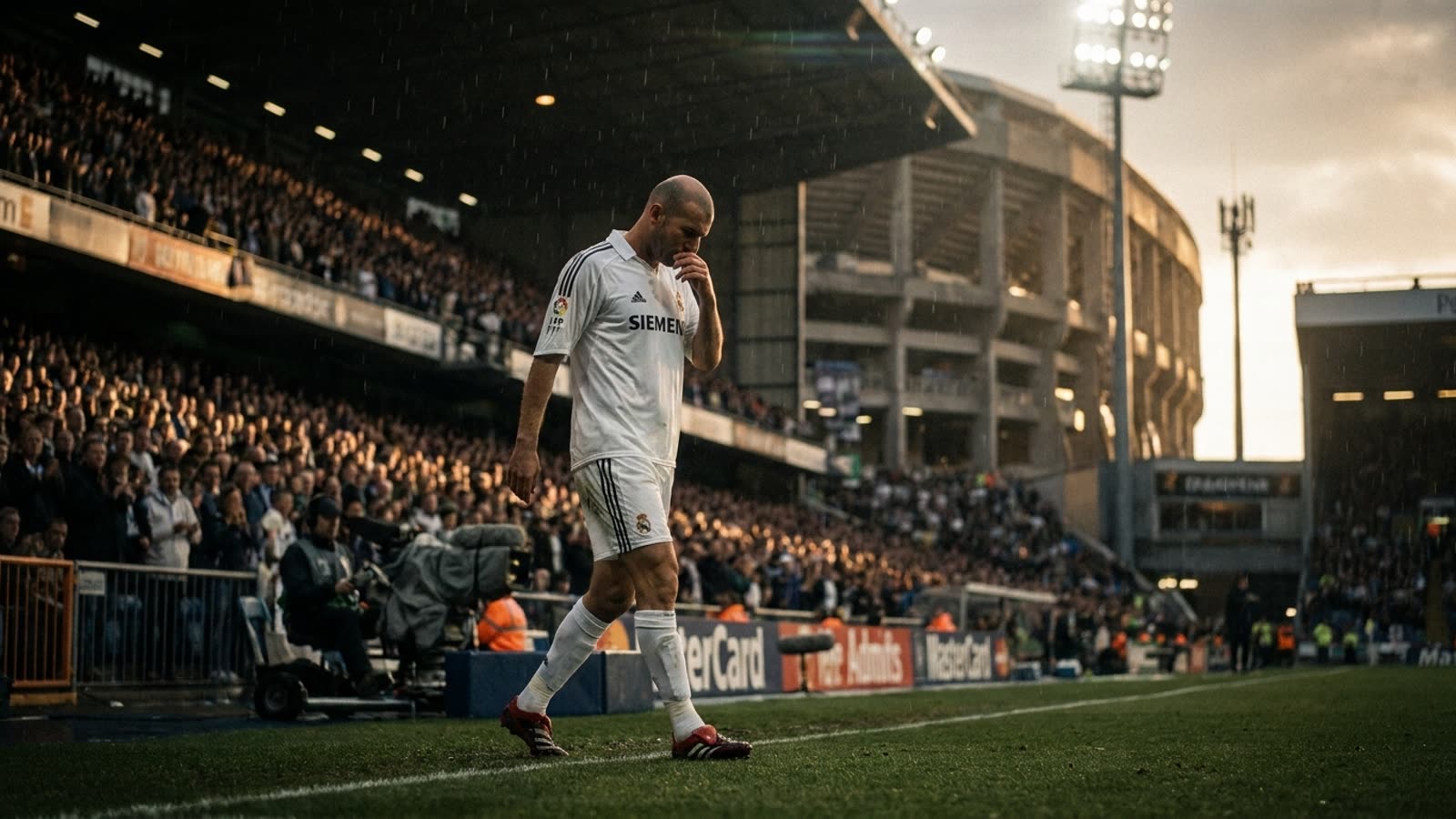
Zinedine Zidane walked off the pitch in Berlin on July 9, 2006, past the World Cup trophy he would never lift, and into a retirement defined entirely by how it began. In the span of ninety seconds, the greatest midfielder of his generation had converted a nerveless Panenka penalty and then driven his forehead into Marco Materazzi's chest, receiving the red card that would be his last professional act. No athlete has ever authored a more perversely complete ending.
The headbutt was not, as some romantics have suggested, a moment of noble rage. It was a thirty-four-year-old man losing control at the worst possible moment, with a fourth World Cup final appearance slipping away and extra time ticking down. Yet it was also, undeniably, Zidane — the same volcanic temperament that had seen him sent off fourteen times in his career, the same capacity for the inexplicable that had produced the volleyed goal against Bayer Leverkusen and the brace of headers that dismantled Brazil in 1998.
The architecture of a myth
What makes the Berlin final so enduring is its narrative compression. Zidane's panenka in the seventh minute was an act of almost contemptuous calm, the ball kissing the underside of the crossbar before dropping in. For an hour afterward, he orchestrated France's midfield with the serene authority that had defined his peak years at Real Madrid. Then Materazzi said something — the Italian later confirmed it involved Zidane's sister — and the architecture collapsed.
The slow-motion replays became iconic precisely because they resisted interpretation. Zidane's expression as he turned and walked toward Materazzi was blank, almost peaceful. The headbutt itself was oddly formal, a decisive act rather than a wild swing. And then the long walk past the trophy, eyes forward, while a billion people watched a legend refuse to look back.
Why it still resonates
Football has produced more consequential moments and more skilled players, but few images carry the same symbolic weight. The headbutt crystallized something true about competitive greatness: that the intensity required to reach the summit is not easily switched off, that the line between transcendence and self-destruction is vanishingly thin. Zidane's departure was a Rorschach test. Was it a tragedy of provocation, a failure of discipline, or simply the inevitable conclusion for a man who had always played on the edge of control?
The answer, of course, is all three. Zidane himself has never fully explained or apologized, offering only that he could not regret an act that felt, in the moment, necessary. This refusal to narrativize has only deepened the mystique. He did not become a cautionary tale or a redemption story. He simply stopped, frozen in amber at the exact moment his genius and his fury became indistinguishable.
Our take
We are drawn to athletes who seem to operate by different rules, and then we are shocked when those rules include self-immolation. Zidane's headbutt was not a fall from grace but a revelation of the grace's true nature — contingent, volatile, human. The 2006 final gave us the rarest thing in sports: an ending that refuses to resolve. Nearly two decades on, it remains the most honest exit any great player has ever made.