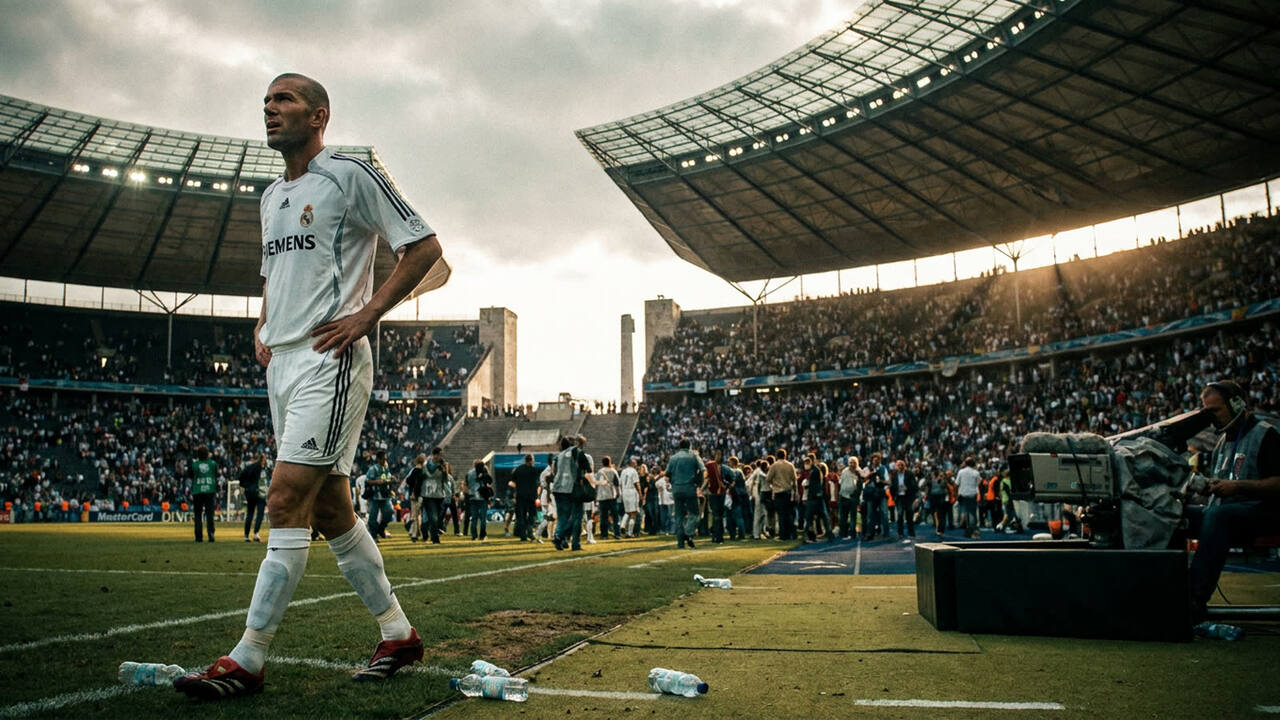
No athlete has ever chosen a worse moment to become entirely, catastrophically human.
Zinedine Zidane had spent the 2006 World Cup final doing what he had done for two decades: making football look like an art form performed by someone operating on a different plane of existence. His panenka penalty against Buffon was audacious. His control was immaculate. At 34, in what everyone knew would be his final match, he was conducting a masterclass. And then, in the 110th minute, with the score level and a penalty shootout looming, he drove his forehead into Marco Materazzi's chest and walked off into sporting immortality for all the wrong reasons.
The unbearable weight of context
What makes the Zidane headbutt so enduring is not the act itself—players lose their tempers constantly—but the impossible convergence of circumstances. This was the World Cup final. This was his last professional match. This was a player widely considered the most elegant of his generation, perhaps any generation. The red card came not in some forgotten group stage fixture but on the largest stage football offers, with a billion people watching.
Materazzi's provocation, reportedly targeting Zidane's sister, has been dissected endlessly. But the content of the insult matters less than what the response revealed: that Zidane, for all his preternatural calm on the ball, carried something volatile beneath the surface. The same intensity that produced those gliding runs and impossible touches could not, in the end, be compartmentalized.
Greatness as a double-edged sword
Zidane's career was bookended by red cards in World Cups—he was sent off against Saudi Arabia in 1998 for stamping on an opponent, though France still won that tournament. The 2006 final merely confirmed a pattern. His genius was inseparable from a certain combustibility. The man who could produce the volley against Leverkusen in the 2002 Champions League final, a goal of such technical perfection it still looks computer-generated, was also capable of spectacular self-destruction.
This is what separates the headbutt from other infamous sporting meltdowns. It was not a young player succumbing to pressure or an aging star fading into irrelevance. It was Zidane at the peak of his powers, playing beautifully, choosing violence anyway. The juxtaposition is what haunts.
The image that won't fade
Photographs of the incident have a strange, almost religious quality—Materazzi crumpling, Zidane already turning away, the Berlin sky indifferent above them. It has been rendered in sculpture, referenced in film, analyzed by philosophers. The moment transcended sport because it captured something universal about human fallibility at the worst possible time.
France lost the shootout. Italy became world champions. Zidane collected his Golden Ball award for best player of the tournament and walked past the trophy without glancing at it. His expression suggested a man who understood, with terrible clarity, exactly what he had done.
Our take
We prefer our sporting legends to exit gracefully—the final championship, the victory lap, the tearful wave. Zidane denied us that comfort and gave us something more honest instead. His headbutt was a reminder that greatness does not confer immunity from stupidity, that the same fire that makes someone extraordinary can also burn them. It was ugly, inexcusable, and somehow the most fitting possible ending for a player who was never quite as serene as he appeared.