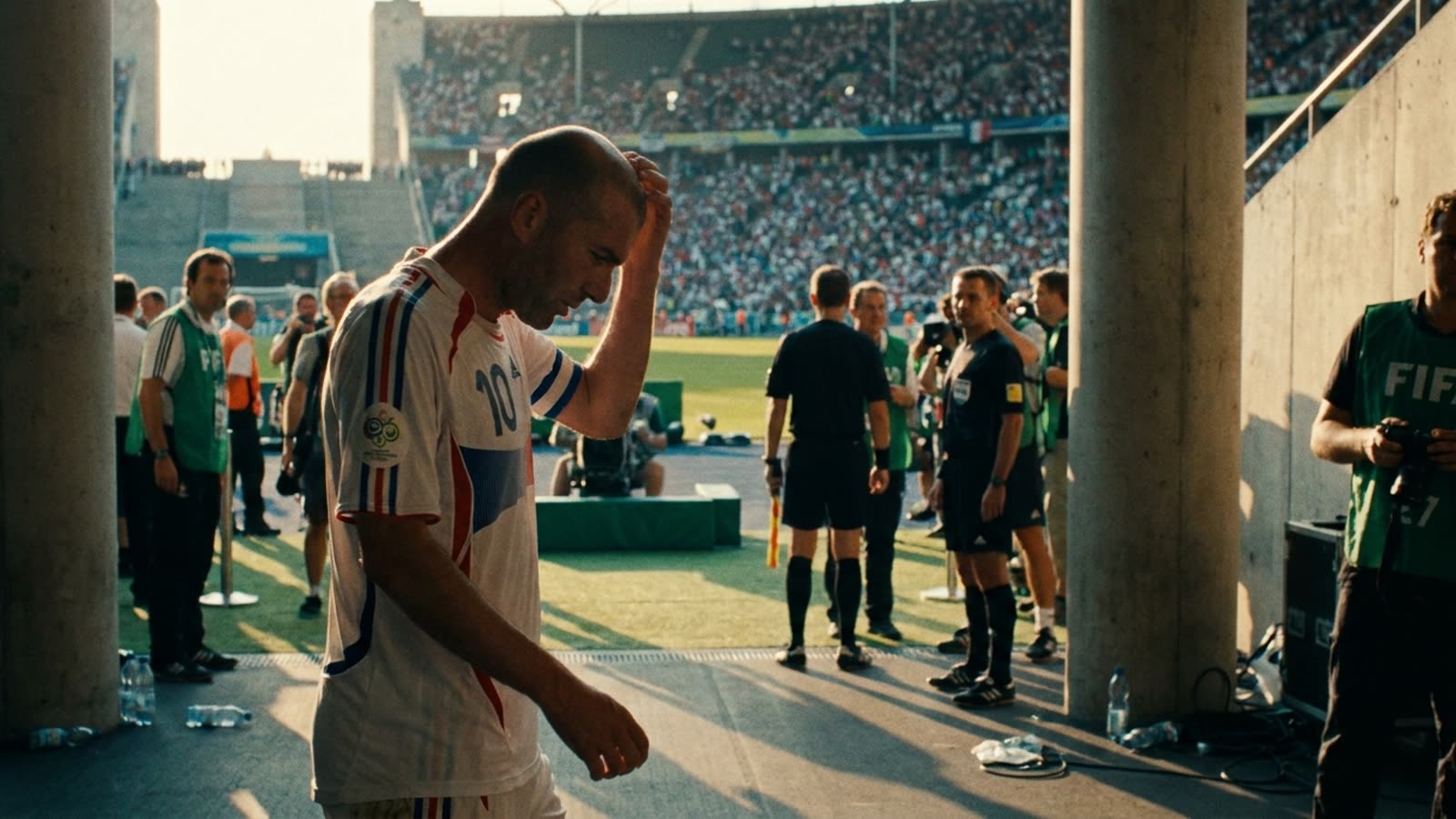
The conventional wisdom about sporting legacies is that they are built, brick by brick, through accumulated excellence. Zinedine Zidane's career suggests otherwise. His defining moment came not from a goal or a trophy lift but from a chest-to-chest confrontation with Marco Materazzi in the 2006 World Cup final, followed by a lowered head and a collision that sent the Italian defender sprawling.
It was the last meaningful act of Zidane's playing career. France lost the subsequent penalty shootout. The greatest midfielder of his generation walked past the trophy without glancing at it, disappeared down the tunnel, and never played another professional match. By every rational measure, it was a catastrophe. Yet somehow, impossibly, it only magnified his mystique.
The paradox of the imperfect exit
Athletes who depart at their peak—Michael Jordan's second retirement, for instance—are celebrated for their timing. Those who linger too long become cautionary tales. Zidane did neither. He left at precisely the wrong moment, in precisely the wrong way, and the result was neither diminishment nor tidy closure but something far more compelling: ambiguity.
The headbutt resists easy interpretation. Was it a failure of temperament, proof that even transcendent talent cannot fully master the animal brain? Or was it, as some French commentators argued at the time, a refusal to be humiliated, a declaration that dignity matters more than trophies? Materazzi's provocation—reportedly an insult about Zidane's sister—has never been fully confirmed in its precise wording. The uncertainty only adds to the moment's strange gravity.
What is certain is that Zidane had already scored in that final, a nerveless Panenka penalty that chipped over Gianluigi Buffon and kissed the underside of the crossbar before dropping in. He had, in other words, already written a perfectly acceptable ending. He chose to append a postscript that no one could have scripted.
Why the image endures
Photographs of the headbutt have appeared on murals, in galleries, and as the subject of academic papers. A bronze statue in Paris depicts the moment. The image endures because it captures something true about competitive fire: it is not a faucet that can be turned on for matches and off for provocations. The same intensity that allowed Zidane to dominate the 1998 and 2006 World Cups—two goals in the final against Brazil, that penalty against Italy—was the intensity that could not tolerate whatever Materazzi whispered.
This is uncomfortable for the sports-as-character-building narrative. We prefer our heroes to be disciplined, to channel aggression into excellence and leave the rest behind. Zidane's headbutt suggests that the channeling is never complete, that the furnace powering greatness occasionally burns through its casing.
The afterlife of a moment
Zidane's post-playing career has been, by any standard, extraordinary. As a manager, he won three consecutive Champions League titles with Real Madrid, a feat no one else has accomplished. He did so with a demeanor so calm it bordered on soporific, offering little in press conferences, betraying nothing on the touchline. The contrast with Berlin could not be starker.
Perhaps that is the final lesson of the headbutt: it was not a revelation of Zidane's true self but a reminder that the true self is multiple. The man who lost control in extra time is the same man who, years later, would calmly rotate Gareth Bale and Isco while navigating the egos of a galáctico dressing room. Both are real. Both coexist.
Our take
The headbutt should have been a tragedy. Instead, it became an icon, proof that sports narratives do not require neat resolutions to be powerful. Zidane's exit was a mess, and it was perfect—not in spite of its chaos but because of it. We remember athletes who win. We remember athletes who fail spectacularly. Zidane managed to do both in the same ten seconds, and that is why, nearly two decades later, we are still talking about it.