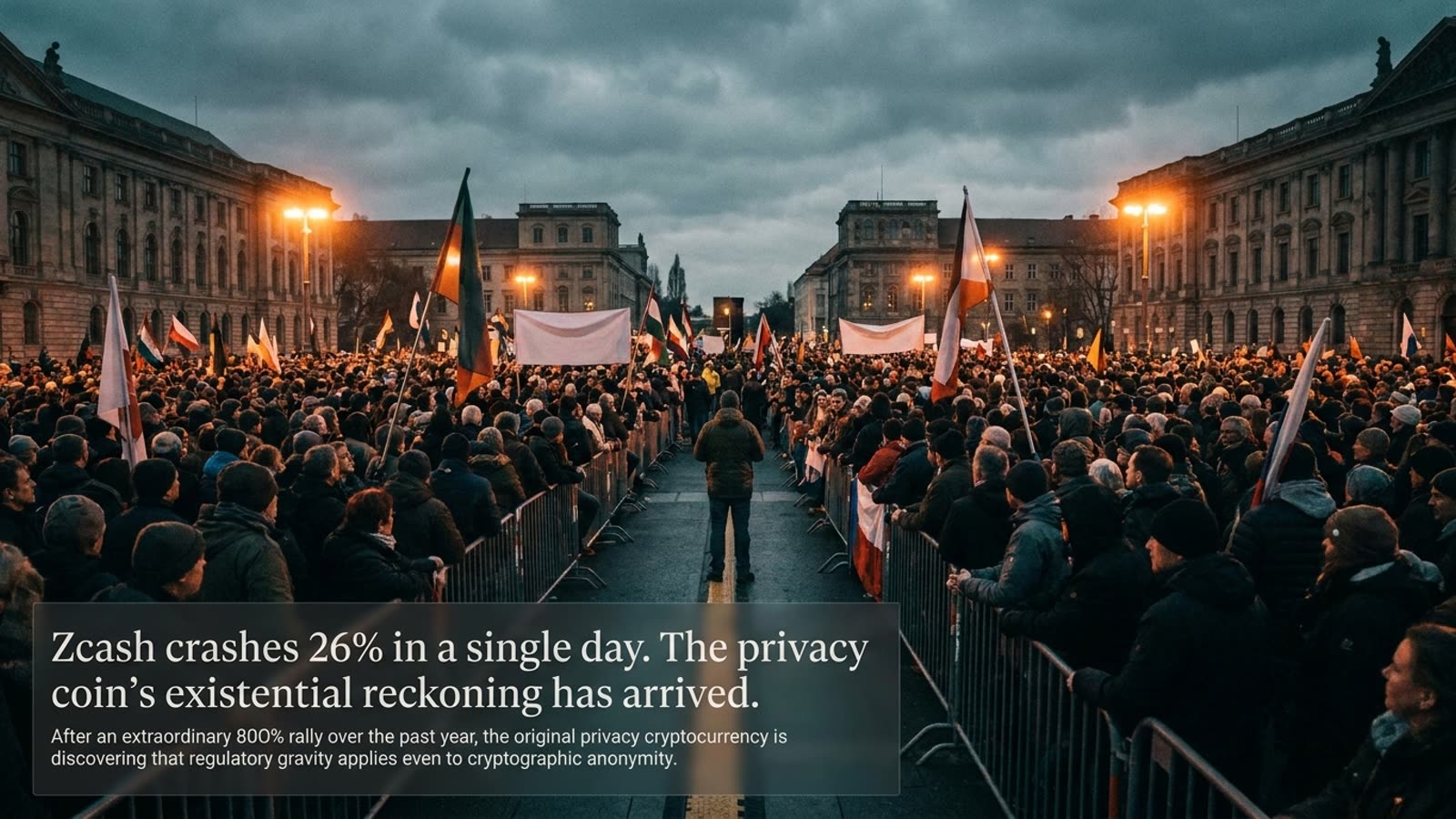
The privacy coin trade, one of crypto's most ideologically charged bets, is unwinding with startling velocity. Zcash dropped more than a quarter of its value in 24 hours on Wednesday, a move that would be remarkable for any asset but feels particularly significant for a token that had seemed to defy the broader market's malaise with an improbable multi-hundred-percent annual gain.
The timing is not coincidental. Privacy-preserving cryptocurrencies have spent the past year in an increasingly uncomfortable regulatory spotlight, with global enforcement agencies coordinating more aggressively than ever to trace and restrict anonymous transaction rails. Zcash, which pioneered zero-knowledge proof technology to enable fully shielded transactions, has long been the standard-bearer for this corner of the market—and now appears to be bearing the standard's weight.
The rally that wasn't supposed to happen
Zcash's 800%-plus gain over the past year was always something of an anomaly. While Bitcoin and Ethereum struggled with ETF outflow pressures and macro correlation headaches, ZEC attracted a peculiar coalition: privacy maximalists doubling down on first principles, speculators betting on scarcity as exchanges delisted the token, and a surprisingly robust derivatives market that amplified both directions. The token's market cap climbed back into the top 20, a position it hadn't held since the 2021 bull market.
But rallies built on exchange delistings contain their own contradiction. Each removal from a major platform—Coinbase dropped ZEC for UK users, Binance restricted it in multiple jurisdictions—simultaneously reduced liquidity and concentrated trading among increasingly specialized venues. The result was a market that could move violently on relatively modest volume.
Regulatory walls closing in
The global regulatory posture toward privacy coins has shifted from skepticism to active hostility. The Financial Action Task Force's updated guidance effectively treats privacy-enhancing features as presumptive red flags for money laundering risk. The European Union's MiCA framework, now fully implemented, creates significant compliance burdens for any exchange listing tokens with built-in obfuscation. Japan banned privacy coins years ago; South Korea followed. The United States hasn't issued an outright ban, but the message from enforcement actions has been unambiguous.
Zcash's developers have attempted to thread this needle by emphasizing that shielded transactions are optional—users can choose transparent addresses that behave like Bitcoin. This architectural compromise was supposed to provide regulatory cover. Increasingly, it appears regulators are uninterested in the distinction.
Our take
The privacy coin thesis was always more philosophical than commercial: a bet that cryptographic anonymity would eventually be recognized as a fundamental right rather than a regulatory liability. That bet is losing. Zcash's technology remains genuinely innovative—zero-knowledge proofs have found applications far beyond privacy coins—but the token itself is caught between an ideology that demands uncompromising anonymity and a regulatory reality that punishes it. The 26% single-day drop isn't a buying opportunity; it's a market pricing in the possibility that privacy coins, as an investable category, may simply be regulated out of existence. The code will survive. The trade may not.