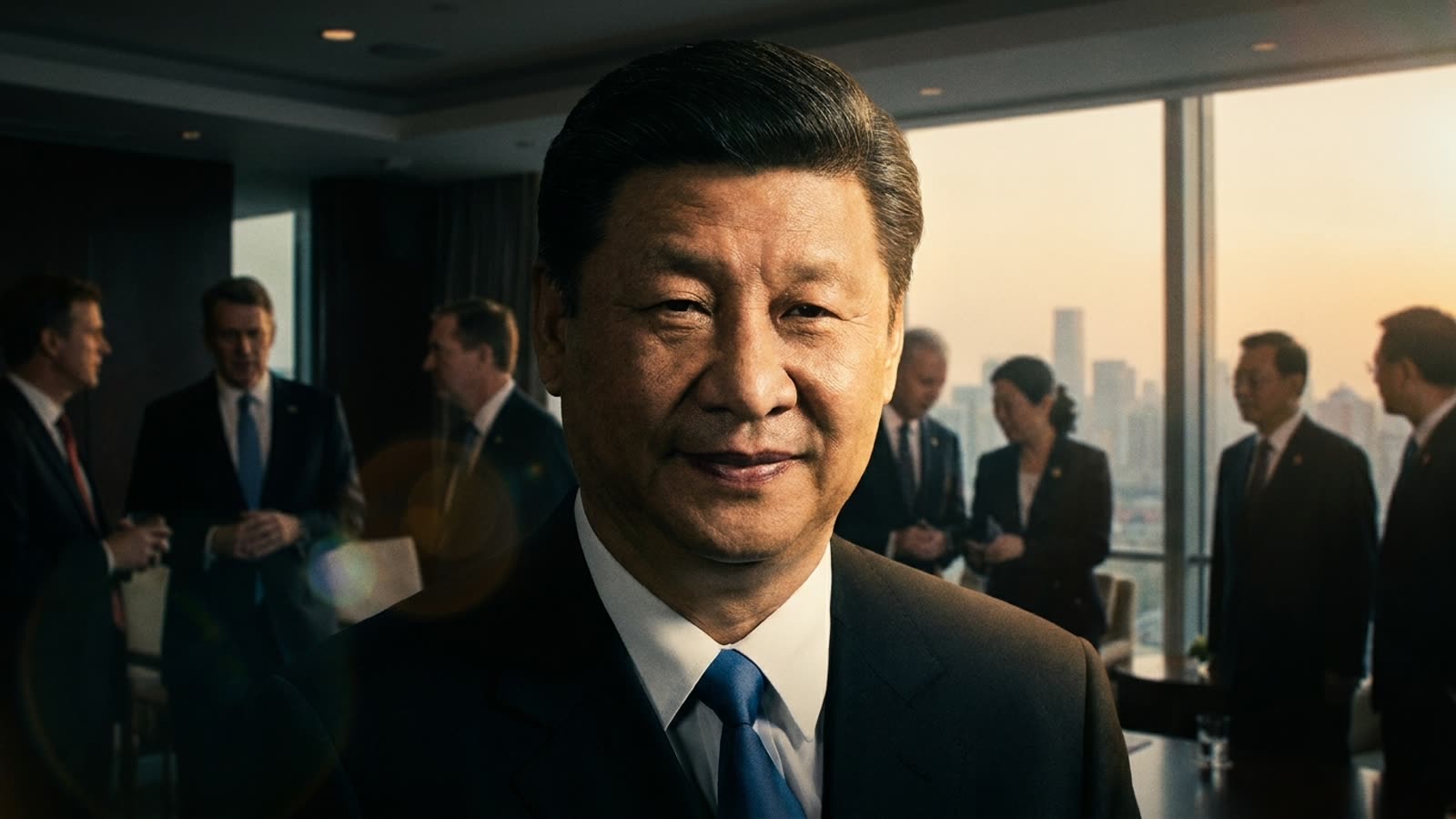
Xi Jinping spent Wednesday delivering two messages that only sound contradictory. To the chief executives of Nvidia, Tesla, and Apple—summoned to Beijing alongside Donald Trump's delegation—he promised China would "open wider" to foreign investment. To Trump himself, he warned that US-China relations hinge entirely on Taiwan, and that trade wars produce "no winners." The duality is the point: Beijing is offering carrots to American capital while brandishing sticks at American policy.
The optics were carefully staged. Jensen Huang, Elon Musk, and Tim Cook—three men whose companies depend heavily on Chinese manufacturing, markets, or both—praised the "great importance" of the Chinese market in terms that would have been unremarkable a decade ago but now carry political freight. Their presence lent legitimacy to Xi's claim that China remains open for business, even as Washington tightens export controls on advanced semiconductors and Beijing retaliates with rare-earth restrictions.
The leverage game
Xi's audience selection was strategic. Nvidia cannot sell its most advanced AI chips to China under current US rules, yet it still derives significant revenue from the country and desperately wants restrictions eased. Tesla operates its most efficient factory in Shanghai and faces rising competition from BYD. Apple assembles the vast majority of iPhones in China and has spent years diversifying to India and Vietnam—a hedge Beijing notices. Each CEO arrived with vulnerabilities Xi could exploit and incentives he could dangle.
The "open wider" language echoes rhetoric Beijing has deployed since the 1990s, typically when it needs foreign capital or technology. Analysts note that previous promises of openness have often preceded selective liberalization: enough to keep multinationals invested, not enough to threaten state champions. The question is whether this round differs. With China's property sector still wounded, youth unemployment stubbornly high, and foreign direct investment at multi-decade lows, Xi has genuine reasons to court Western firms.
Taiwan as the red line
Yet the Taiwan warning undercuts any notion of a broader thaw. Xi told Trump directly that the island's status is non-negotiable and that stability depends on American restraint. This is not new, but the timing—delivered face-to-face during a summit meant to de-escalate trade tensions—signals that Beijing will not trade sovereignty concerns for tariff relief. Trump, who has oscillated between threatening 60 percent tariffs on Chinese goods and praising Xi as a "brilliant" leader, now faces the limits of transactionalism: some things China will not sell.
The summit's outcome remains unclear. Both sides have incentives to announce progress—Trump wants a deal he can tout before midterms, Xi wants sanctions relief—but the structural conflicts over technology, Taiwan, and industrial policy have only deepened since their last meeting. The CEOs' presence may grease negotiations or may simply provide photo opportunities that let both leaders claim momentum.
Our take
Xi is running a classic good-cop-bad-cop routine, except he's playing both roles. The invitation to American executives is genuine in the sense that China wants their investment and expertise; it is theatrical in the sense that "openness" will remain selective and reversible. The Taiwan warning is the tell. Beijing is willing to negotiate on trade, but it is not willing to let trade negotiations become a lever on sovereignty. American CEOs will take the meetings, pocket whatever market access they can, and continue hedging their supply chains. The real audience for Xi's performance was not in the room—it was the Chinese public, who saw their leader simultaneously welcoming and warning the world's superpower. That is the balance Xi intends to strike indefinitely.