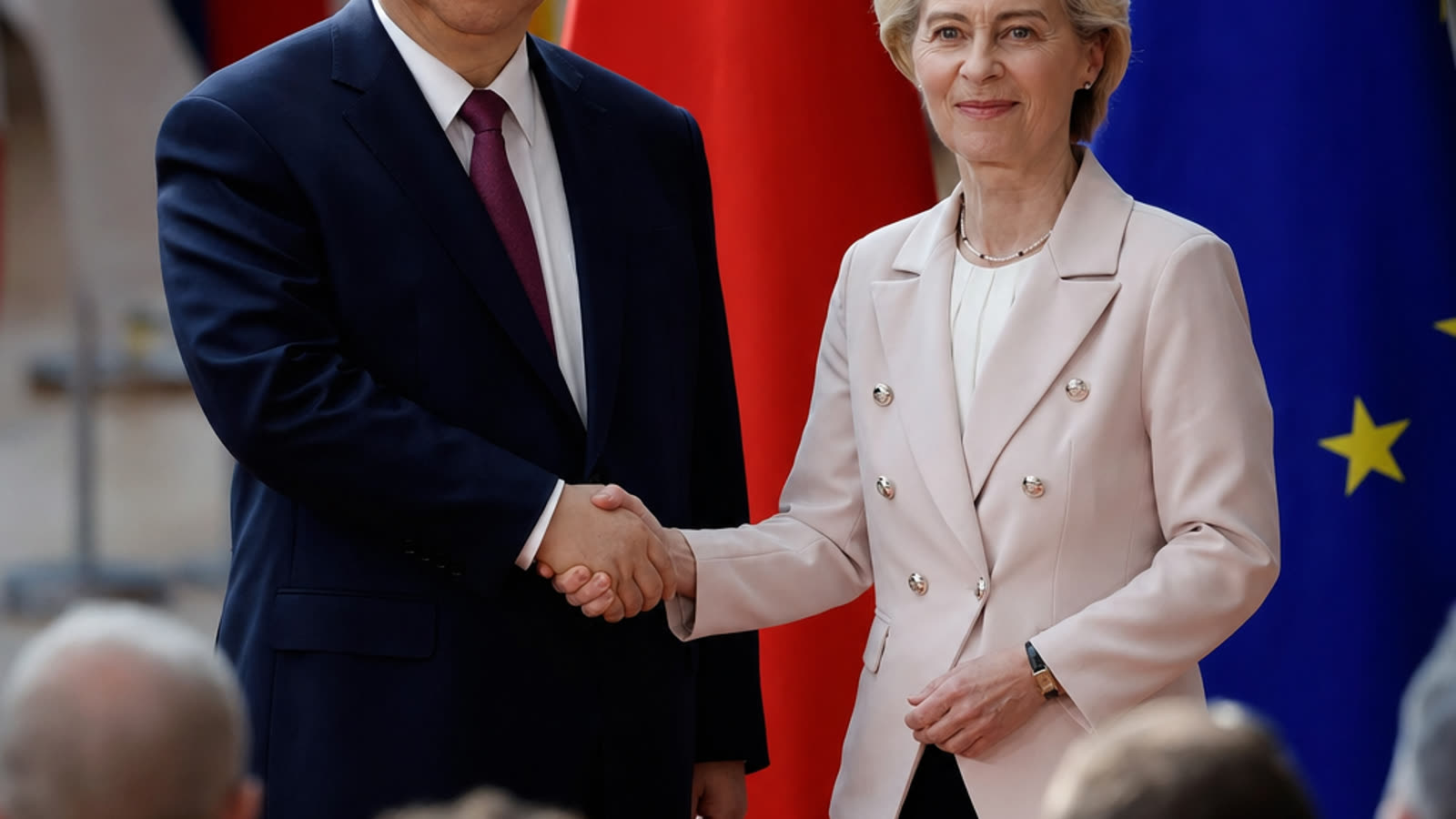
Chinese President Xi Jinping and European Commission President Ursula von der Leyen met in Brussels on Tuesday for a closely watched summit that underscored the depth of transatlantic-Asian economic tensions but produced no substantive agreements on trade, tariffs, or geopolitical alignment.
The talks, which stretched more than three hours, centered on European tariffs on Chinese electric vehicles, Beijing's dominance in critical mineral supply chains, and the war in Ukraine. Both leaders emerged with carefully worded statements that acknowledged dialogue but signaled continued divergence on core issues.
"We had a frank and detailed exchange," von der Leyen told reporters after the meeting. "But let me be clear: we are not aligned on the path forward." She declined to specify whether the EU would reconsider its recent decision to impose provisional duties of up to 38 percent on Chinese-made EVs, a move that has inflamed trade relations and drawn sharp rebukes from Beijing.
Xi, speaking through an interpreter, called for "mutual respect" and warned against "protectionism disguised as security concerns." He did not address the tariffs directly but emphasized China's role as a stabilizing force in global supply chains, particularly for lithium, cobalt, and rare-earth elements essential to Europe's green transition.
Auto Tariffs at Center Stage
The EV dispute has become the most visible flashpoint in EU-China relations. Brussels argues that Chinese manufacturers benefit from unfair state subsidies that distort competition and threaten Europe's automotive sector. Beijing counters that European firms have long enjoyed similar support and that the tariffs violate World Trade Organization principles.
The stakes are high. Chinese automakers, led by BYD and Geely, have rapidly expanded their footprint in Europe, capturing nearly 10 percent of the continent's EV market in 2023. European manufacturers, particularly Germany's legacy carmakers, face mounting pressure to compete on price while navigating the bloc's stringent emissions standards.
German Chancellor Olaf Scholz, reacting to the summit from Berlin, struck a cautious tone. "We must protect our industrial base, but we cannot afford a trade war that harms German jobs and European consumers," he said in a brief statement. "I urge both sides to find a negotiated solution before provisional measures become permanent."
Scholz's remarks reflect Germany's delicate position. The country is Europe's largest economy and its most China-dependent, with major automakers like Volkswagen and BMW generating substantial revenue from Chinese sales. Any escalation risks retaliation that could devastate German exports.
Critical Minerals and Strategic Dependency
Beyond autos, the summit addressed Europe's reliance on Chinese-controlled supplies of critical minerals. China processes more than 60 percent of the world's lithium and 80 percent of its rare earths, giving Beijing significant leverage over Europe's ambitions to build a domestic battery industry.
Von der Leyen pressed Xi on diversifying supply chains and opening Chinese markets to European mining and processing firms. According to an EU readout, Xi offered no commitments but expressed willingness to continue technical discussions. European officials privately acknowledged that progress on this front remains distant.
The Commission has launched its own critical minerals strategy, including partnerships with Australia, Canada, and several African nations, but those efforts are years from reducing dependency on Chinese sources.
Russia Looms Over Talks
The war in Ukraine shadowed the summit, though neither leader devoted significant public remarks to the subject. Von der Leyen reportedly raised concerns about Chinese firms supplying dual-use goods to Russia, a charge Beijing has consistently denied.
Xi reiterated China's stated position of neutrality but offered no indication that Beijing would pressure Moscow to negotiate. European diplomats said they expected little movement on the issue, viewing it as a lower priority for Xi than trade and economic concerns.
No Path Forward
The summit concluded without a joint statement or scheduled follow-up talks, a stark contrast to the optimism that accompanied earlier rounds of EU-China dialogue. Analysts described the meeting as a holding pattern, with both sides unwilling to make concessions that could be portrayed as weakness domestically.
"This was about managing the relationship, not transforming it," said a senior European diplomat, speaking on condition of anonymity. "No one expected breakthroughs, and no one got them."
As Xi departed for Beijing, the provisional tariffs remained in place, set to become permanent unless the EU and China reach an agreement before November. For now, the impasse holds.
AI-generated editorial — The Joni Times