Football has witnessed countless controversies, but only once has a head of state descended from the stands, marched onto the pitch, and successfully demanded a goal be erased from existence. That this happened during a World Cup match, broadcast globally, and that FIFA did essentially nothing about it, tells you everything about the sport's relationship with money and power.
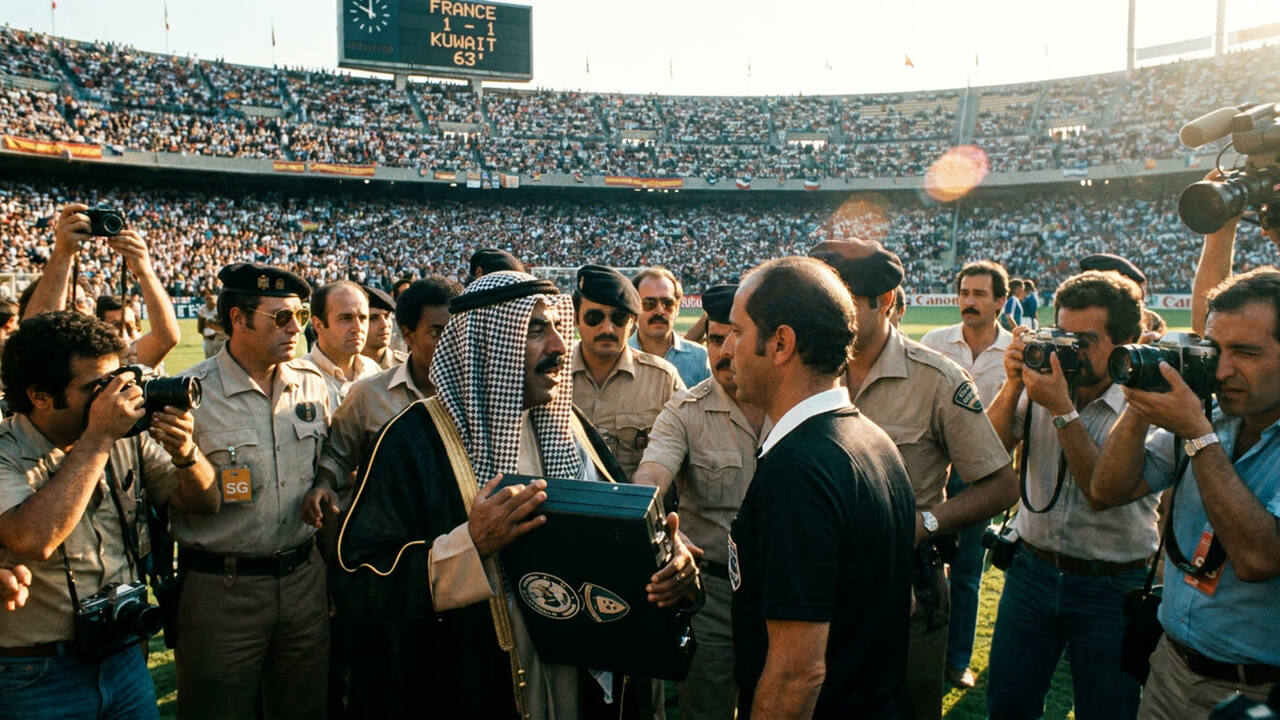
The date was June 21, 1982. France and Kuwait met in Valladolid during the group stage of the Spanish World Cup. France were leading 3-1 in the second half when Alain Giresse swept the ball into the net for what appeared to be a fourth. The Kuwaiti players stopped, convinced they had heard a whistle—perhaps from the crowd, perhaps imagined—and claimed the goal should not stand. The Soviet referee, Miroslav Stupar, initially awarded it.
What happened next defied every protocol in the sport's rulebook.
A prince makes his move
Sheikh Fahad Al-Ahmed Al-Jaber Al-Sabah, president of the Kuwait Football Association and a member of the ruling family, rose from his seat in the VIP section. He did not send a delegate. He did not lodge a formal complaint. He walked directly onto the field, surrounded by Kuwaiti officials, and confronted the referee. The Kuwaiti team threatened to leave the pitch entirely.
Stupar, facing a diplomatic incident in real time, reversed his decision and disallowed the goal. France protested furiously. Michel Platini, already one of the world's finest players, was incredulous. The match resumed, France eventually won 4-1 anyway, and Kuwait exited the tournament in the group stage. But the damage to football's credibility was done.
FIFA's response was characteristically toothless. Stupar was removed from the officiating roster for the remainder of the tournament. The Sheikh received a modest fine—reports suggested around $10,000, pocket change for Kuwaiti royalty. No structural reforms followed. No rule was written to prevent a similar intervention.
The template for modern entanglement
Viewed from the present, the Kuwait incident reads as a preview of football's deeper entanglement with Gulf state wealth. The 1982 episode was crude, almost comically brazen—a prince physically inserting himself into a match. Today's influence is subtler: sovereign wealth funds purchasing clubs, sportswashing campaigns laundered through sponsorship deals, World Cups awarded to nations where the sport has shallow roots but deep pockets.
The Sheikh's walk onto the pitch was embarrassing precisely because it was visible. The transaction was legible to anyone watching. Contemporary football has learned to conduct similar transactions off-camera, through boardrooms and broadcast rights negotiations, where the leverage of money over sport operates without the inconvenience of a global audience witnessing it in real time.
Sheikh Fahad himself met a tragic end during Iraq's invasion of Kuwait in 1990, reportedly killed while defending the royal palace. His football intervention became a footnote, occasionally resurrected in compilations of World Cup oddities. But it deserves more serious consideration as an early warning sign.
Our take
The 1982 incident is often treated as a quirky anecdote, a "can you believe this happened" moment for nostalgic highlight reels. That framing lets everyone off the hook. FIFA's failure to impose meaningful consequences signaled to wealthy actors worldwide that football's integrity was negotiable. The Sheikh tested the boundaries and found them soft. Four decades later, the sport is still living with the consequences of that discovery.