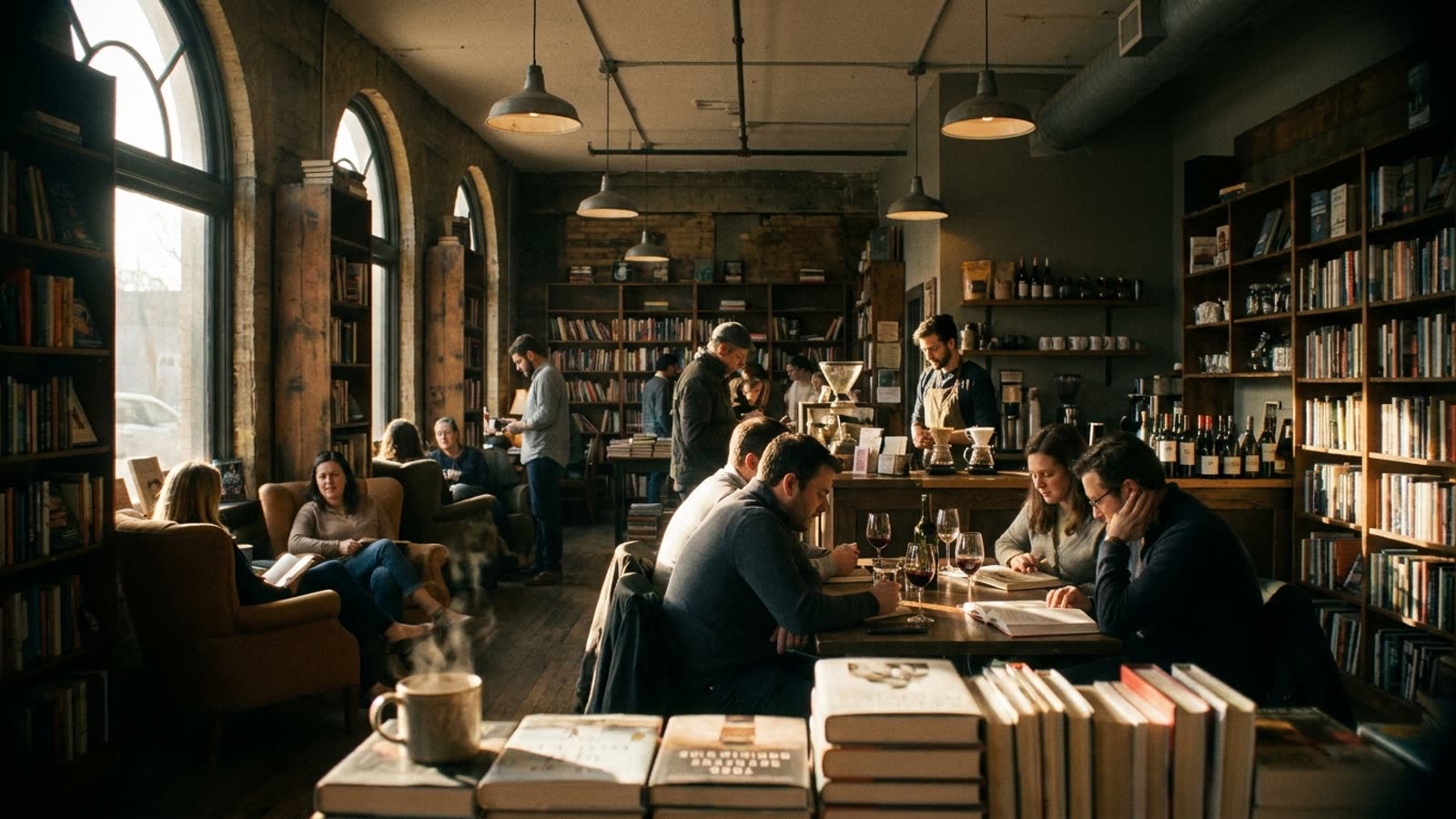
The prophecy was clear: Amazon would kill the bookstore, and good riddance. Physical retail was inefficient, sentimental, doomed. Yet walk through any gentrifying neighborhood in the Western world and you'll find something the forecasters missed — a new independent bookstore, usually with exposed brick, certainly with a coffee bar, possibly hosting a reading by a debut novelist nobody outside the neighborhood has heard of.
The bookstore survived by becoming something else entirely.
The third place thesis
Sociologist Ray Oldenburg coined the term "third place" to describe the cafés, barbershops, and pubs where community happens outside home and work. For decades, that role belonged to Starbucks, which built an empire on the promise of comfortable loitering. But the coffee chain optimized itself toward efficiency — mobile ordering, smaller seating areas, background music calibrated for quick turnover. It became a transaction, not a destination.
Independent bookstores moved into the vacuum. They offer what algorithmic retail cannot: serendipity, curation, and the particular pleasure of being surrounded by people who share your pretensions. The staff recommendation card — handwritten, idiosyncratic, occasionally wrong — is a rebuke to the "customers also bought" carousel. It says: a human being with taste selected this for you.
The economics of vibes
The business model only works because bookstores stopped trying to compete on books alone. Events generate foot traffic and community loyalty. Sideline merchandise — tote bags, candles, letterpress cards — carries margins that paperbacks cannot. The café isn't an amenity; it's often the profit center. Some stores have added wine and beer, transforming evening readings into something closer to literary nightlife.
The pandemic, counterintuitively, accelerated this. Lockdowns reminded people what they missed about physical spaces, and the subsequent remote-work boom created a class of professionals desperate for reasons to leave their apartments. The bookstore offered something the home office couldn't: ambient humanity without the obligation of direct interaction. You can spend two hours browsing, buy nothing, and still feel you've participated in civic life.
The curation premium
What independent stores sell, ultimately, is editorial judgment. In an era of infinite choice and algorithmic recommendation, the finite, opinionated selection becomes valuable precisely because someone excluded things. The store that stocks only literary fiction, or only cookbooks, or only books about the sea, is making a claim about what matters. That claim is the product.
This explains why bookstores have become aspirational lifestyle spaces rather than mere retailers. The customer isn't just buying a novel; they're buying membership in a community that reads novels, that values slowness, that rejects — or at least performs rejecting — the frictionless convenience of one-click ordering.
Our take
The bookstore's resurrection is real, but it's worth being honest about what survived. These aren't the cramped, chaotic shops of literary nostalgia, staffed by grumpy clerks who judged your selections. They're lifestyle boutiques for the professional class, as carefully designed as any Apple Store. That's not a criticism — design and intention are how small retailers compete — but it does mean the bookstore's cultural role has changed. It's less a place where you discover difficult books and more a place where you perform being the kind of person who reads. Whether that's a decline or an evolution depends on what you thought bookstores were for in the first place.